
After a Kubernetes role change, the connector in a streaming company's production cluster can no longer read one namespace, and workload results for that namespace stop. The Cortex tenant role was not modified. Where is the broken permission?
Select an answer to reveal the explanation.
Short Explanation
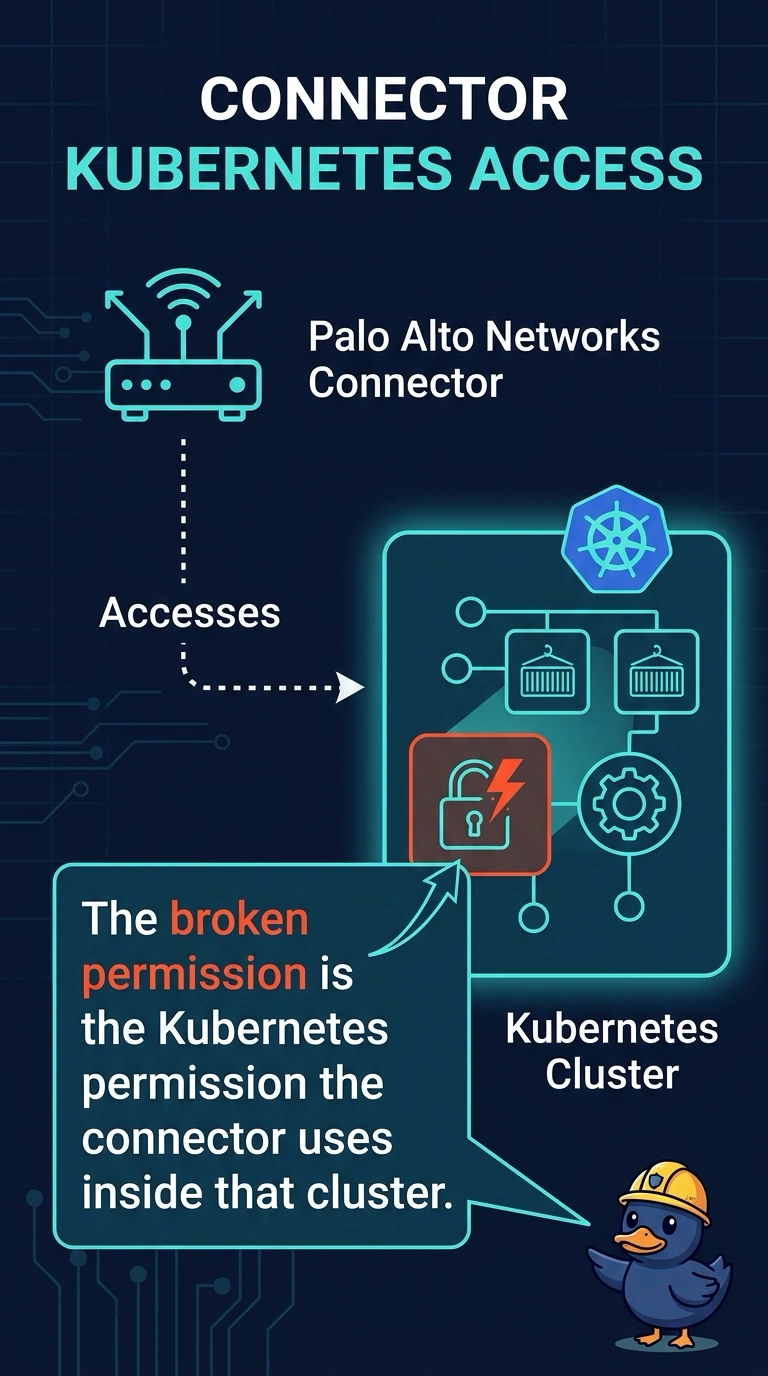
Think of the connector as a reader who lost a library card inside the building, while the tenant badge at the front gate still works. You changed Kubernetes access, and the namespace went dark, so the broken permission is the Kubernetes permission the connector uses in the cluster. The cloud onboarding identity, the IDE API key, and the GitHub webhook secret do not let the connector read that namespace.
Full Explanation
The Kubernetes connector runs in the cluster and reads resources so rules can evaluate kind, metadata, and spec. After an in-cluster role change, one namespace stops producing workload results, so the broken permission is the Kubernetes permission the connector uses to read that namespace. The cloud onboarding identity creates resources in the outpost account; it is not the credential the connector presents inside the cluster, and this symptom does not indicate an outpost-account creation problem. The API key developers use so the IDE plugin can read application policy supports the plugin’s policy access, not the connector’s access to a namespace. The webhook secret shared between GitHub and the Cortex tenant authenticates webhook deliveries; a mismatch can interrupt those deliveries, but it does not control whether the connector can read Kubernetes resources in one namespace. Exam caveat: a connector that can read the namespace may still show no workload issues if no rule applies to the Cloud Workload policy, so empty results alone do not prove a permission failure. Practical check: review the connector’s Kubernetes access to the affected namespace, restore the required read permission, and confirm workload results return for that namespace.