
A new correlation joins endpoint events with cloud-audit events and would page on-call if it raised issues today. The logic has not been tested. How should the engineer prove it first?
Select an answer to reveal the explanation.
Short Explanation
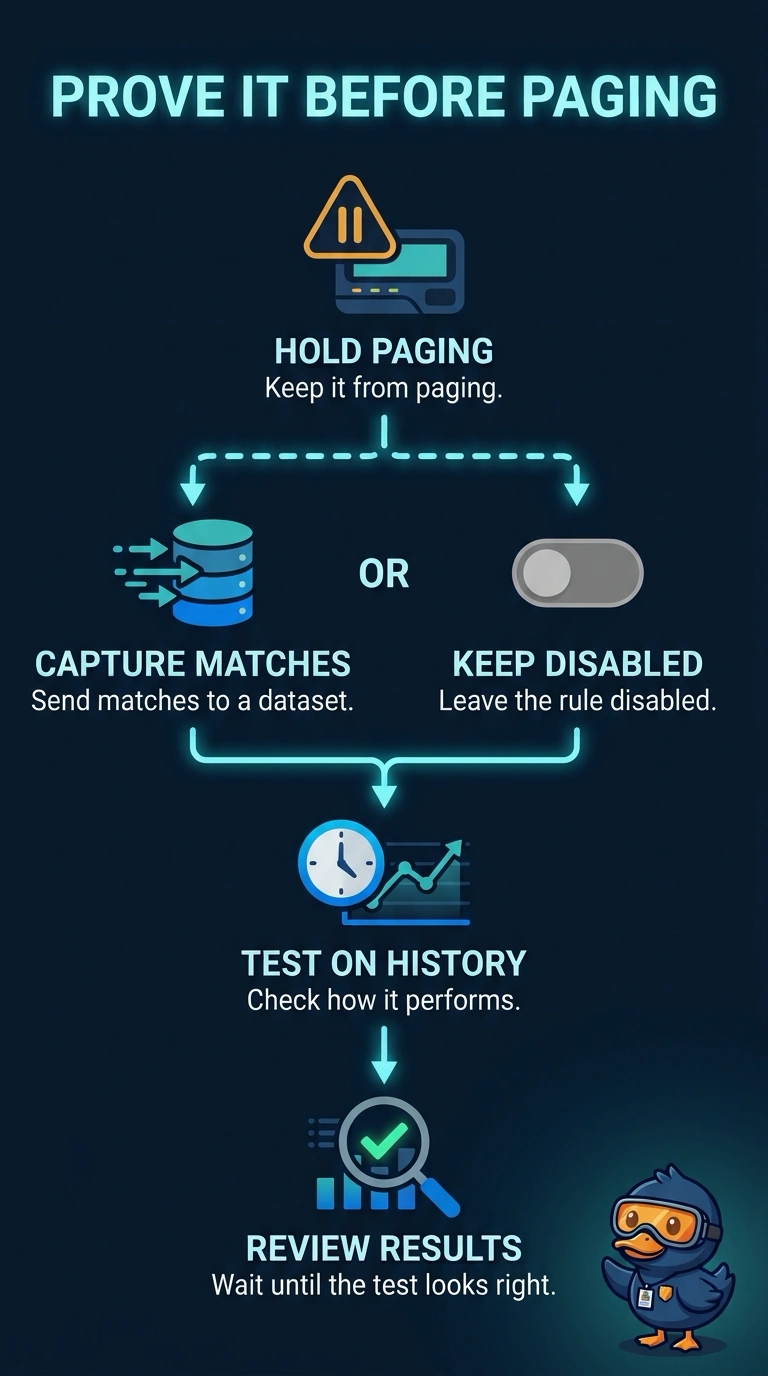
You do not test a fire alarm by evacuating the building. Write the correlation to a dataset, or leave it disabled, until history shows the join is right. The trap is paging on-call on the first draft, or handing an unreviewed rule a playbook that tries to fix production.
Full Explanation
A correlation can raise an issue or only write a dataset. The safe proof is to validate on history, test, and prefer a disabled rule or a dataset action until the join is tuned. Enabling it so the first page is the test skips that step and alerts on-call on an unreviewed query. An IOC matches a known hash, address, domain, or path on endpoint data. Rewriting the correlation as an IOC drops the cloud-audit join and does not test this rule. A playbook is the response. A detection rule does not remediate by itself, and attaching a playbook before the logic is tuned automates the wrong action. Scheduled correlation can run as often as every 10 minutes. Shortening the interval past that is not the supported schedule, and it does not replace a dataset test. Exam caveat: analytics that use asset roles are a different detection from this hand-written correlation. Do not tune one by editing the other. Operational check: point the rule at a dataset, replay a known-good and a known-bad window from history, and enable issue creation only after the bad window matches and the good window does not.