
Cortex learns an API path from the gateway, and that path appears in none of the imported specifications. No attack payload has been seen. How should the team classify it?
Select an answer to reveal the explanation.
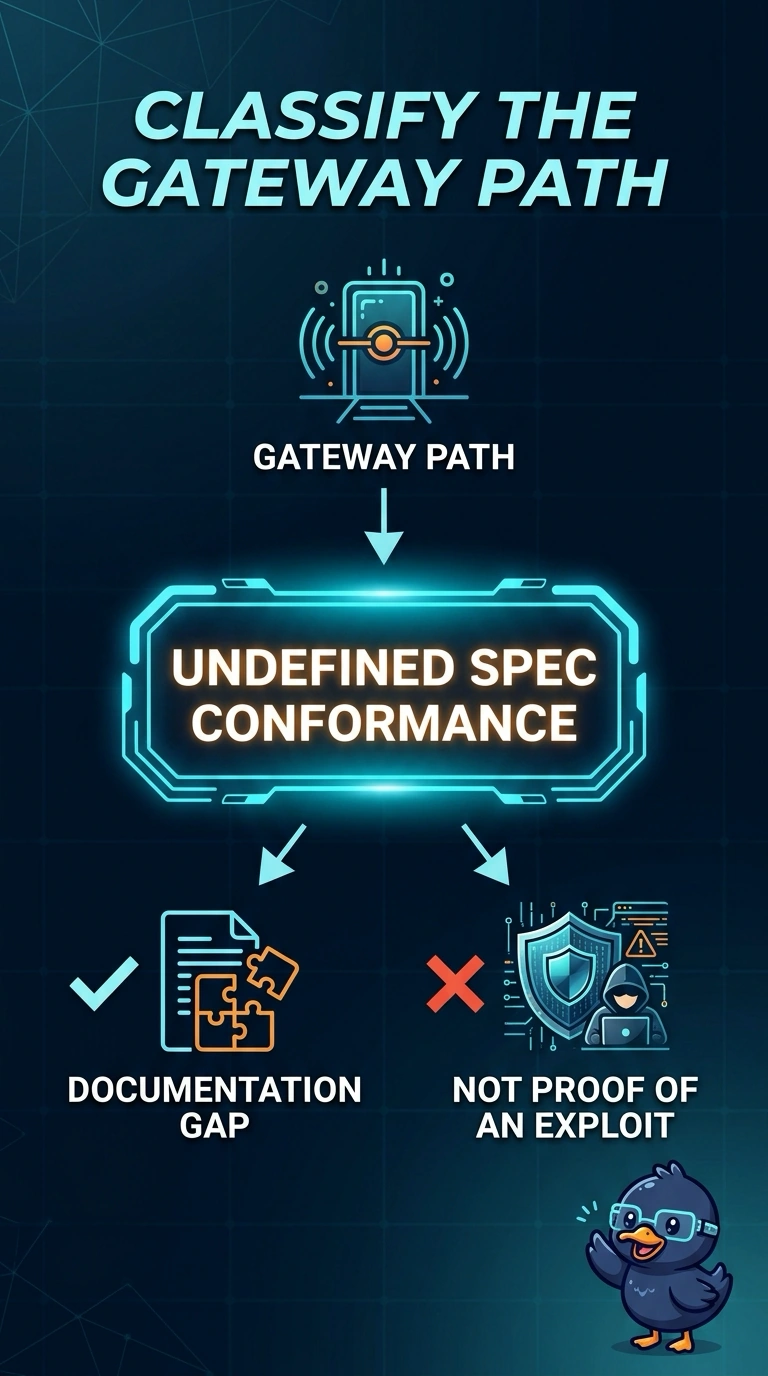
Short Explanation
Think of a door your building uses that never made it onto the fire map. You learned the path from the gateway and found it in no specification, so it is undefined spec conformance: a documentation gap, not proof of an exploit. An inactive endpoint would be fully specified but have no gateway traffic; a conflict requires specifications to disagree, and a behavior indicator concerns endpoint data rather than this API documentation gap.
Full Explanation
Gateway integrations compare learned endpoints with imported specifications and label them match, mismatch, conflict, or undefined. A path that appears in the gateway and in no specification is undefined spec conformance: the runtime surface is ahead of the documentation. That gap is not, by itself, proof of an exploit, and no attack payload has been seen. Conflict indicates the endpoint matches more than one API specification file; the files need not first be proved inconsistent. Because no file contains this path, there cannot be more than one match. An inactive endpoint is fully specified but has not received gateway traffic. This path has gateway traffic and no specification, the opposite situation. A behavior indicator concerns real-time behavior on endpoint data or supported cloud-audit data and must filter by event type. An undocumented API path is an API posture comparison, not an endpoint behavior, and does not justify isolating the gateway host. Exam caveat: undefined coverage can still be internet-exposed or lack authentication; those posture flags are separate from classifying the path as an exploit. Practical check: open the endpoint, confirm its undefined state and that no specification contains the path, then add the operation to the specification or remove it from the gateway.