
An incident lead wants a compromised cloud virtual machine isolated from the network. The machine has no XDR agent, and the only control on the draft is a cloud configuration rule. What can actually isolate that host?
Select an answer to reveal the explanation.
Short Explanation
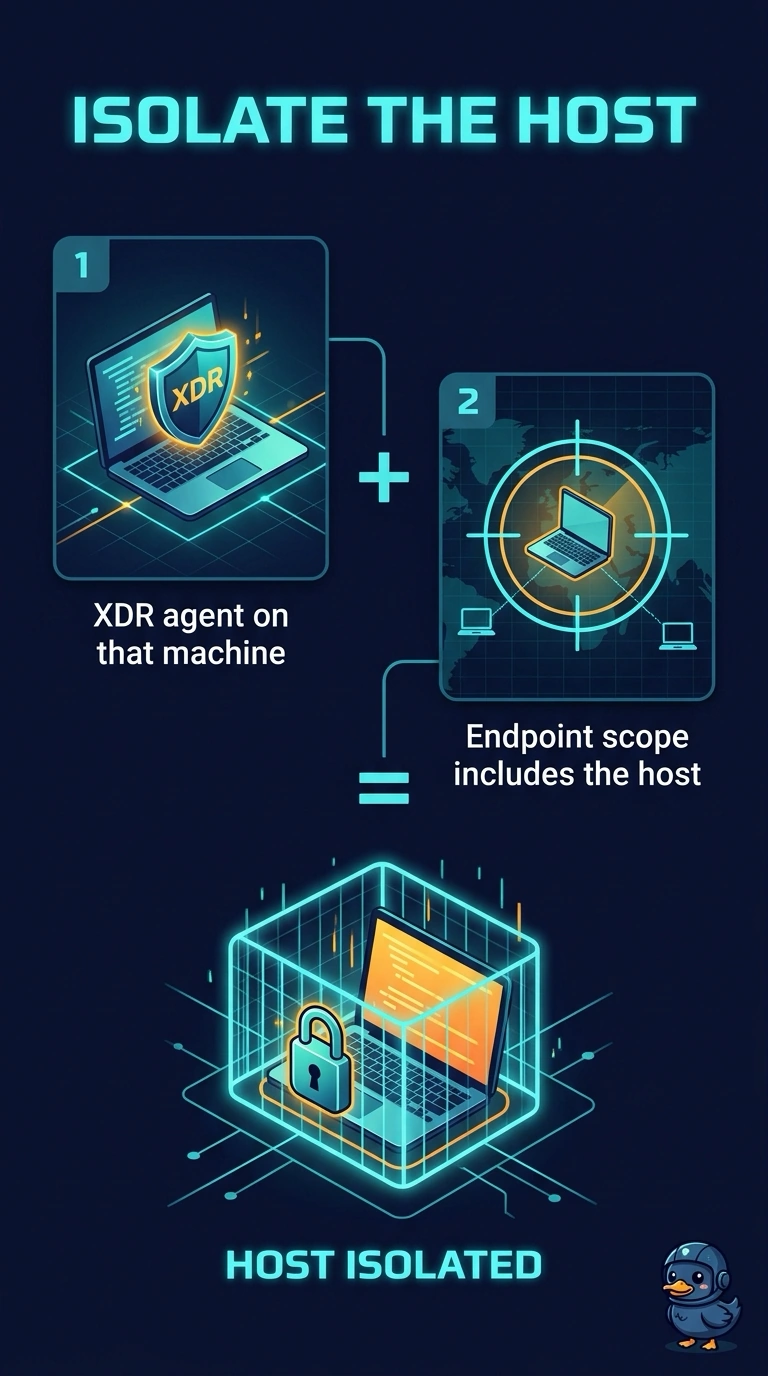
Think of isolation as a hand on the host power cord, which means someone has to be in the room. You have no agent on this virtual machine, so a cloud configuration rule can describe a posture problem and cannot pull the host off the network. Isolation here is an endpoint response.
Full Explanation
Isolating a host is an endpoint response carried by the XDR agent, and endpoint actions are limited by endpoint scope. Without an agent on the virtual machine, and without scope that includes that host, there is no endpoint path to isolate it. A cloud configuration rule can flag misconfiguration, exposure, or identity issues. It does not quarantine a running machine when a finding is marked critical. A compliance report mapped to a custom control is an assessment. Viewing or mapping a report does not perform network isolation, and a custom control does not become an endpoint response just because the label says so. A data-classification profile matches patterns such as card numbers under profiles such as PCI or PHI. It can surface sensitive data. It does not isolate an object or a virtual machine from the network. Exam caveat: serverless coverage follows the function integration rather than a package placed inside every invocation, so do not expect this virtual-machine isolation step to look the same on a function. Operational check: install the agent, confirm heartbeat, confirm the host is inside the operator endpoint scope, and only then run the isolation and verify the machine drops off the network.