
A hospital prevention profile blocks a radiology viewer hash on every endpoint that receives it, but only the imaging PCs run that binary. A teammate wants a global exception. Which exception scope fits the evidence?
Select an answer to reveal the explanation.
Short Explanation
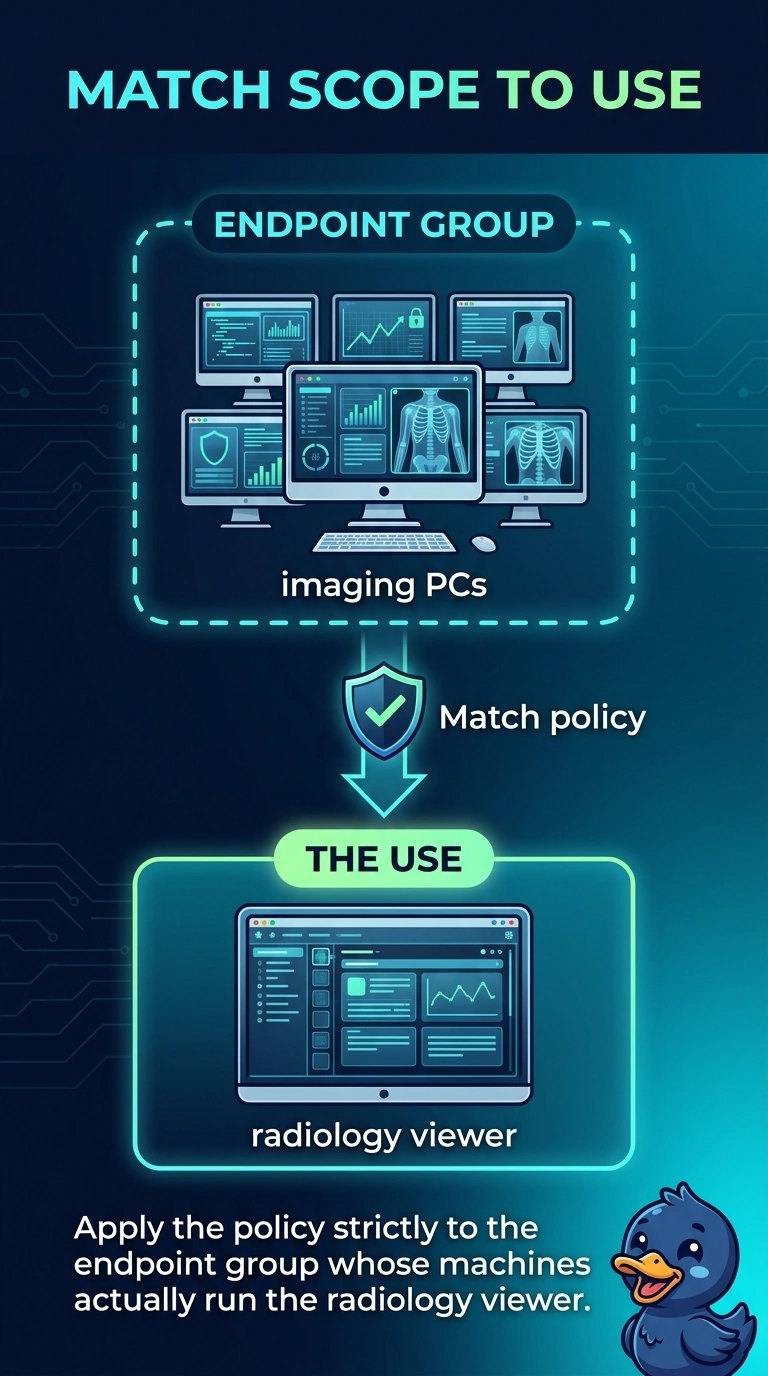
Think of a global exception as unlocking every door because one clinic lost a key. You only have evidence on the imaging PCs, so the carve-out belongs on that endpoint group. A tenant-wide skip would let the same hash run on machines that should still block it.
Full Explanation
Exceptions are scoped, and a global exception is broader than a carve-out on the machines that actually run the binary. Endpoint groups decide which hosts share a prevention profile, so the hash exception belongs on the imaging group and the block stays in force for every other group that receives the same profile. A global exception that skips the hash on every endpoint in the tenant removes the control from finance laptops and servers that have no imaging workload and no false-positive evidence. A cloud configuration exception on the public-storage exposure rule lives in posture. It evaluates cloud exposure, not a process hash on a PC, so it cannot let the viewer start. A static asset group of imaging buckets is a cloud inventory list, and a static group cannot be an access scope. It does not attach an endpoint exception to the PCs that run the viewer. Exam caveat: if the imaging PCs are split across two endpoint groups, an exception on only one group leaves the other group blocked. Operational check: open the exception, confirm the scope is the imaging endpoint group, then sample a non-imaging host in the same profile and verify the hash is still blocked.