
Campus clusters have the admission controller and the XDR agent. A vulnerable image still deploys. The vulnerability policy creates an issue and does not set prevention. Why does the deployment proceed?
Select an answer to reveal the explanation.
Short Explanation
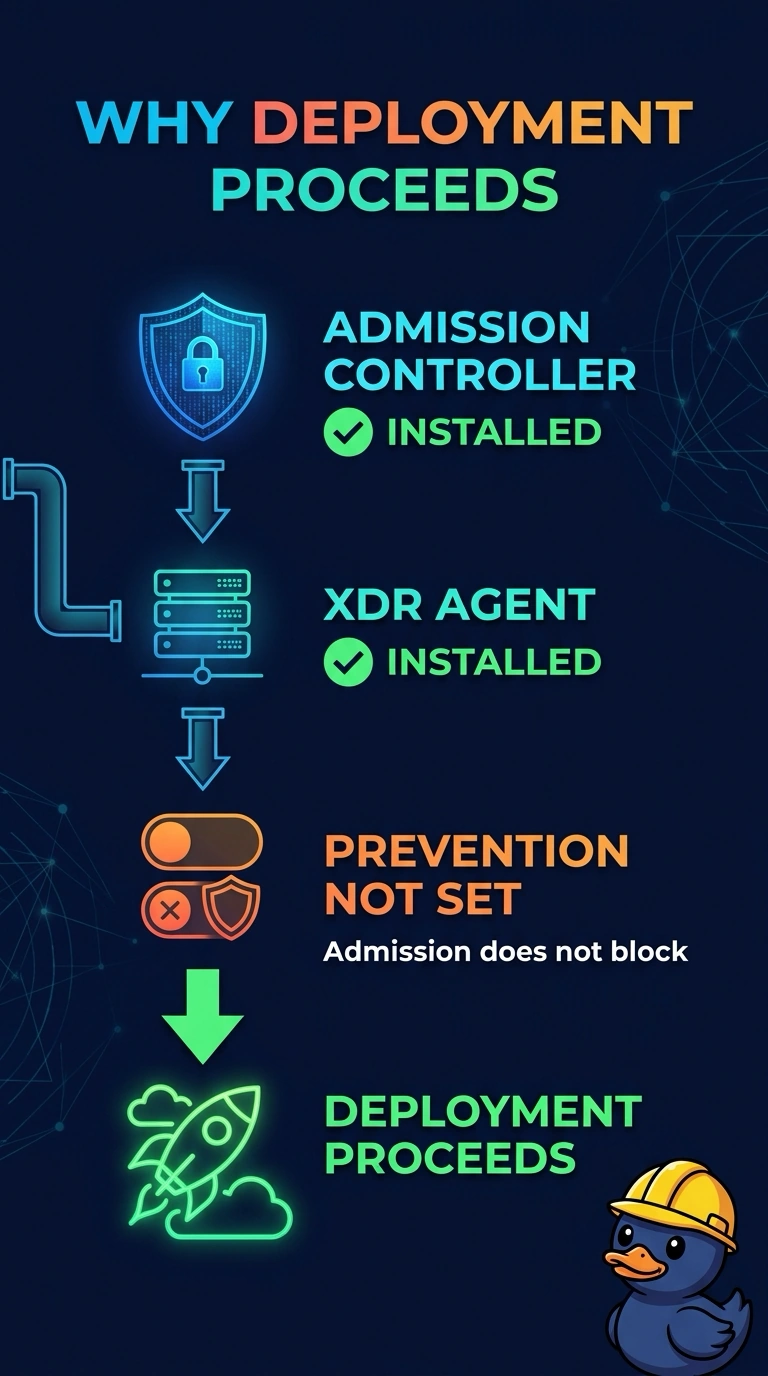
Think of a guard who writes a report and has not been told to lock the gate. You already have the admission controller and the agent, and the policy only creates an issue, so the deployment is not blocked. A deny rule on the connector is a different control and the wrong Rego shape.
Full Explanation
Vulnerability-policy actions are issue creation or ignore, and prevention. Prevention is what can block a new Kubernetes deployment when the agent and the admission controller are present. This policy creates an issue and does not set prevention, so the deployment proceeds even though both the controller and the agent are installed. Choosing a non-blocking action leaves the cluster unprotected for that finding. A Kubernetes Connector rule evaluates resources. Supported custom rules use package panw.compliance and match, not deny. The connector's posture rule evaluation alone is not a blocking action. Current connector onboarding can separately enable admission enforcement and deploy real-time agents; this question already states that the required components exist, but the policy lacks prevention. First match is not skipped when a policy creates an issue. The issue action is the match. Prevention is a separate action the policy did not set. Cloud scan is a scan-mode choice where Palo Alto Networks runs the scanners. It does not delete customer images as part of an admission decision. Exam caveat: a lower policy that does set prevention never runs if this issue-only policy matches first. Operational check: edit the matching policy to set prevention, keep the agent and the admission controller in place, and confirm a new deployment of the image is blocked.