
A retailer has an unnecessary external CI job invoking full image scans hourly on unchanged images, consuming customer-managed runner resources. What should be reviewed before buying a larger Cortex license?
Select an answer to reveal the explanation.
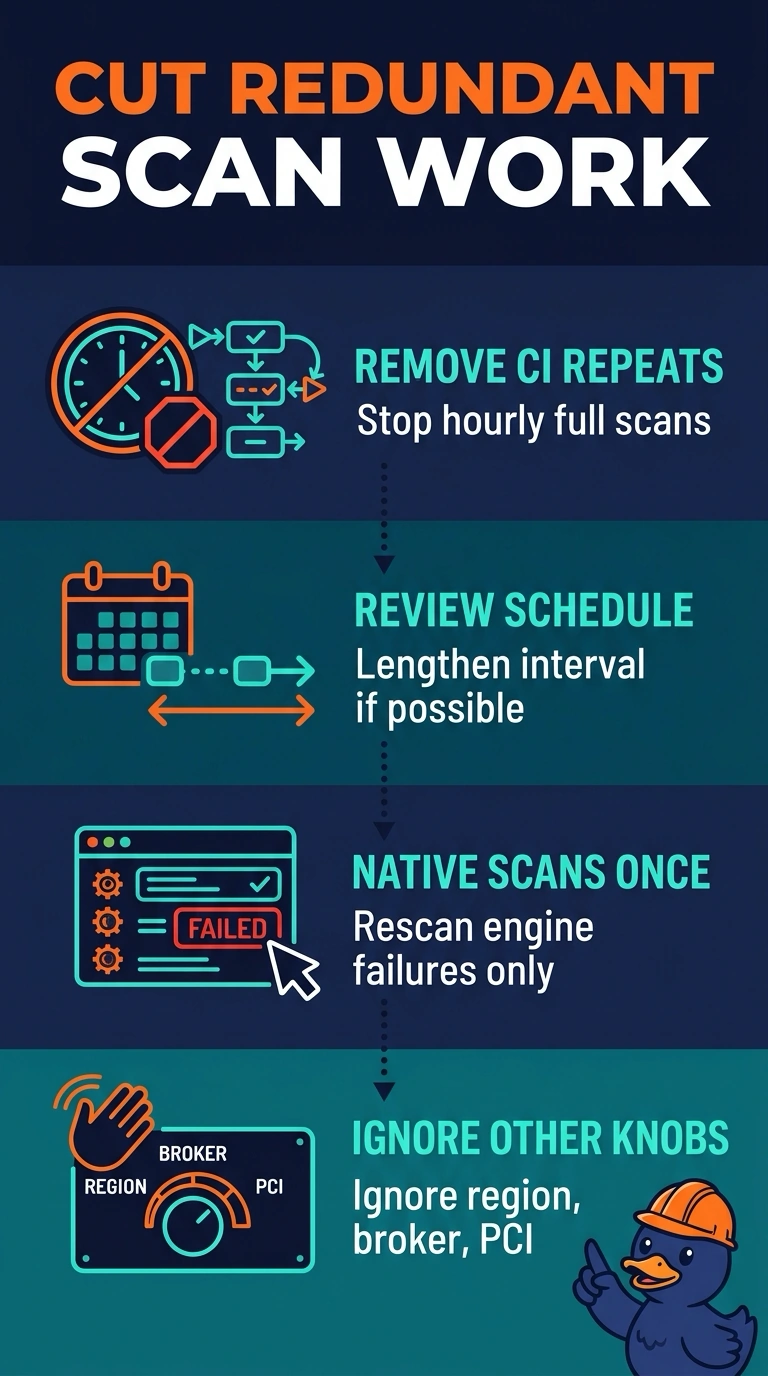
Short Explanation
Reduce unnecessary scan frequency by lengthening the interval or removing redundant invocations — you fix this CI waste before buying a larger license. Native registry scanning normally scans immutable images once, rescanning for engine updates or prior failures; vulnerability intelligence can be re-evaluated without downloading the image again. Do not infer that every scheduled cycle rereads unchanged images.
Full Explanation
The correct response is to remove redundant CI scan invocations and review the required scanning schedule before changing licensing, because the spend is customer-managed runner resources burned by an unnecessary external job invoking full image scans hourly on unchanged images. Reduce unnecessary scan frequency by lengthening the interval or removing redundant invocations. Native registry scanning normally scans immutable images once, rescanning for engine updates or prior failures; vulnerability intelligence can be re-evaluated without downloading the image again. Do not infer that every scheduled cycle rereads unchanged images. The tenant region addresses verdict-request routing, with verdict requests going to the region closest to the endpoint, which does not remove redundant invocations or change runner consumption. Broker registry-scanning mode exists, but moving the scanner does not resolve unnecessary repeated work. The PCI profile classifies cardholder data, and disabling patterns only changes data findings without stopping image scans.