
A pipeline design would store one shared break-glass user password and reuse it for every job that opens Cortex cases. What should those jobs authenticate with instead?
Select an answer to reveal the explanation.
Short Explanation
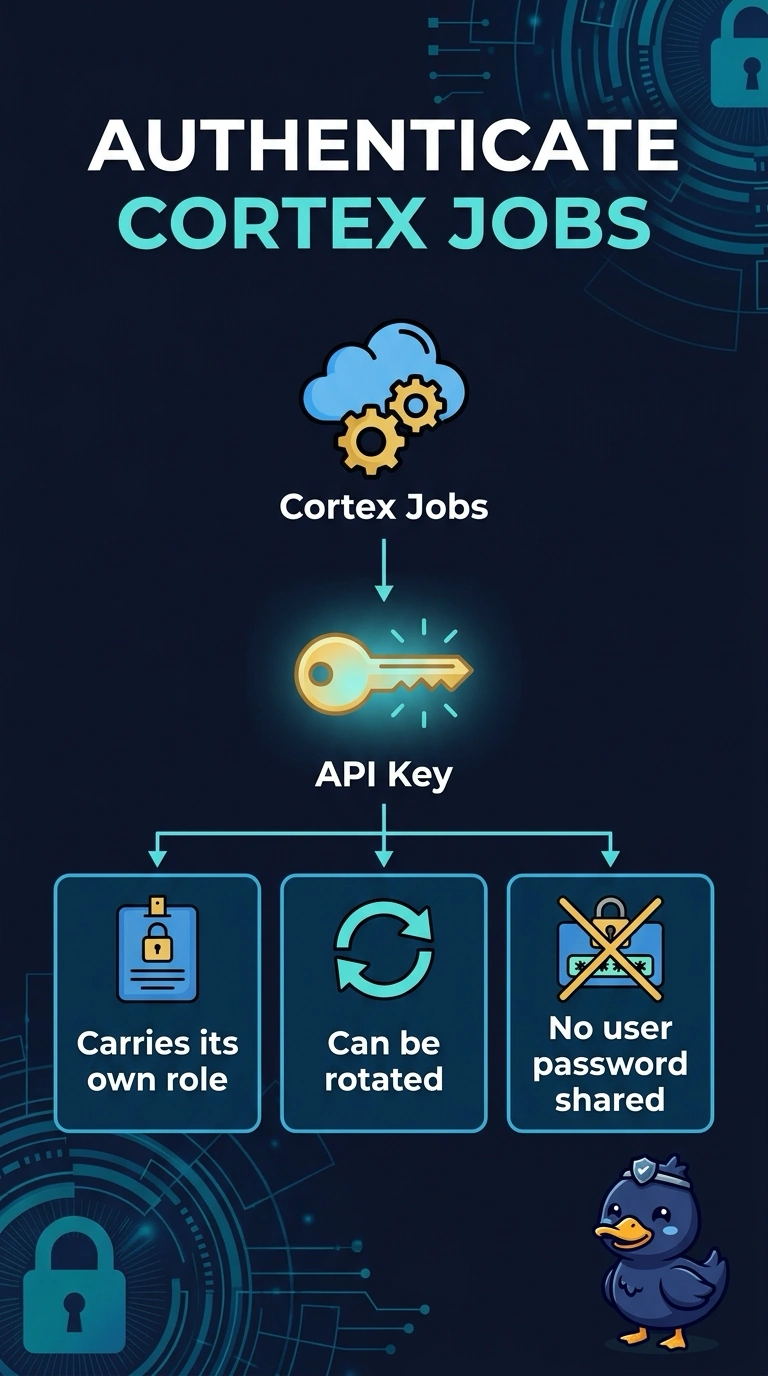
A shared break-glass password is one key copied onto every janitor's ring. You want an API key that carries its own role, so you can rotate that key without handing anyone a user password. The trap is swapping in an administrator password or a Broker login and calling that automation.
Full Explanation
API keys carry a role and are not a shared user password. A pipeline that opens cases should use a key bound to a role that can perform that action, and the key can be rotated on its own when the job or the person changes. A static asset group is a hand-picked list of assets. It is not an identity, and SBAC cannot even use a static group as an access scope. The Broker VM is a closed appliance for endpoint routing, log collection, and file forwarding. Its local login is not a tenant automation identity, and third-party jobs do not belong on that appliance. Storing one tenant administrator password in a CI variable repeats the original mistake with a broader role. Every job inherits full administration, and rotation still means sharing a user password. Exam caveat: the key's role, not the mere existence of a key, decides whether issue creation or case updates succeed. Operational check: create a key on a role limited to the case actions the jobs need, store that key in the pipeline secret store, and confirm a retired key stops working without a password change on a human user.