
A regional hospital must keep raw file contents inside its own cloud boundary and does not want Palo Alto Networks to read those files during DSPM. Which design matches that constraint?
Select an answer to reveal the explanation.
Short Explanation
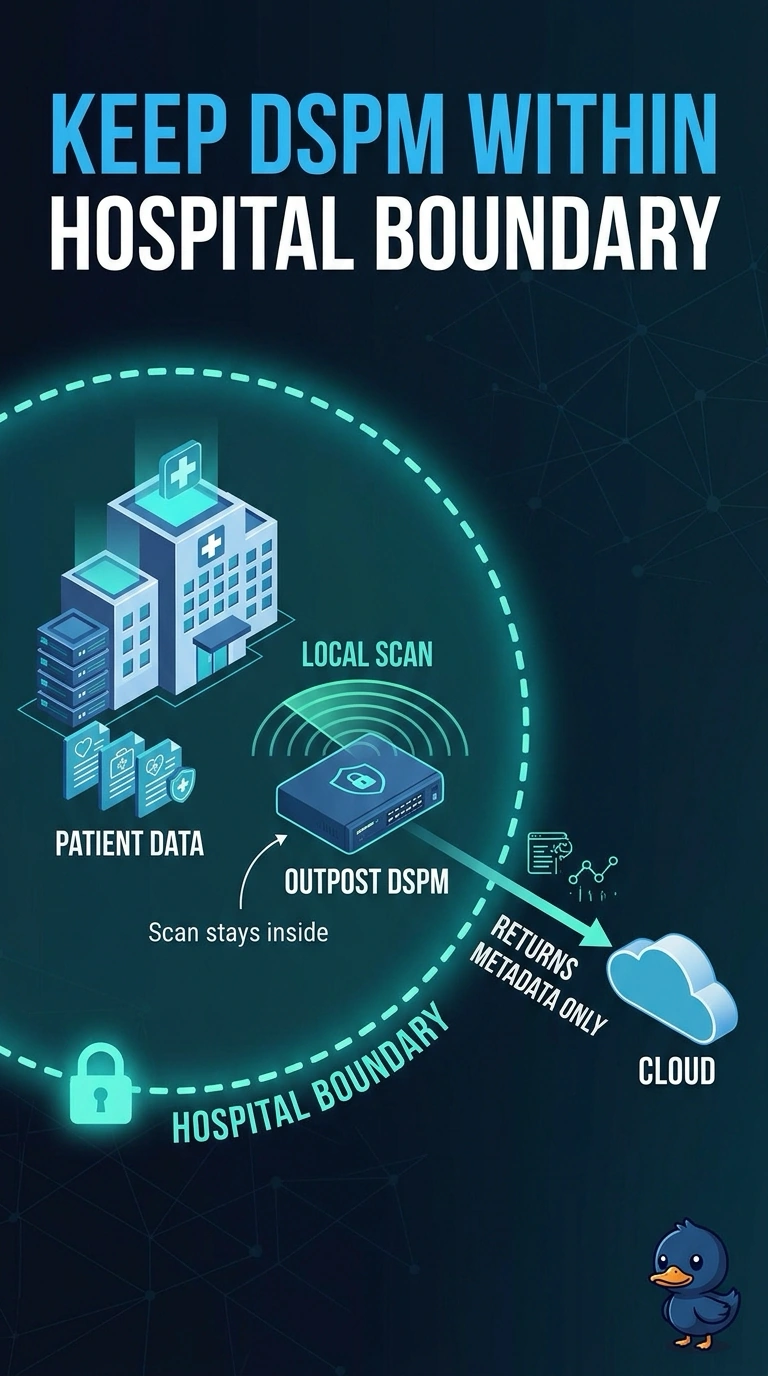
Think of cloud-scan DSPM as sending the files to a reading room you do not control, even if the copies are thrown out afterward. You want raw contents to stay in the hospital boundary, and outpost DSPM returns metadata only. The trap is picking cloud scan because the data is deleted after the read.
Full Explanation
Outpost scan is the design for data residency or a boundary the customer must own. DSPM on an outpost sends metadata only, so Palo Alto Networks is not reading the raw file contents the hospital wants kept inside its own accounts. That is the match for this constraint. Cloud-scan DSPM can see customer data inside Palo Alto Networks accounts and deletes it after the scan. Deletion after the read still means the contents were read outside the hospital boundary, which violates the requirement even though it limits retention. A Broker VM bridges on-premises sources, endpoint routing, and log forwarding. Deploying one with DSPM left off does not classify the hospital's cloud files and does not choose outpost DSPM. Office 365 DSPM is a SaaS path and is cloud scan only. It does not keep a hospital's cloud-account files inside an outpost, and it is the wrong store if the files are not in Microsoft 365. Exam caveat: the outpost account must be dedicated, with no other workloads, and the hospital pays for outpost compute, quotas, and image egress. Operational check: confirm DSPM for the hospital environment is on the outpost and that results are metadata, not a cloud-scan job that handled the file contents.