
A furniture maker runs AWS accounts, Azure subscriptions, and a VMware data center. Which footprint fact forces an outpost instead of cloud scan for a cloud account?
Select an answer to reveal the explanation.
Short Explanation
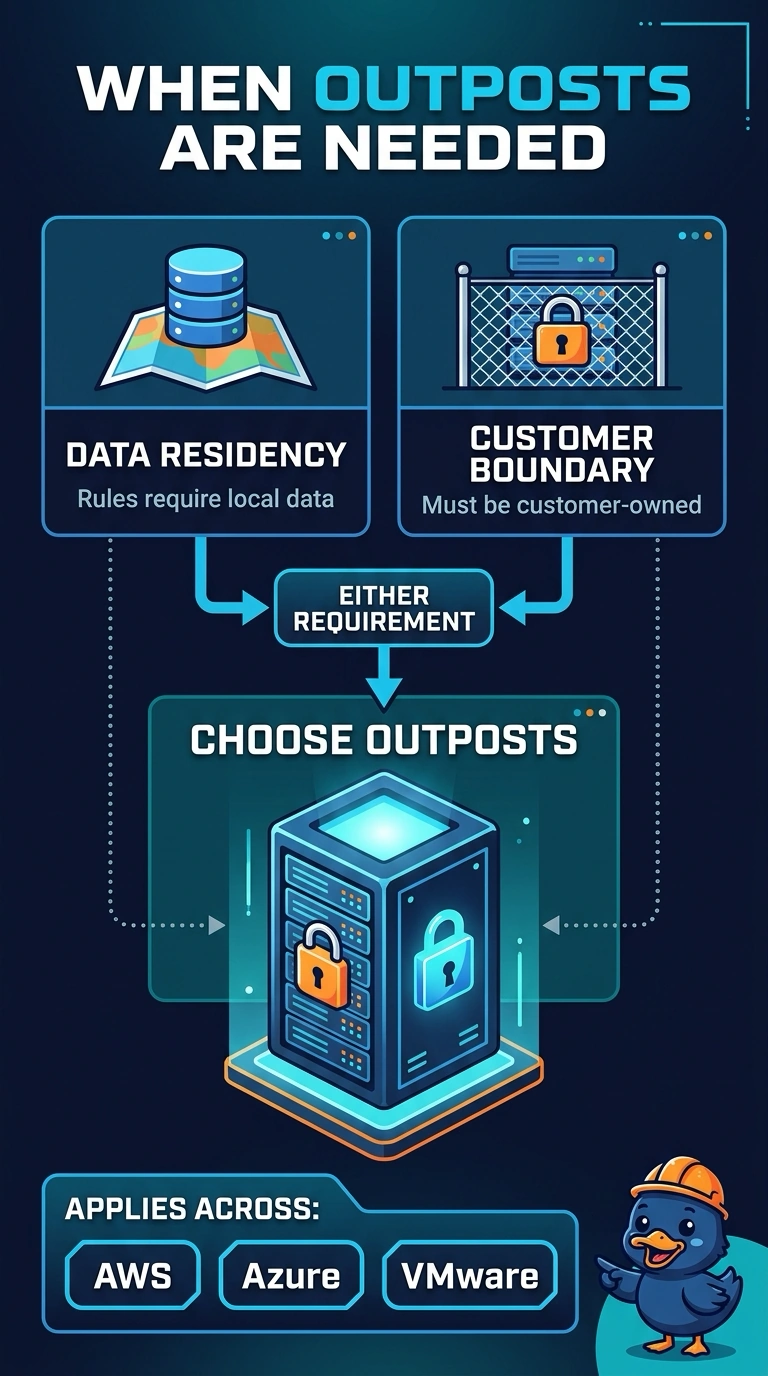
You can treat cloud scan as the default truck you hire, and an outpost as the truck you insist on garaging yourself. You need an outpost only when residency or a boundary you must own rules out cloud scan. Having both AWS and Azure, or running VMware, does not by itself force that choice.
Full Explanation
Cloud scan is the recommended default because Palo Alto Networks runs the scanners and carries most of that compute. Outpost scan is for data residency or a boundary the customer must own; that constraint is what forces an outpost for a cloud account. Having both AWS and Azure is an inventory fact about two providers, not a deployment constraint: each environment can use cloud scan or outpost according to its own requirements, and multi-cloud alone does not force an outpost. A VMware data center is an on-premises footprint, not an outpost inside a cloud account; on-premises data sources use a Broker VM. Preferring that Palo Alto Networks carry scanner compute supports cloud scan rather than requiring an outpost. Exam caveat: SaaS data security posture management stays on cloud scan even when a cloud account uses an outpost. Practical check: document the residency or ownership boundary for each account, choose an outpost only where that constraint exists, and plan a Broker VM separately for VMware data sources.