
An outpost runs in one region. A private registry in a second region is never scanned, and no scanner runs in that second region. What should be aligned before the registry is called covered?
Select an answer to reveal the explanation.
Short Explanation
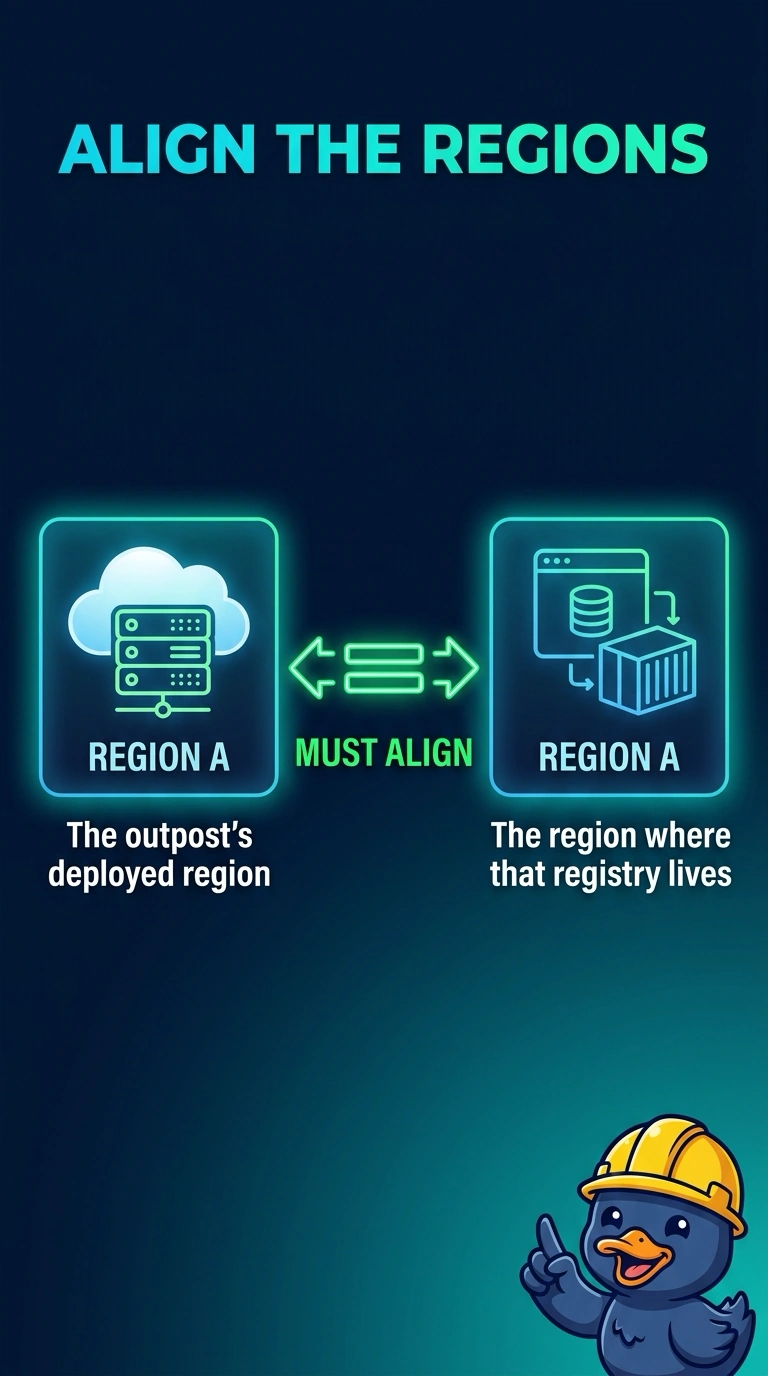
Think of a workshop whose tools are in one city and a warehouse in another. Your outpost’s scanners run where the outpost is deployed, while this registry is in a region with no scanner. Align the outpost’s region with the registry’s region before calling the images covered; a tenant note does not provide coverage.
Full Explanation
An outpost scans in the regions where its scanners run. Because this private registry is in a second region with no scanner running there, it is outside the outpost’s coverage; align the outpost’s deployed region with the registry’s region before treating the registry as scanned. Pairing a source-control webhook secret with a registry password stored as a tenant note mixes a git webhook with a credential that is not in the cloud-native secret store, and does not put a scanner in the registry’s region. A Broker VM is not an outpost: it can host a Registry Scanner applet for supported private registries when configured through a registry data connector, but an applet list paired with an arbitrary hostname is not sufficient. An editor trigger reports code findings in the IDE; it does not pull images from a private registry. Exam caveat: even in the right region, the registry credential must still be in the secret store the outpost expects, or the pull fails after regional alignment. Practical check: confirm a scanner runs in the registry’s region, confirm the credential store is populated, and confirm a private image from that registry returns a scan.