
A game studio runs its builds in Jenkins and wants those CI scan results in Cortex. Connecting Jenkins is the proposal on the table. What does that connection cover?
Select an answer to reveal the explanation.
Short Explanation
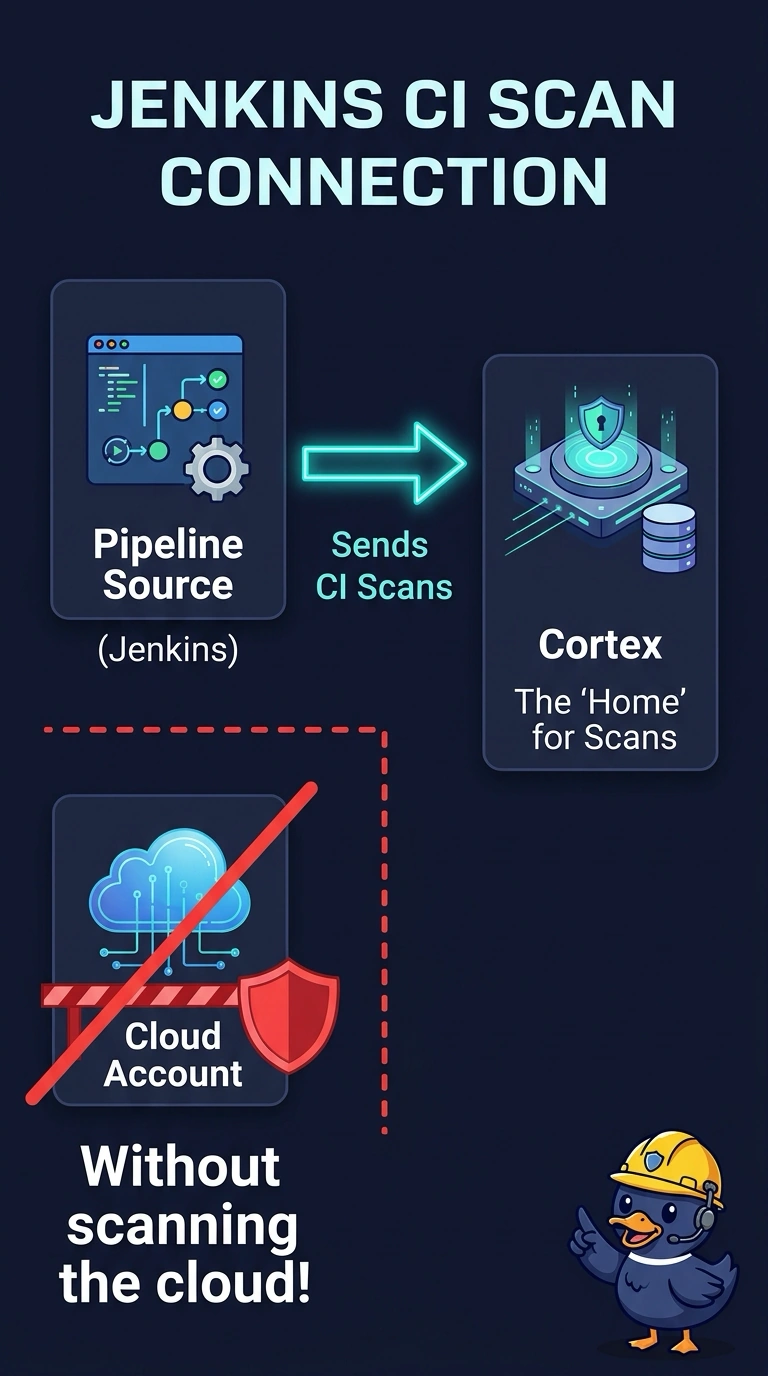
Think of Jenkins as the assembly line and the cloud account as the warehouse next door. You connect Jenkins so CI scans have a home. That pipeline connection does not walk into the warehouse and scan the cloud account.
Full Explanation
Jenkins is an application-pipeline onboarding, alongside GitHub and GitLab. For Jenkins CI/CD System Scan, install the supplied Cortex Cloud plugin and configure the generated JWT. The code-scan integration is a separate documented workflow. Connecting Jenkins gives CI scans a home in Cortex. That connection does not by itself scan a cloud account. Agentless scanning of every account the Jenkins role can assume treats the CI credential as a cloud onboarding. Cloud accounts are onboarded with the capabilities you turn on there, not by pointing Jenkins at them. Replacing cloud-account onboarding and starting data security on its own overstates the pipeline connection. Data security on a cloud account is a cloud-account capability. A Jenkins connection is not that stack. An XDR agent on each build node is runtime coverage for a host, and a cloud audit-log trail is a cloud ingestion path. Neither one is created by onboarding the CI system, and neither one is required for the pipeline results to have a home. Exam caveat: the CLI still enforces a gate only when the unified policy CI trigger is on and the job treats the exit status as a failure. The Jenkins connection alone does not flip that trigger. Operational check: confirm Jenkins shows as the pipeline source and that cloud-account scan status did not change just because the CI connection succeeded.