
A film studio wants a standard AWS outpost and also plans to hand-write a new VPC and egress path for the scanners. Which path is that custom network?
Select an answer to reveal the explanation.
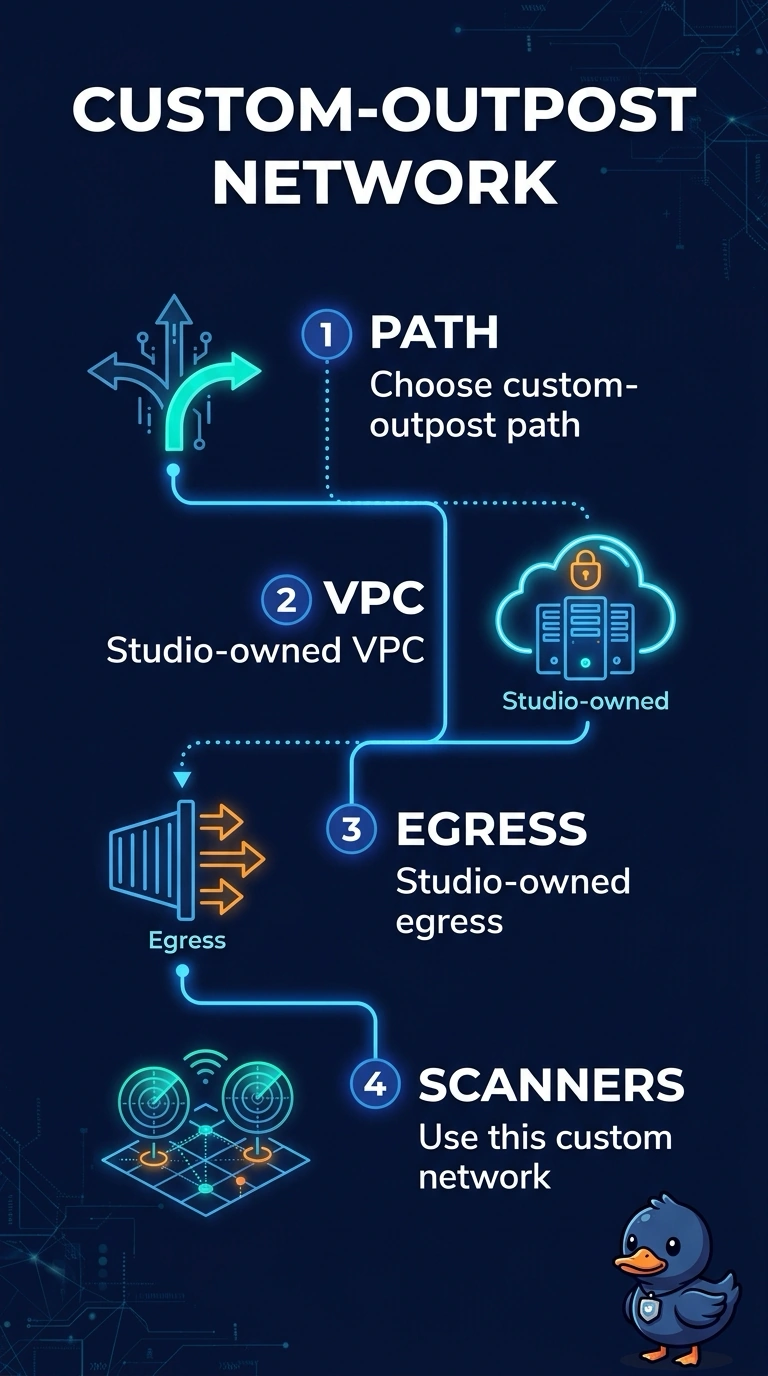
Short Explanation
Think of the generated template as the standard kit, and a hand-built VPC as bringing your own building. You are designing the network yourself, so this is the custom-outpost path, not the standard template. Cloud scan and a Broker VM are different boxes entirely.
Full Explanation
A standard outpost is the Cortex-generated template, Terraform or CloudFormation on AWS, applied in a dedicated account. A custom outpost is the path when the customer owns the network, the app registration, or the egress path. The studio's hand-written VPC and egress is that custom path, and the team will keep owning it. Choosing the standard template would mean applying the generated design, not writing a new VPC. Managed cloud scan skips the outpost, so there is no scanner VPC for the studio to hand-write. A Broker VM in the application VPC is a bridge appliance. It is not an outpost, and placing it in the application network does not create either outpost type. If the studio later adopts the generated template, that design is a standard outpost and the hand-written VPC is no longer required. Exam caveat: turning outbound internet off on a custom outpost is allowed and also drops capabilities that need that path. Operational check: record whether the scanners use the generated template or the studio VPC, and if it is the studio VPC, confirm the design is tracked as a custom outpost the studio will operate.