
A pipeline should assess an authorized running test API and its OpenAPI file with cortexcli. The job runs only the Code Security command and then treats a quiet result as a clean specification. Why is that result not an API assessment?
Select an answer to reveal the explanation.
Short Explanation
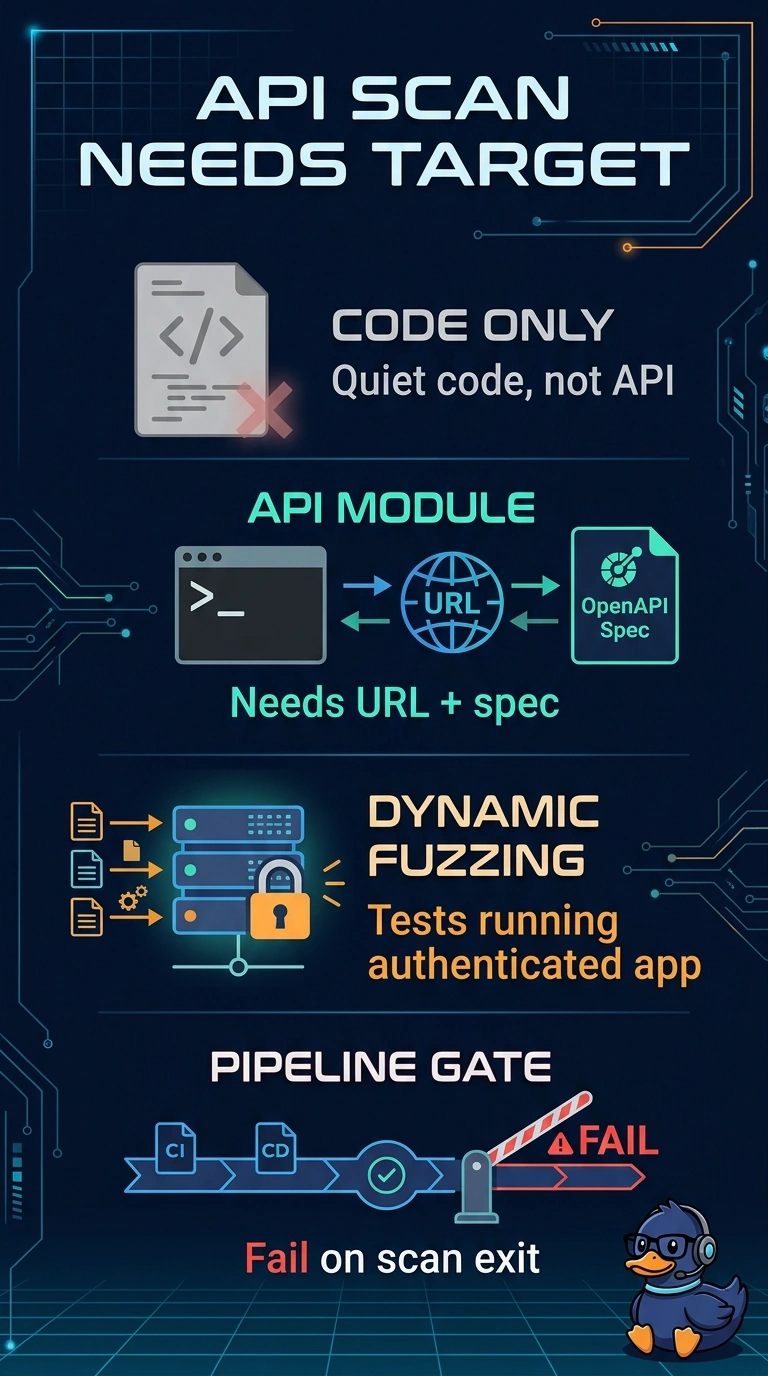
You ran only Code Security, so you never actually tested the running API. The API module performs dynamic fuzzing of the running application using the specification and required authentication; it is not merely a static OpenAPI document review. Don't mistake a quiet code result for a clean API test.
Full Explanation
The correct approach uses the CLI API scan module with the target application URL and OpenAPI file, because a code-only scan does not test the running API. The API module performs dynamic fuzzing of the running application using the specification and required authentication; it is not merely a static OpenAPI document review. A pipeline that runs only Code Security can report quiet on code while leaving the authorized test application unexercised, so that quiet result cannot stand in as an API verdict. Code Security does not compare an imported specification with live gateway traffic; that comparison of match, mismatch, conflict, or undefined belongs to the gateway integration and is not produced by a code-only command. An editor trigger reporting in the IDE does not execute a pipeline assessment of the running application, so skipping the CLI because the editor was quiet leaves CI with no API test. An image-scan report of vulnerabilities, malware, and secrets describes container content, and an empty malware report says nothing about how the running API handles fuzzed requests. Exam caveat: even the correct module enforces a gate only when the pipeline treats its exit status as failure, and gateway comparison still requires its integration. Operational check: confirm the invocation supplies both application URL and OpenAPI file with authentication, then confirm output names the tested API, not only Code Security findings.