
A Jenkins job already publishes JUnit test reports and also has a code-scanning page that ingests SARIF. The team wants cortexcli Code Security results in both of those existing consumers. Which output choice fits?
Select an answer to reveal the explanation.
Short Explanation
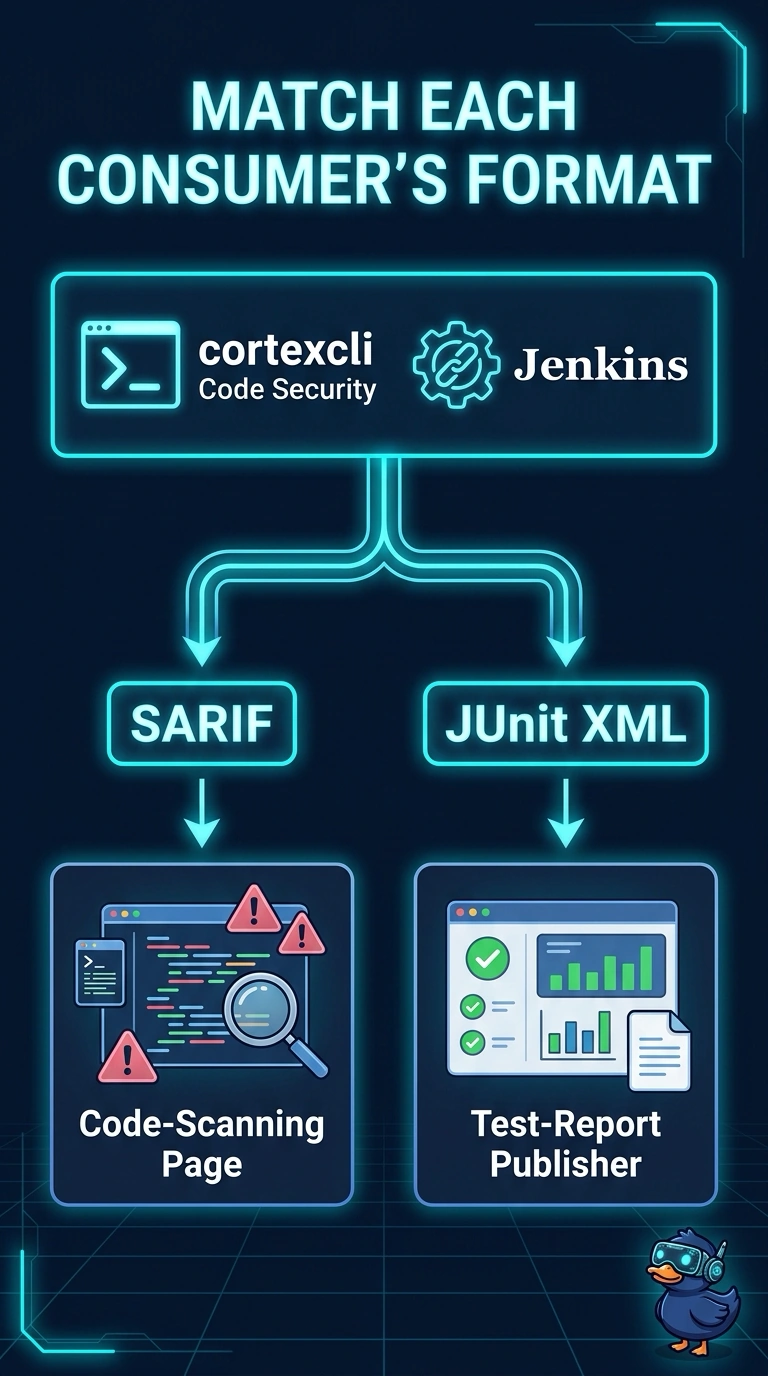
You would not hand the lab a poster when the machines are waiting for the file formats they already read. You want Code Security results in a SARIF consumer and a JUnit consumer, and those are two of the outputs cortexcli can emit. The trap is picking CycloneDX or SPDX just because they are also on the output list.
Full Explanation
Code Security output from cortexcli includes JSON, SARIF, CycloneDX, SPDX, and JUnit XML. The Jenkins code-scanning page already ingests SARIF, and the test-report publisher already ingests JUnit, so those two formats land in the consumers the job has today. A PDF summary and a CSV of file names are not Code Security outputs, so the existing pages would not ingest them as scan results. CycloneDX and SPDX are real outputs, and they describe a software bill of materials. They are the wrong pair for a JUnit test report and a SARIF code-scanning page, even though both names appear in the CLI output list. A JSON archive is also a real output, but a file nobody parses does not feed either consumer. Exam caveat: emitting the right format does not by itself fail the job. The pipeline still has to treat the CLI exit status as a failure when the policy says to gate. Operational check: open one build, confirm the code-scanning page shows the SARIF upload and the test report shows the JUnit XML, and confirm both came from the same Code Security run.