
A campus repository has no lockfile, and software composition analysis lists almost no dependencies. The team wants to treat that short list as complete. What should they verify first?
Select an answer to reveal the explanation.
Short Explanation
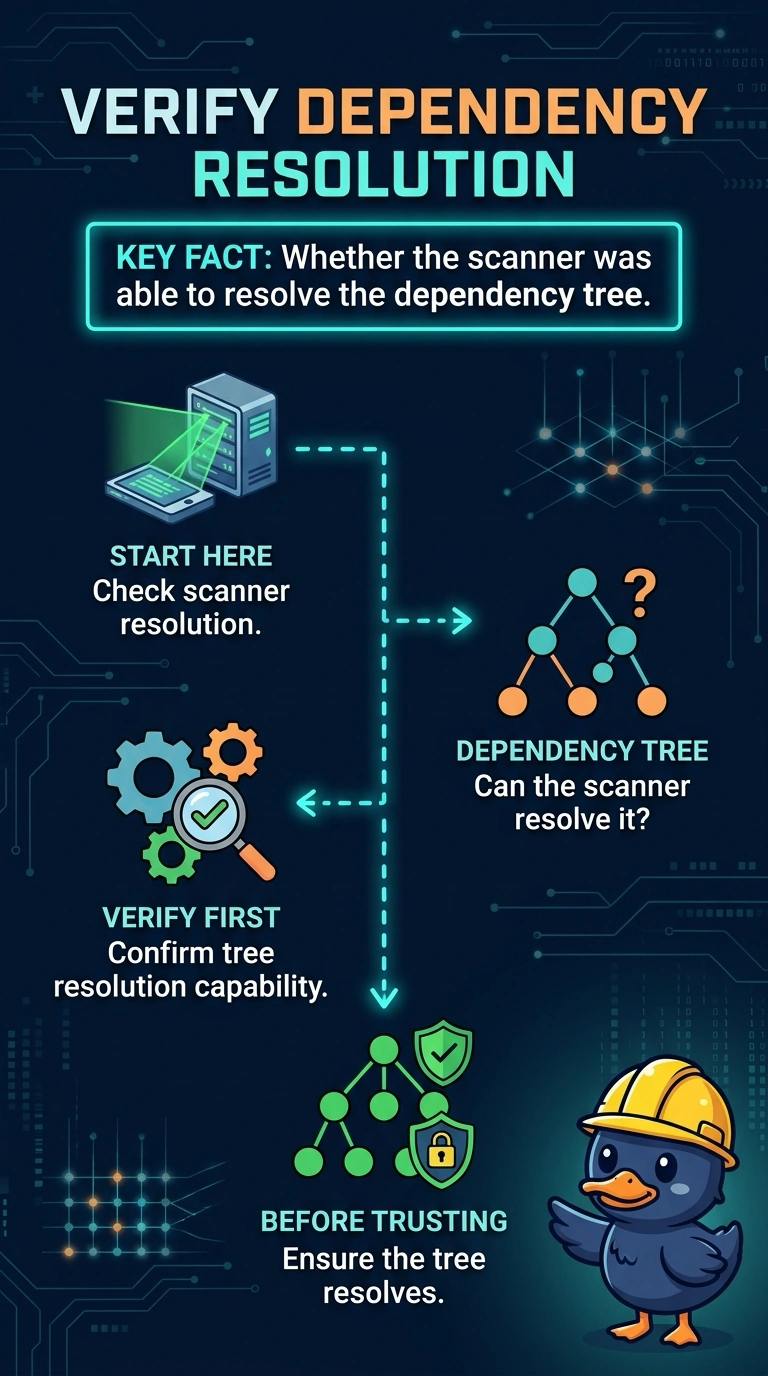
Think of a packing list you could not finish because the boxes were unlabeled. Your composition result is nearly empty, and there is no lockfile, so the first check is whether the scanner could resolve the dependency tree. A short list is not a clean application, and a firewall does not reconstruct that tree.
Full Explanation
Software composition analysis reports direct and transitive dependencies it can resolve. A repository with no lockfile may leave that resolution incomplete, so a nearly empty list can mean the scanner did not build the tree rather than that the application has almost no libraries. The team should verify whether resolution succeeded before calling the result complete. A web application firewall inspects traffic in front of a running service. It does not create a lockfile and does not feed the composition scanner. Infrastructure-as-code drift is a deployed template that no longer matches the repository. A short dependency list is not drift, and a vulnerability-policy ignore would hide issues rather than prove the scan resolved packages. Image text recognition is the global OCR setting for data classification. It reads text inside images for data profiles. Composition analysis does not depend on that switch to read package manifests. Exam caveat: direct pins can still hide a transitive library when resolution stops early, so a populated direct list is not proof the transitive tree was walked. Operational check: review the scan log for dependency resolution, add the lockfile or the manifest the scanner can read, and compare the new dependency count with the short list.