
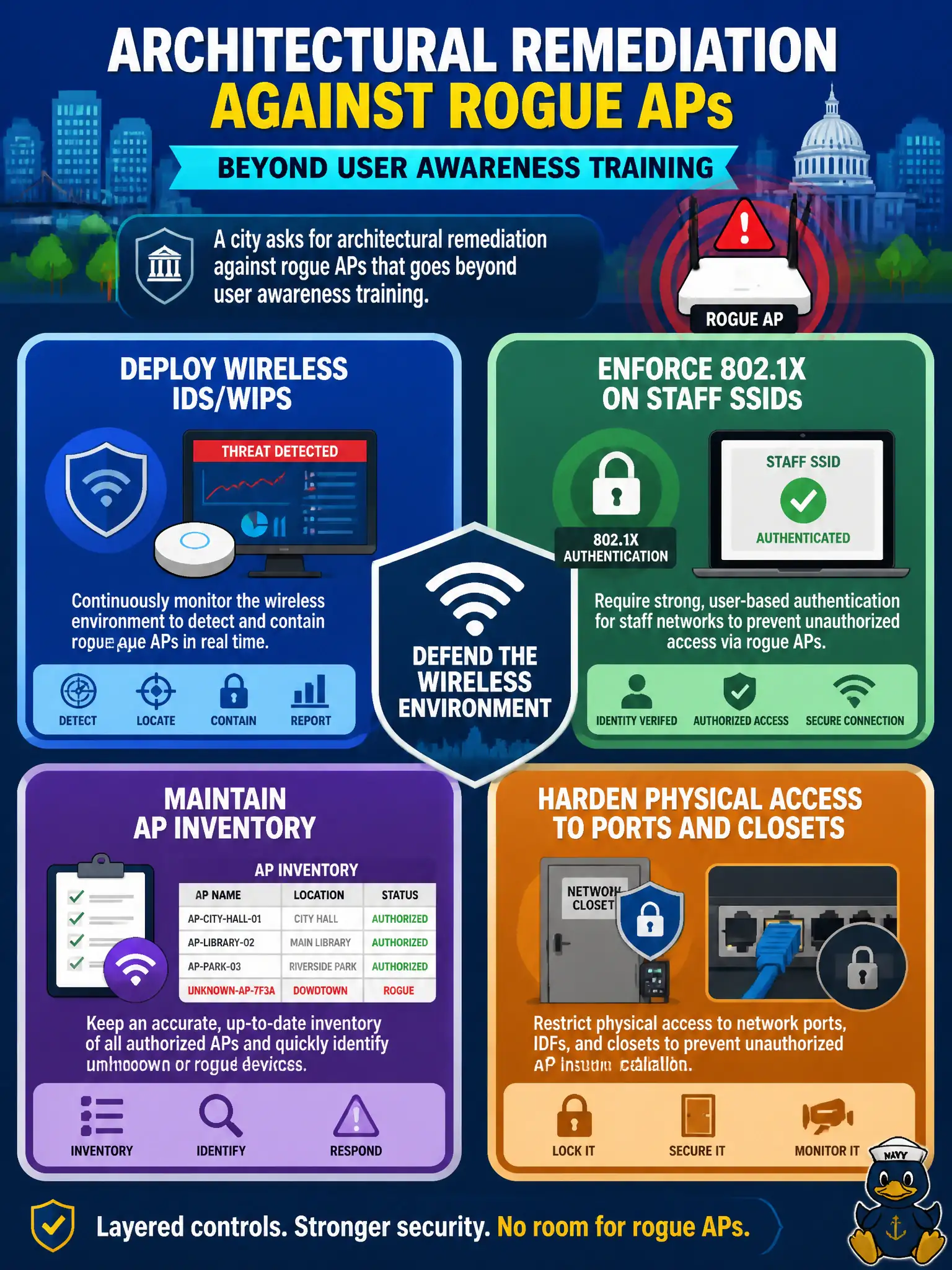
A city asks for architectural remediation against rogue APs that goes beyond user awareness training. Which theme set best fits?
Select an answer to reveal the explanation.
Short Explanation
Training helps, but architecture is the seatbelt. WIPS watching, 802.1X on staff SSIDs, a real inventory, and locked closets beat another slide deck. Rogues hate well-run radio neighborhoods.
Full Explanation
Architectural remediation against rogue access points for a city must go beyond awareness training and combine detection, strong authentication, inventory discipline, and physical hardening. Deploying wireless IDS/WIPS, enforcing 802.1X on staff SSIDs, maintaining an authorized AP inventory, and controlling physical access to Ethernet ports and telecom closets addresses how rogues appear and how clients get fooled. Disabling logging while relying only on annual phishing emails removes telemetry defenders need and leaves RF and Layer-2 gaps untouched. Replacing every laptop with cellular-only hotspots and abandoning WLAN inventory is operationally unrealistic and still leaves unmanaged radio risk. Publishing the corporate PSK on the intranet so users can spot fake portals expands credential exposure and does not authenticate legitimate infrastructure. Exam caveat: awareness complements architecture; it does not replace WIPS, 802.1X, or closet security. Operational check: verify WIPS coverage maps for civic buildings, confirm staff SSIDs require 802.1X, reconcile AP inventory to controller or cloud sources of truth, and walk telecom rooms for unlocked drops. For municipal and campus engagements, keep the finding language tied to authorized scope, name the building or SSID class affected, and state the residual risk to residents or staff if the rejected option had been chosen. Re-validate after the next change window that the selected control still matches inventory, monitoring, and RoE abort criteria used by the city wireless program.