
A rogue AP offers open authentication while the real municipal network is WPA2. Why might some clients still join the weaker lookalike?
Select an answer to reveal the explanation.
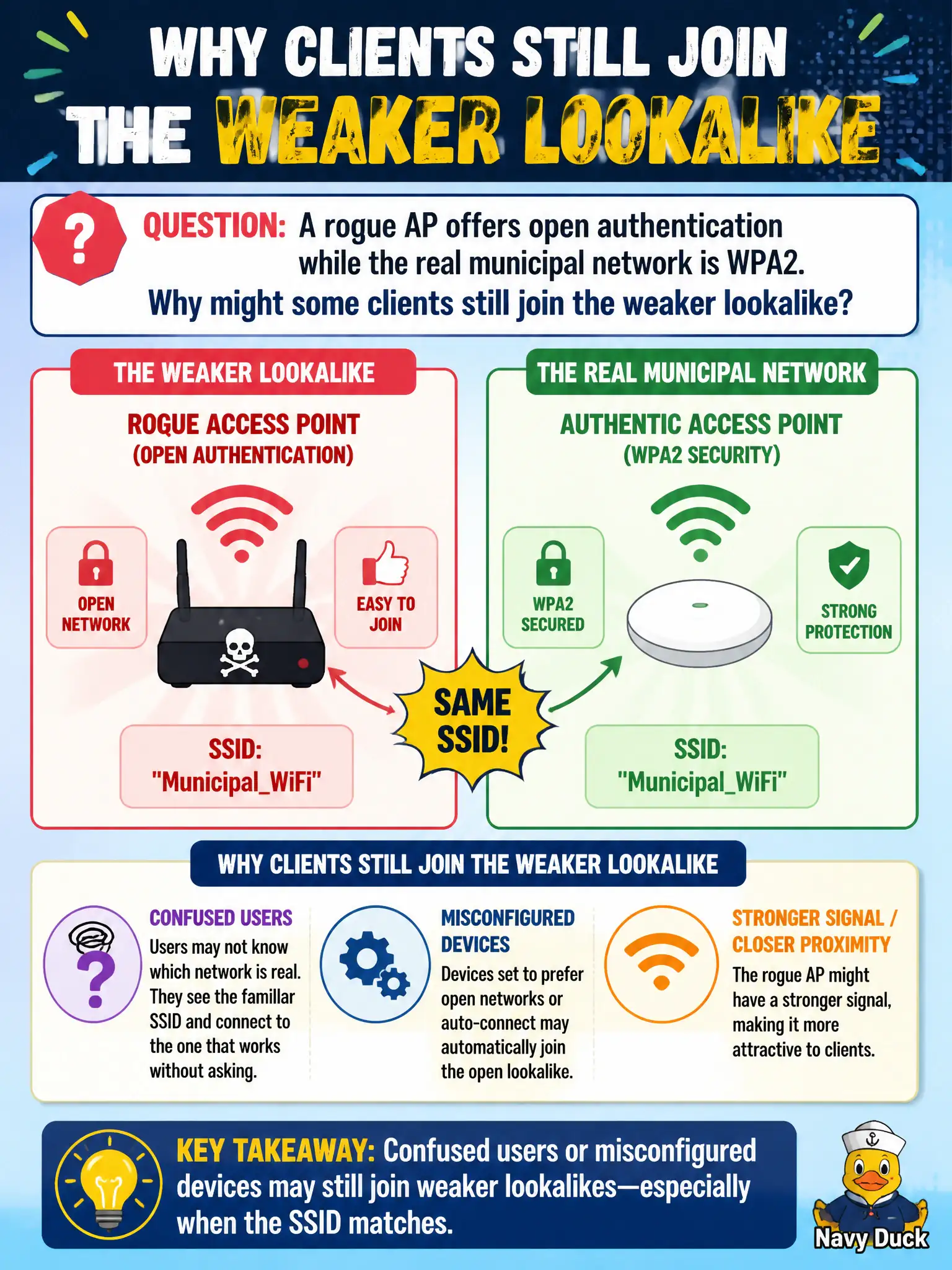
Short Explanation
Same SSID, open door, and a rushed human or a bad profile can still stroll in—even when the real network is WPA2. Matching names beat matching security in the messy real world. Standards do not prefer open over WPA2, and you do not need a finished crack to attract a join.
Full Explanation
A rogue AP offering open authentication while the real municipal network is WPA2 may still attract clients because confused users or misconfigured devices may join weaker lookalikes—especially when the SSID matches. Security mode superiority on the real BSS does not automatically prevent human or profile-driven joins to an open twin. Civic awareness and monitoring must account for that behavior.
'Open lookalikes are cryptographically preferred by all 802.11 standards over WPA2' fails because open lookalikes are not cryptographically preferred by all 802.11 standards over WPA2. 'Clients never join open networks if any WPA2 BSS exists in the same city' fails because clients sometimes do join open networks even when WPA2 BSS exists nearby—not never. 'Open rogues only attract clients after aircrack-ng finishes a dictionary attack' fails because open rogues do not attract clients only after aircrack-ng finishes a dictionary attack.
Exam caveat: saved open profiles and user haste are enough—no cracker required for the twin join class. Operational check: in an authorized lobby exercise, observe whether lab clients prefer the open lookalike, capture screenshots, and feed results into staff training. Improve official SSID naming clarity and rogue detection. In municipal wireless operations, record the rationale in the engagement notes so future assessors know which control or technique class was chosen and which failure modes the rejected options would create for city services.