
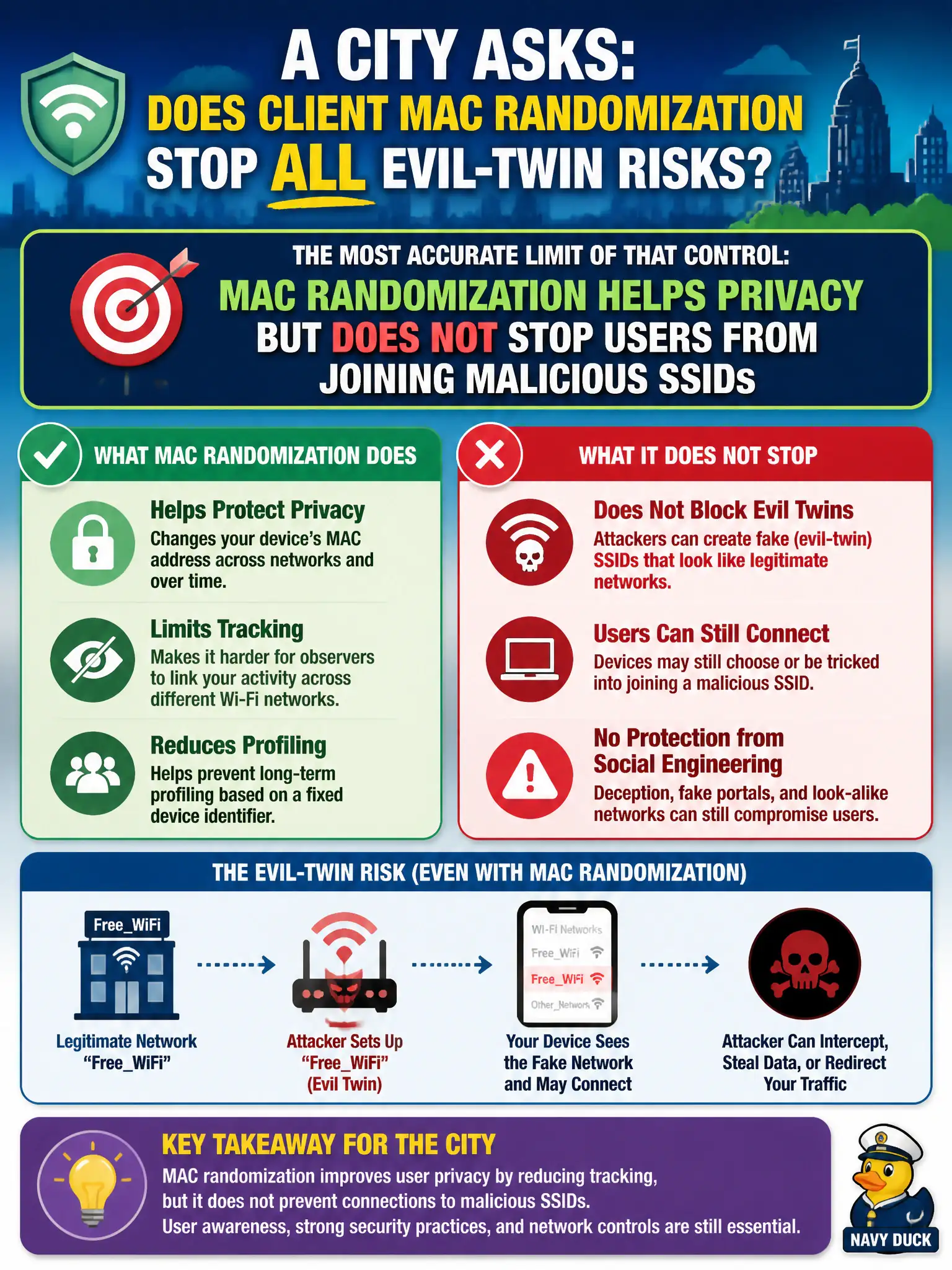
A city asks whether client MAC randomization stops all evil-twin risks. What is the most accurate limit of that control?
Select an answer to reveal the explanation.
Short Explanation
Spinning a new MAC is like wearing sunglasses—it helps anonymity a bit, but you can still walk into the wrong shop if the sign matches. Evil twins still work when people join the lookalike SSID. Randomization is not a magic SSID force field.
Full Explanation
Client MAC randomization helps privacy but does not stop users from joining malicious SSIDs. Municipal stakeholders sometimes over-credit randomization as an evil-twin killer; assessors should correct that limit. Users can still choose a lookalike network and land on a rogue portal regardless of rotating MACs.
'Randomization makes SSID impersonation cryptographically impossible on all bands' fails because randomization does not make SSID impersonation cryptographically impossible on all bands. 'Randomization automatically enables PMF and disables all open networks citywide' fails because randomization does not automatically enable PMF and disable all open networks citywide. 'Once MACs rotate, captive portals can never present a login page' fails because MAC rotation does not prevent captive portals from presenting a login page.
Exam caveat: privacy features ≠ association integrity controls. Operational check: include MAC randomization limits in civic awareness briefings, pair with SSID/BSSID verification guidance, and maintain rogue detection inventories. Test with lab clients under RoE to show joins still occur when users pick the twin. In municipal wireless operations, record the rationale in the engagement notes so future assessors know which control or technique class was chosen and which failure modes the rejected options would create for city services.