
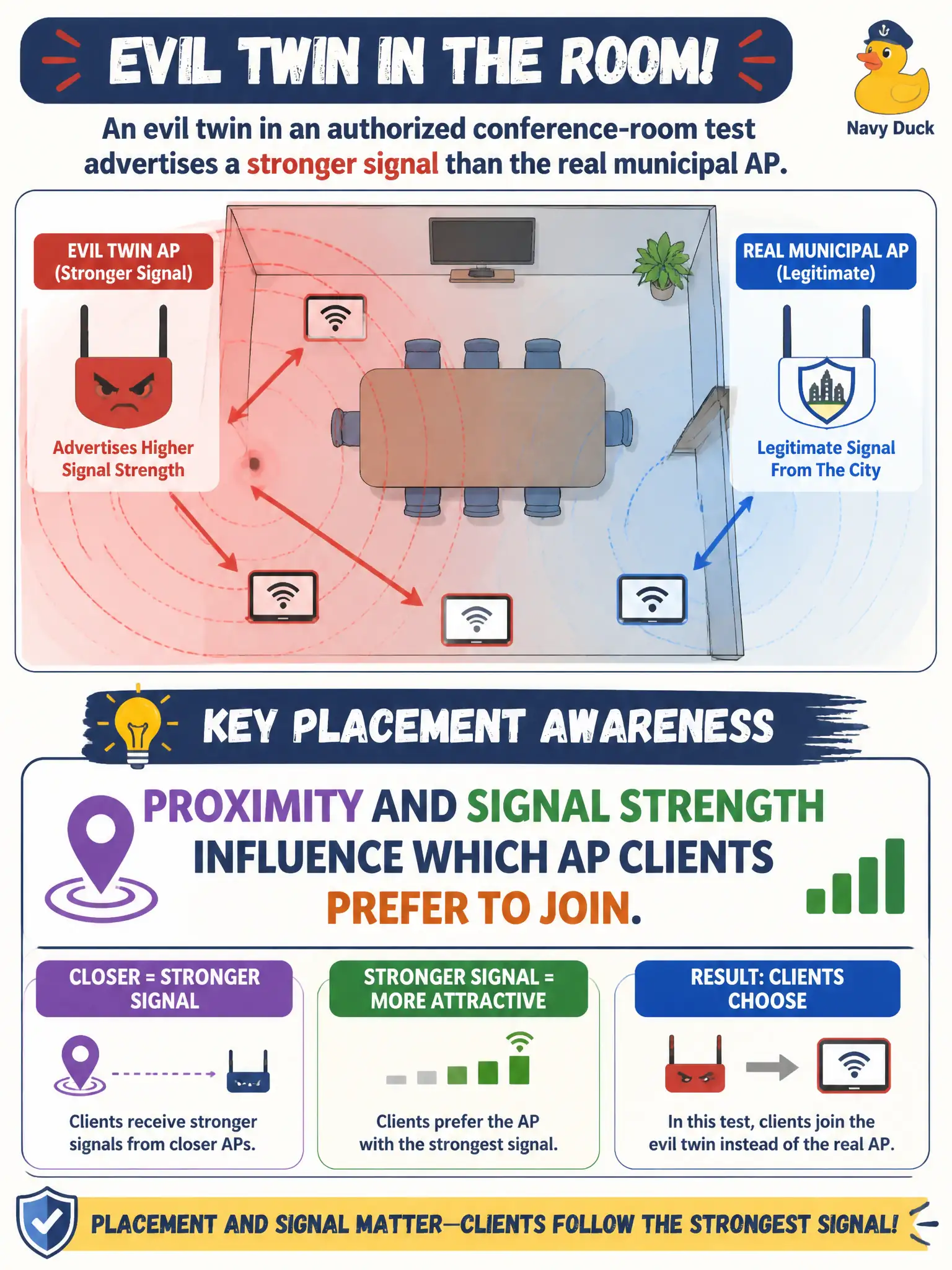
An evil twin in an authorized conference-room test advertises a stronger signal than the real municipal AP. What placement awareness should the assessor take away?
Select an answer to reveal the explanation.
Short Explanation
Move closer, shout louder on the air, and stations often follow the boombox. Evil twins win associations with placement and power as much as with a copied name. Weakest-BSSID myths, core VLAN pruning tales, and alphabetical SSID sorts are not how clients roam.
Full Explanation
An evil twin in an authorized conference-room test that advertises a stronger signal than the real municipal AP illustrates placement awareness: proximity and signal strength influence which AP clients prefer to join. Civic purple teams use controlled power and location to study attraction—not to claim clients always prefer the weakest BSSID or alphabetical SSIDs. RF realities drive twin effectiveness.
'Signal strength is irrelevant because clients always prefer the weakest BSSID' fails because clients do not always prefer the weakest BSSID; signal strength is highly relevant. 'Stronger beacons only affect wired VLAN pruning on the core switch' fails because stronger beacons do not primarily affect wired VLAN pruning on the core switch. 'Clients ignore RSSI and select APs solely by alphabetical SSID order' fails because clients do not select APs solely by alphabetical SSID order while ignoring RSSI.
Exam caveat: winning RSSI without authorization is harmful—contain lab twins carefully. Operational check: measure RSSI of real versus test twin at client seats, keep twin power minimized to the conference room, watch association targets, and shut down if clients outside scope connect. Record placement lessons for municipal defender training. In municipal wireless operations, record the rationale in the engagement notes so future assessors know which control or technique class was chosen and which failure modes the rejected options would create for city services.