
A student argues that WPS risks only matter on legacy WEP networks. What correction should an instructor give?
Select an answer to reveal the explanation.
Short Explanation
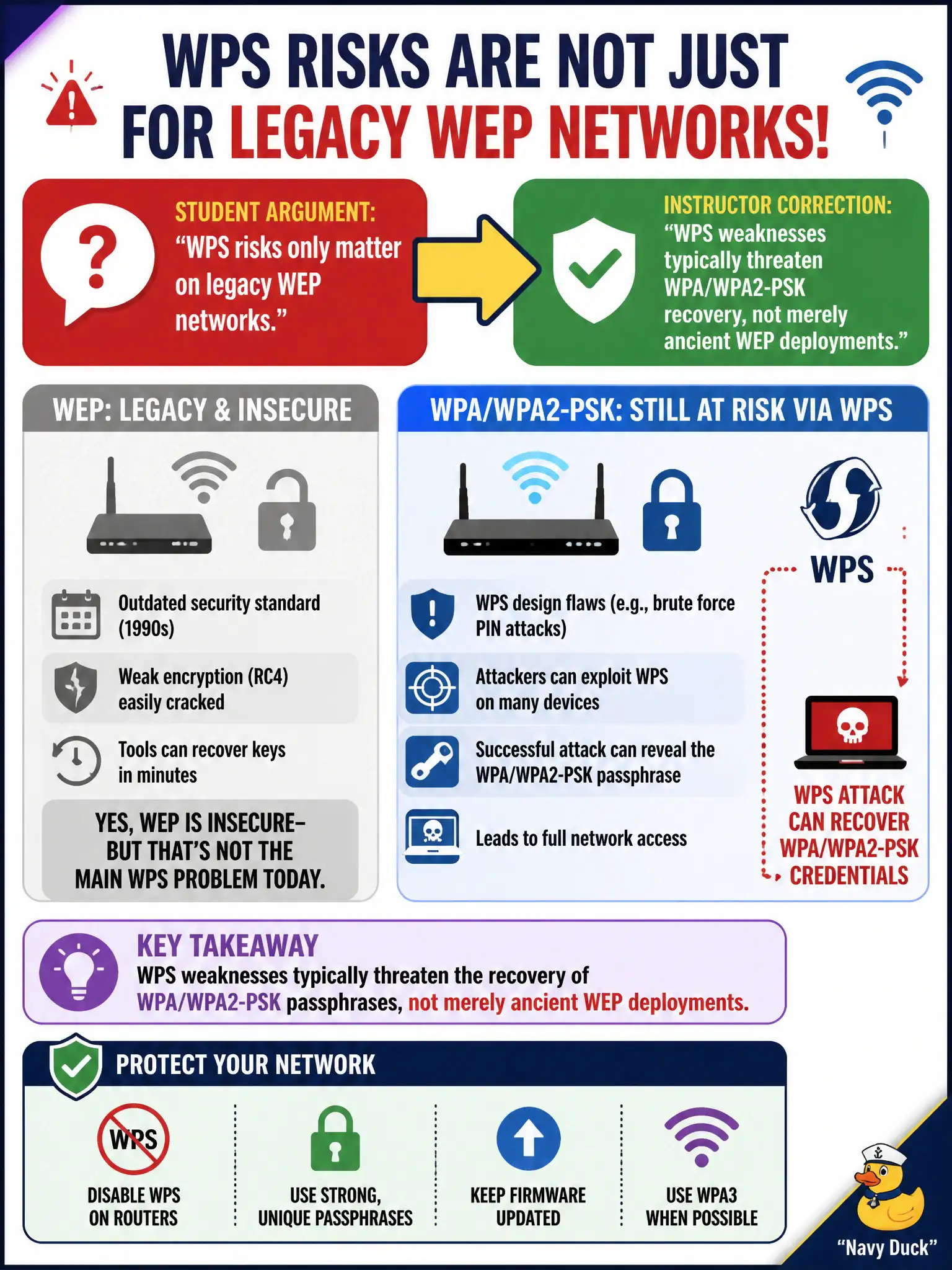
WPS hitchhiked onto modern PSK Wi-Fi—the danger is walking away with the WPA passphrase, not only beating museum-piece WEP. Do not file it under 'old crypto only.'
Full Explanation
WPS weaknesses typically threaten WPA/WPA2-PSK recovery, not merely ancient WEP deployments. Municipal assessors who dismiss WPS because the network is WPA2 miss the core risk class: PIN issues can lead toward the Personal passphrase. Civic inventories must flag WPS on modern PSK SSIDs, not only museum WEP gear.
'WPS cannot coexist with WPA2, so only WEP APs ever expose a PIN' fails because WPS can coexist with WPA2; it is not limited to WEP APs. 'WPS risks apply exclusively to cellular hotspots and never to 802.11 APs' fails because WPS risks apply to 802.11 APs—not exclusively to cellular hotspots. 'Recovering a WPS PIN never reveals a WPA passphrase on any vendor platform' fails because recovering a WPS PIN can lead to WPA passphrase exposure on vulnerable platforms—it is not never-reveals.
Exam caveat: WPA3/SAE and WPS combinations vary—still inventory WPS state rather than assuming legacy-only risk. Operational check: correlate wash-scan WPS flags with WPA2-PSK staff/guest SSIDs in the city estate, prioritize disablement, and test only in-scope. Educate stakeholders that WPA2 plus WPS is still a meaningful finding. In municipal wireless operations, record the rationale in the engagement notes so future assessors know which control or technique class was chosen and which failure modes the rejected options would create for city services.