
A municipal technician asks what WPS was originally intended to solve for consumers. What is the best description?
Select an answer to reveal the explanation.
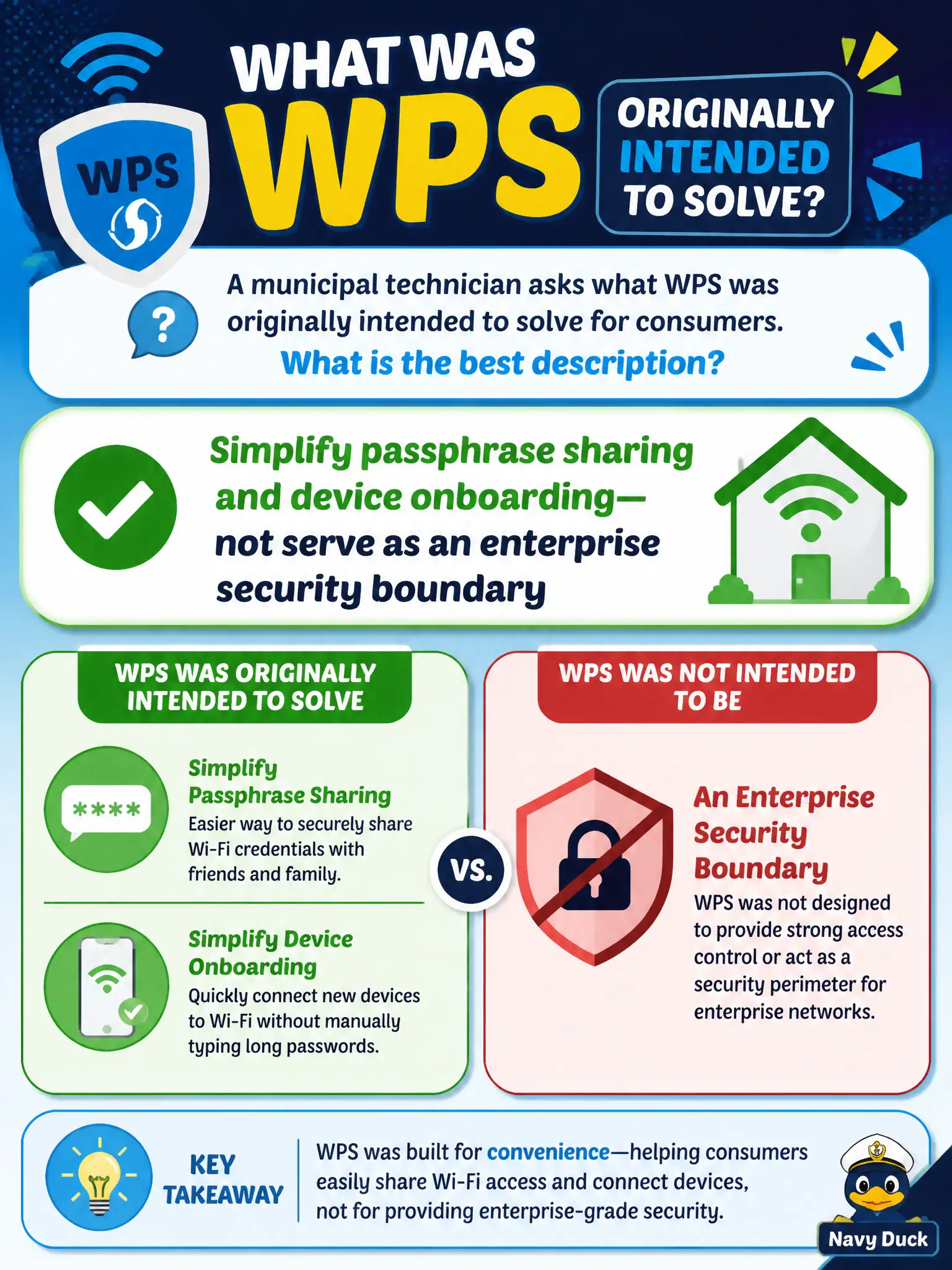
Short Explanation
WPS was the 'easy join' button for home routers—not the castle wall for city enterprise Wi-Fi. It tried to make sharing passphrases less painful. Treat it as convenience history, not your security architecture.
Full Explanation
WPS was originally intended to simplify passphrase sharing and device onboarding for consumers—not to serve as an enterprise security boundary. Municipal technicians who treat WPS as a campus authentication architecture misunderstand its design goal. Civic enterprise networks should prefer 802.1X and disable consumer onboarding shortcuts on staff SSIDs.
'Replace 802.1X certificate authentication in large campus deployments' fails because WPS was not designed to replace 802.1X certificate authentication in large campus deployments. 'Provide a mandatory government encryption standard stronger than WPA3' fails because WPS is not a mandatory government encryption standard stronger than WPA3. 'Eliminate the need for any access point firmware updates forever' fails because WPS does not eliminate the need for access point firmware updates forever.
Exam caveat: original intent does not equal residual risk—know both the purpose and the weakness class. Operational check: in city architecture reviews, describe WPS as consumer onboarding, require Enterprise for staff, and disable WPS on production APs. Train help-desk staff not to re-enable WPS as a convenience default. In municipal wireless operations, record the rationale in the engagement notes so future assessors know which control or technique class was chosen and which failure modes the rejected options would create for city services.