
A city asks when expanding the wordlist or rules beats switching cracking tools during a WPA2-PSK attempt. What judgment is soundest?
Select an answer to reveal the explanation.
Short Explanation
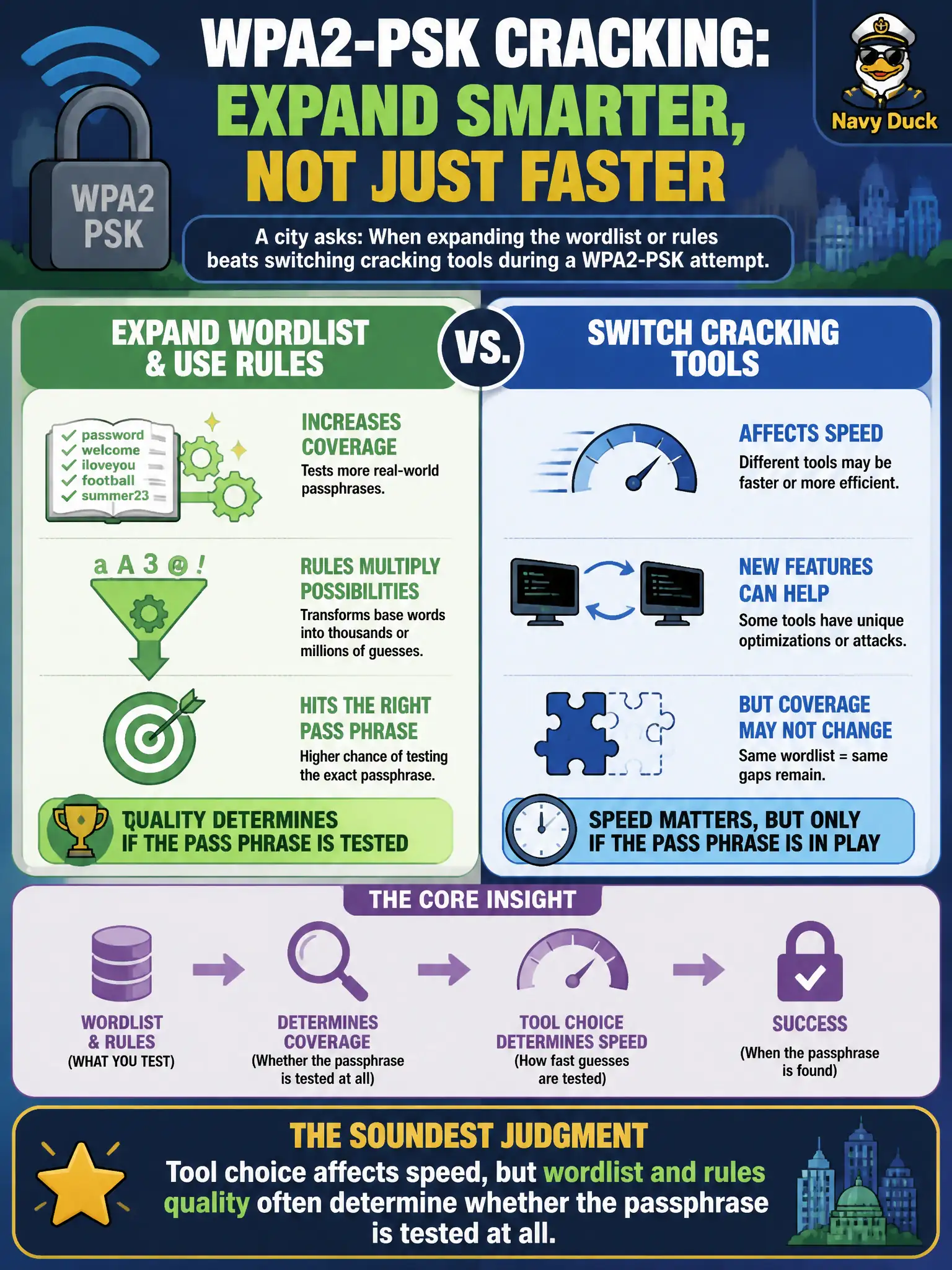
Faster engines help, but if the real passphrase never enters the candidate line, speed just fails quicker. Grow targeted lists and rules when coverage is the gap; switch tools when throughput is the gap. Coverage versus speed is the judgment.
Full Explanation
When a city asks whether expanding the wordlist or rules beats switching cracking tools during a WPA2-PSK attempt, the core judgment is coverage versus throughput: tool choice affects speed, but wordlist and rules quality often determine whether the passphrase is ever tested. Municipal GPU and CPU crackers fail the same way if civic pattern secrets never appear as candidates. After a valid authorized capture, invest in plausible dictionaries and mutations before assuming a different binary will invent the key.
'Any GPU tool guarantees recovery, so wordlists are optional once hashcat starts.' fails because GPU tooling does not make wordlists optional or guarantee recovery. 'Switching tools always invents new handshake bytes that aircrack missed.' fails because switching tools does not invent new handshake bytes that another cracker missed. 'Longer wordlists only help WEP and never affect WPA2-PSK outcomes.' fails because longer wordlists remain highly relevant to WPA2-PSK offline outcomes, not WEP-only.
Exam caveat: timed exams punish both empty mega-lists and endless tool-hopping without improving candidates. Operational check: validate the municipal handshake, run a known-PSK control, expand allowed civic rules/lists, then compare cracker throughput. Name the wordlist and rules in engagement notes so recovery attempts remain reproducible. In municipal wireless operations, record the rationale in the engagement notes so future assessors know which control or technique class was chosen and which failure modes the rejected options would create for city services.