
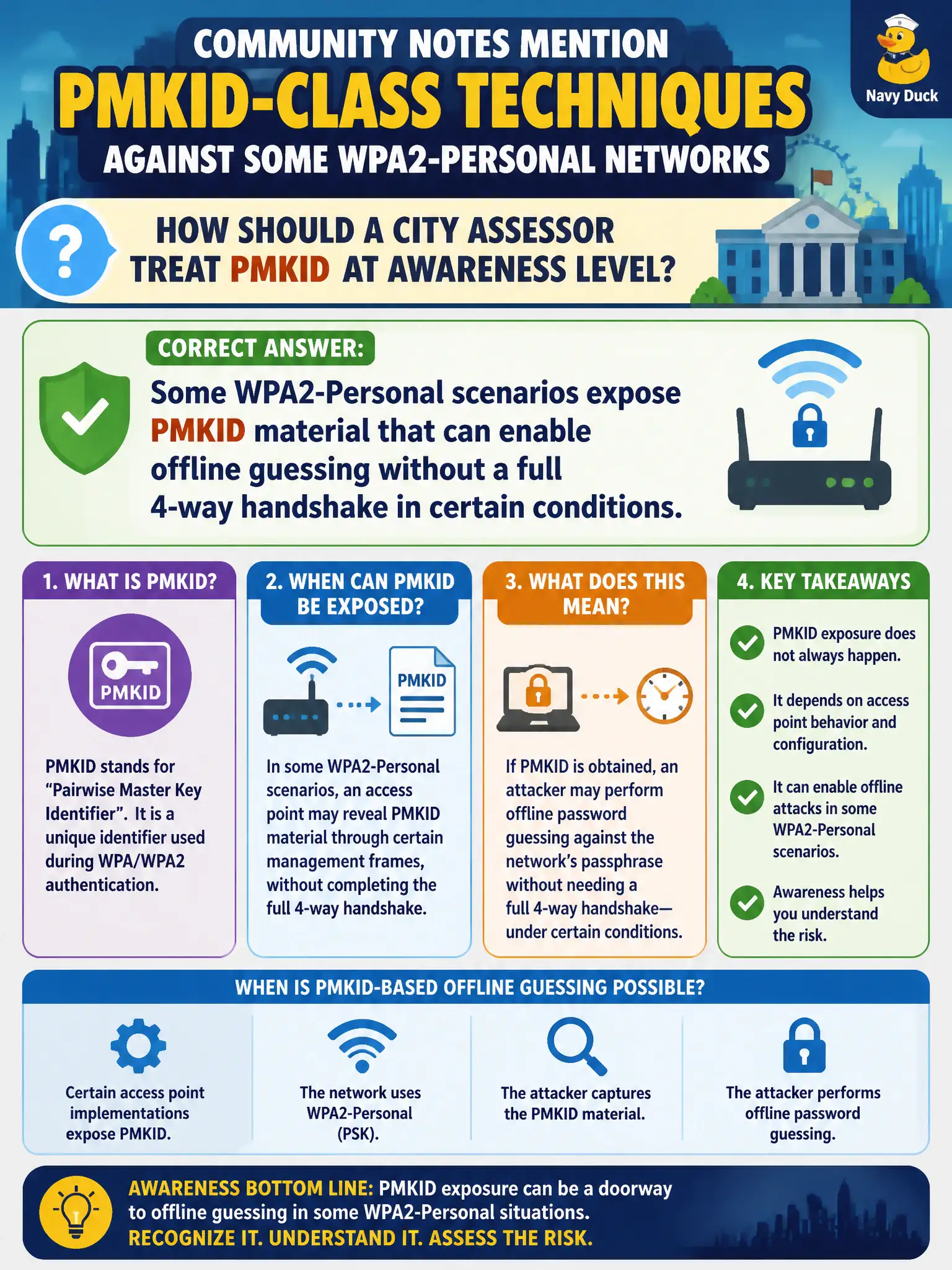
Community notes mention PMKID-class techniques against some WPA2-Personal networks. How should a city assessor treat PMKID at awareness level?
Select an answer to reveal the explanation.
Short Explanation
PMKID is an alternate doorway into offline guessing on some WPA2-Personal setups—sometimes without waiting on a full four-message dance. It is still offline candidate testing, not a cleartext password dump. Awareness beats treating the 4-way as the only possible path.
Full Explanation
PMKID-class techniques against some WPA2-Personal networks form an offline recovery pathway class: in supported scenarios, PMKID-related material can enable offline passphrase guessing without waiting through a full client 4-way handshake collection the same way classic EAPOL hunting does. A city assessor should treat this as awareness-level toolkit literacy—useful when AP and tool behavior cooperate—while still obeying RoE, inventory limits, and dictionary reality. It yields cracker input; it does not plaintext the PSK by itself.
'PMKID always requires a full captive-portal login before offline guessing can begin.' fails because PMKID-class Personal offline work is not gated on captive-portal login. 'PMKID is only relevant to WPA3-SAE and never appears on WPA2-Personal.' fails because PMKID relevance is not limited to WPA3-SAE and can appear in WPA2-Personal scenarios. 'PMKID replaces the need for any wordlist because it reveals the passphrase in cleartext.' fails because PMKID material does not reveal the passphrase in cleartext or eliminate wordlists.
Exam caveat: not every AP yields usable PMKID material—absence means pursue handshake capture, not declare victory or impossibility. Operational check: on authorized municipal BSSIDs only, check for PMKID-class material, export correctly, fall back to complete EAPOL when needed, and label evidence by BSSID before GPU time. Record which pathway fed the cracker in the civic report. In municipal wireless operations, record the rationale in the engagement notes so future assessors know which control or technique class was chosen and which failure modes the rejected options would create for city services.