
Lab notes discuss the PTK after a WPA handshake on a city AP. What role does the PTK play?
Select an answer to reveal the explanation.
Short Explanation
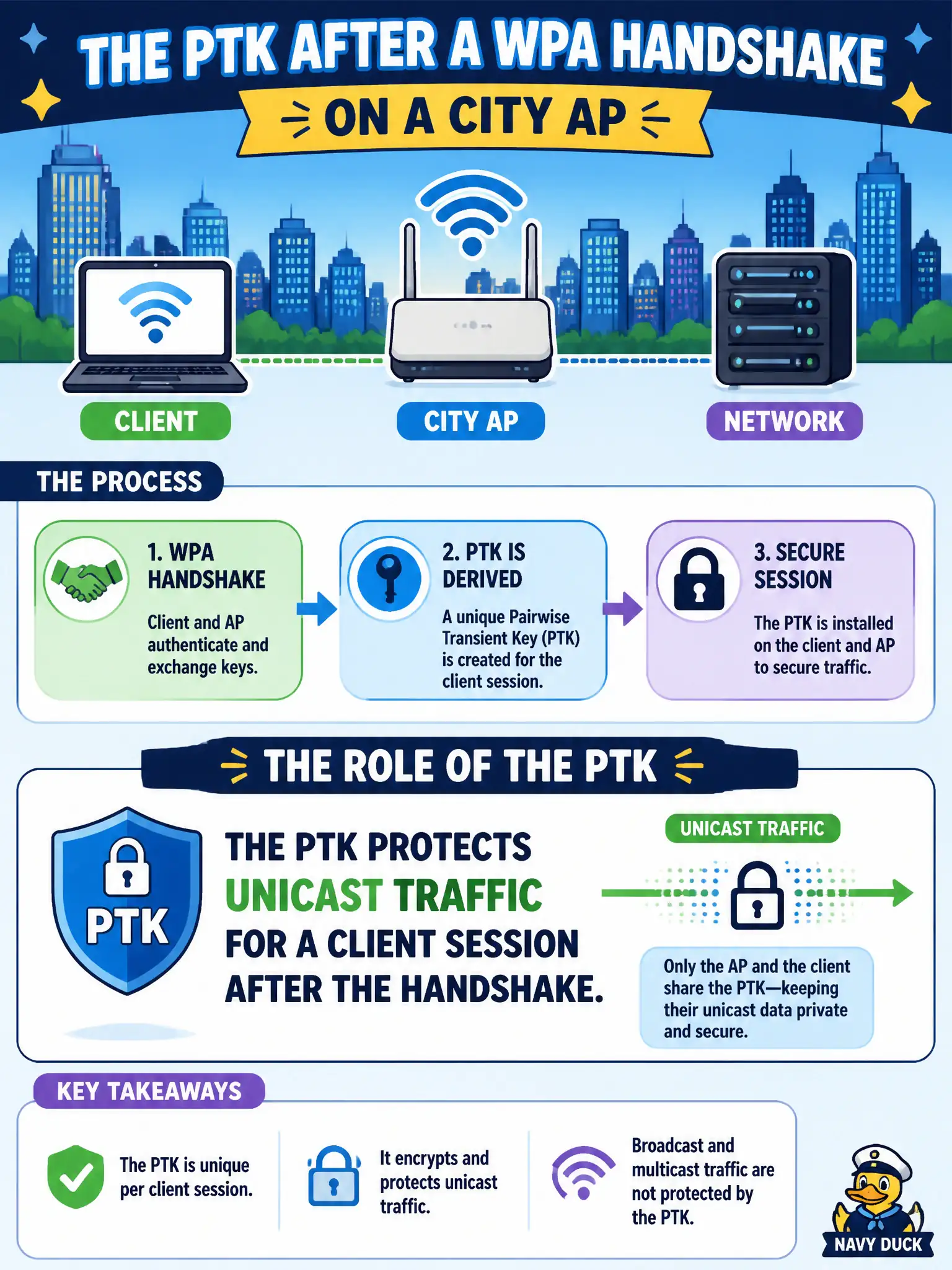
After the handshake finishes, the PTK is the per-client session armor for one-to-one traffic—like a private tunnel key for that laptop’s conversation with the AP. It is not the shared PSK people type, and it is not the forever guest badge. Session pairwise protection is the idea.
Full Explanation
After a WPA handshake on a city AP, the PTK (pairwise transient key) protects unicast traffic for that client session. Lab notes that discuss PTK are pointing at per-session pairwise protection derived through the handshake, distinct from the long-term passphrase shared by Personal clients. Municipal assessors use this vocabulary to explain why compromising or recovering long-term PSK material has broader impact than a single session's transient keys. The PTK is not the shared passphrase typed by every IoT device on the SSID; that long-term secret relates to PSK/PMK context, not the transient pairwise key itself. The PTK does not permanently replace the need for association on future visits; new sessions perform fresh handshake/key establishment as required by the protocol design. The PTK is not used only to encrypt management beacons before association; beacons are management framing, and pairwise transient keys protect the unicast data path after the handshake completes. Exam caveat: do not swap PTK, PMK, and GTK labels under time pressure—each names a different key role. Operational check: when teaching civic staff, diagram passphrase/PMK → handshake → PTK for unicast and GTK for group frames, then relate offline PSK recovery to long-term secret exposure rather than 'stealing one PTK forever.' Keep lab captures labeled so session discussion stays tied to the authorized BSS.