
In a municipal wireless lab, what does the PMK represent relative to the WPA-Personal passphrase?
Select an answer to reveal the explanation.
Short Explanation
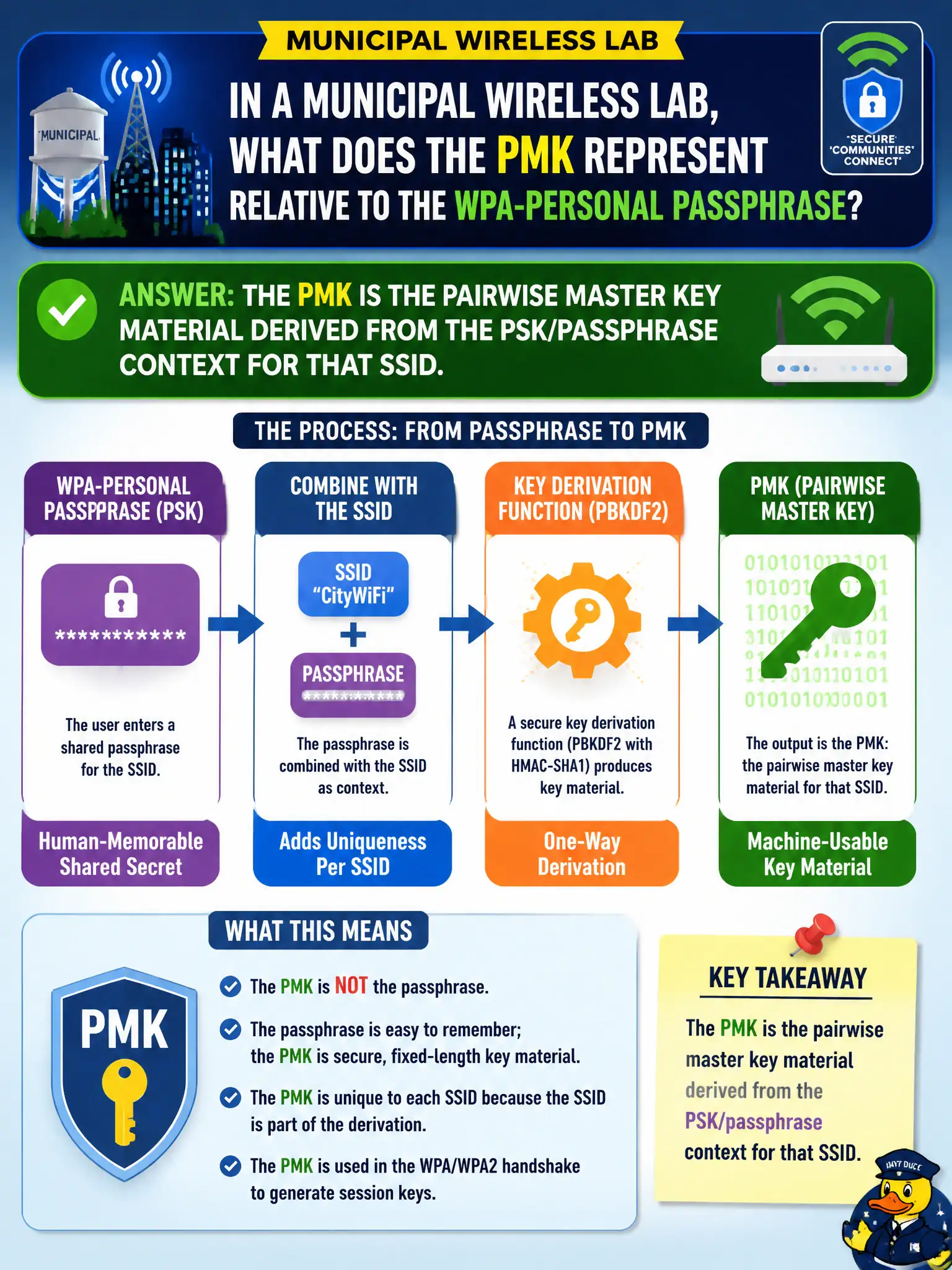
Picture the passphrase as the master mold and the PMK as the key blank poured from that mold for this SSID. From there the handshake shapes per-session keys. PMK sits above the session keys, not in the portal cookie jar.
Full Explanation
In municipal wireless lab vocabulary, the PMK is the pairwise master key material derived from the PSK/passphrase context for that SSID in WPA-Personal. It is the higher-level key material from which session keys are developed during the handshake process. Civic assessors need PMK literacy to understand why capturing handshake material enables offline passphrase testing against Personal networks and why SSID-plus-passphrase context matters. The PMK is not the temporary GTK used only for broadcast video frames; the GTK is the group key for broadcast/multicast to associated clients. The PMK is not the public BSSID printed on the AP sticker; the BSSID is the AP's MAC identity on the BSS. The PMK is not the captive-portal cookie issued after web login; portal cookies are application-layer guest onboarding artifacts unrelated to pairwise master key derivation. Exam caveat: PMK awareness is conceptual—OSWP-style items test role vocabulary, not a demand to dump raw key bytes in reports. Operational check: in city lab explanations, map passphrase → PSK/PMK context → handshake-derived session keys, and ensure staff do not confuse PMK with GTK, BSSID, or portal state. Keep any key material artifacts within authorized evidence handling and never paste live municipal PMK/PSK values into public tickets.