
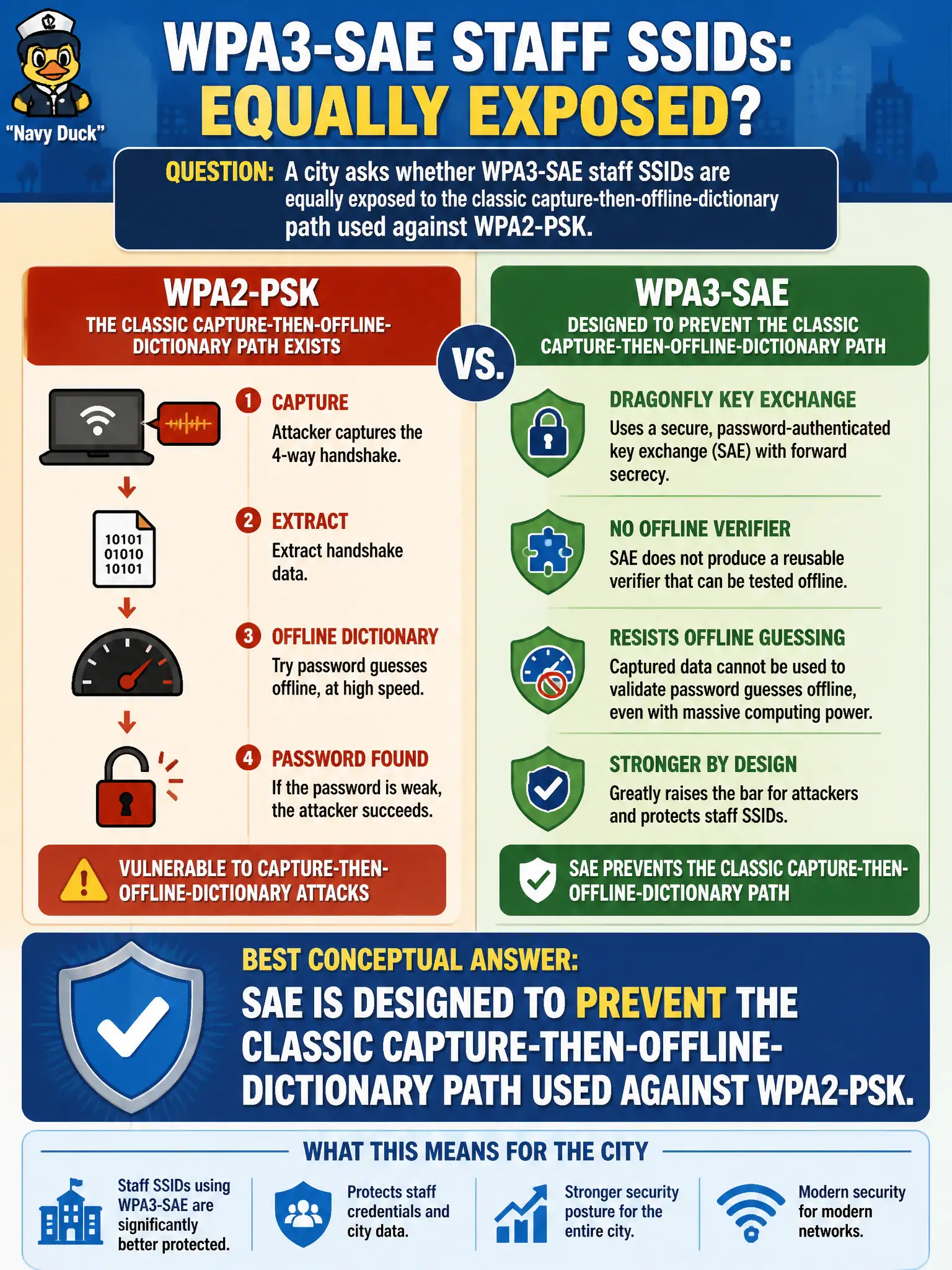
A city asks whether WPA3-SAE staff SSIDs are equally exposed to the classic capture-then-offline-dictionary path used against WPA2-PSK. What is the best conceptual answer?
Select an answer to reveal the explanation.
Short Explanation
WPA2-PSK is like photographing the lock and trying keys at home; SAE changes that game so the old take-home dictionary path does not work the same way. WPA3-Personal was built to block that classic offline PSK crack story. Do not treat SAE networks as the same easy offline target.
Full Explanation
WPA3-SAE staff SSIDs are not equally exposed to the classic capture-then-offline-dictionary path used against WPA2-PSK. SAE (Simultaneous Authentication of Equals) is designed so that recording the handshake exchange does not yield the same offline dictionary oracle that Personal PSK assessments rely on. For municipal judgment questions, the civic takeaway is protocol-class difference: migrating sensitive city SSIDs to SAE reduces that specific offline recovery pathway even though wireless assessment work continues for other surfaces. SAE is not identical to PSK offline dictionary risk forever because both supposedly share the same 4-way PMK derivation story; SAE changes the authentication design relative to WPA2-PSK's PSK-based offline attack narrative. SAE does not merely hide the SSID while leaving offline dictionary attacks unchanged once beacons are recorded; cloaking is unrelated to SAE's resistance goal. SAE does not remove all wireless risks so assessors can skip Personal-network testing entirely; rogue APs, misconfigurations, WPS leftovers, client behavior, and Enterprise issues may still matter under authorization. Exam caveat: SAE resistance to classic offline dictionary work is not a claim that every implementation is flawless or that no other wireless findings exist. Operational check: during city inventory, tag SSIDs as WPA2-PSK versus WPA3-SAE, align technique classes to the negotiated mode, and avoid promising stakeholders that 'WPA3' alone ends all assessment scope. Record in the municipal report which networks still present classic PSK offline surfaces versus SAE deployments.