
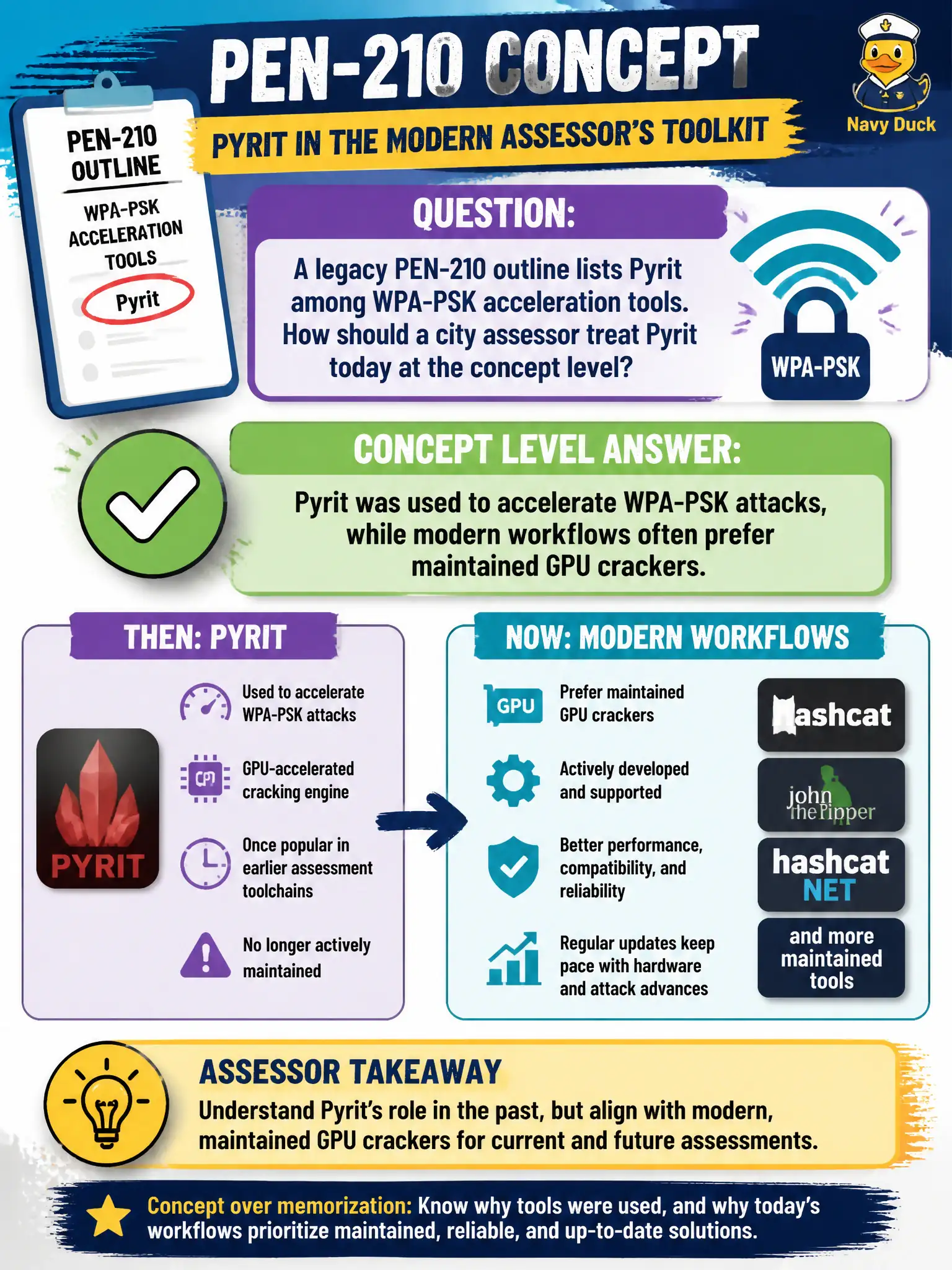
A legacy PEN-210 outline lists Pyrit among WPA-PSK acceleration tools. How should a city assessor treat Pyrit today at the concept level?
Select an answer to reveal the explanation.
Short Explanation
Pyrit is the vintage turbocharger on the old WPA-PSK racecar—great history, less often the daily driver now. It sped up passphrase testing back then; today’s labs usually lean on maintained GPU crackers. Know the class, then pick current tooling.
Full Explanation
Pyrit belongs to the legacy WPA-PSK acceleration class: older wireless curricula used it to speed offline Personal attacks through precomputation and GPU-related workflows. A city assessor should treat it today as historical context—useful for understanding why throughput mattered—while recognizing that modern authorized assessments typically prefer actively maintained GPU hash crackers with current modes and formats. Conceptually, place Pyrit beside coWPAtty-era tooling rather than as the default contemporary path for municipal passphrase recovery. It is not the only OffSec-approved way to recover WPA3-SAE passphrases; SAE is designed to resist the classic capture-then-offline-dictionary path that WPA2-PSK assessments emphasize, and Pyrit is not a mandated SAE oracle. It does not generate PMKIDs by rewriting beacon frames on the municipal channel; PMKID-class material and beacon forgery are separate ideas from Pyrit's historical accelerator role. It does not convert Enterprise PEAP tunnels into open authentication; PEAP/tunnel EAP is an Enterprise surface unrelated to rewriting auth to open via Pyrit. Exam caveat: naming a legacy accelerator on a syllabus is not the same as requiring it operationally or claiming it defeats WPA3-SAE. Operational check: for civic labs, standardize on a maintained cracker workflow, keep Pyrit references as concept literacy, and validate that any hash export still matches the tools the engagement actually runs. Document in municipal runbooks which modern tool replaced historical Pyrit steps so new assessors do not chase unmaintained binaries.