
In a city wireless lab, staff ask what the WPA2-Personal 4-way handshake is meant to prove between the AP and a client. What is the best explanation?
Select an answer to reveal the explanation.
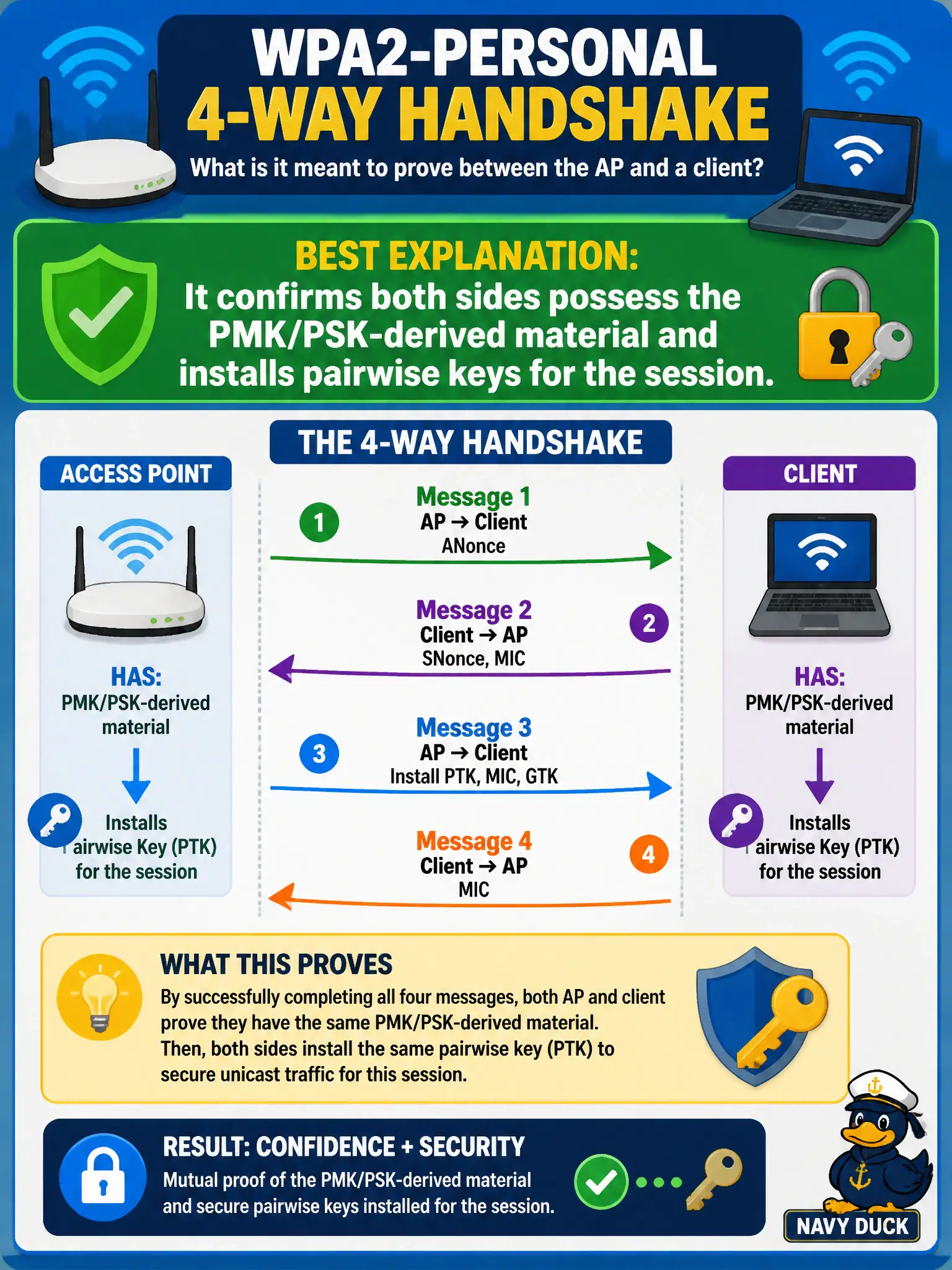
Short Explanation
Think of the 4-way handshake as both sides showing they know the shared secret without yelling the password across the park. Once that checks out, they install the pairwise keys for that session. That is the proof the lab is asking about.
Full Explanation
In a city wireless lab, the WPA2-Personal 4-way handshake’s purpose is to confirm both sides possess the PMK/PSK-derived material and to install pairwise keys for the session. It is a mutual proof and key-installation ceremony, not a billing event, SSID redistribution mechanism, or passphrase publishing channel. Understanding that purpose clarifies why capturing the handshake enables offline verification of passphrase candidates under authorization. Saying it proves the ISP billed the correct account fails by concept: billing is orthogonal to 802.11 key management. Claiming it distributes a new SSID string that replaces the BSSID for future beacons fails by concept: SSID/BSSID identity is not rewritten by the 4-way handshake. Asserting it permanently publishes the passphrase in beacon frames fails by concept: the passphrase is not broadcast in beacons by the handshake design. Exam caveat: a captured handshake proves knowledge verification is possible offline; it does not by itself decrypt all prior traffic without successful key recovery and proper analysis. Operational check: capture a complete 4-way exchange on the lab SSID, explain PMK confirmation and PTK installation in the teaching notes, then demonstrate authorized offline candidate checking against that material.