
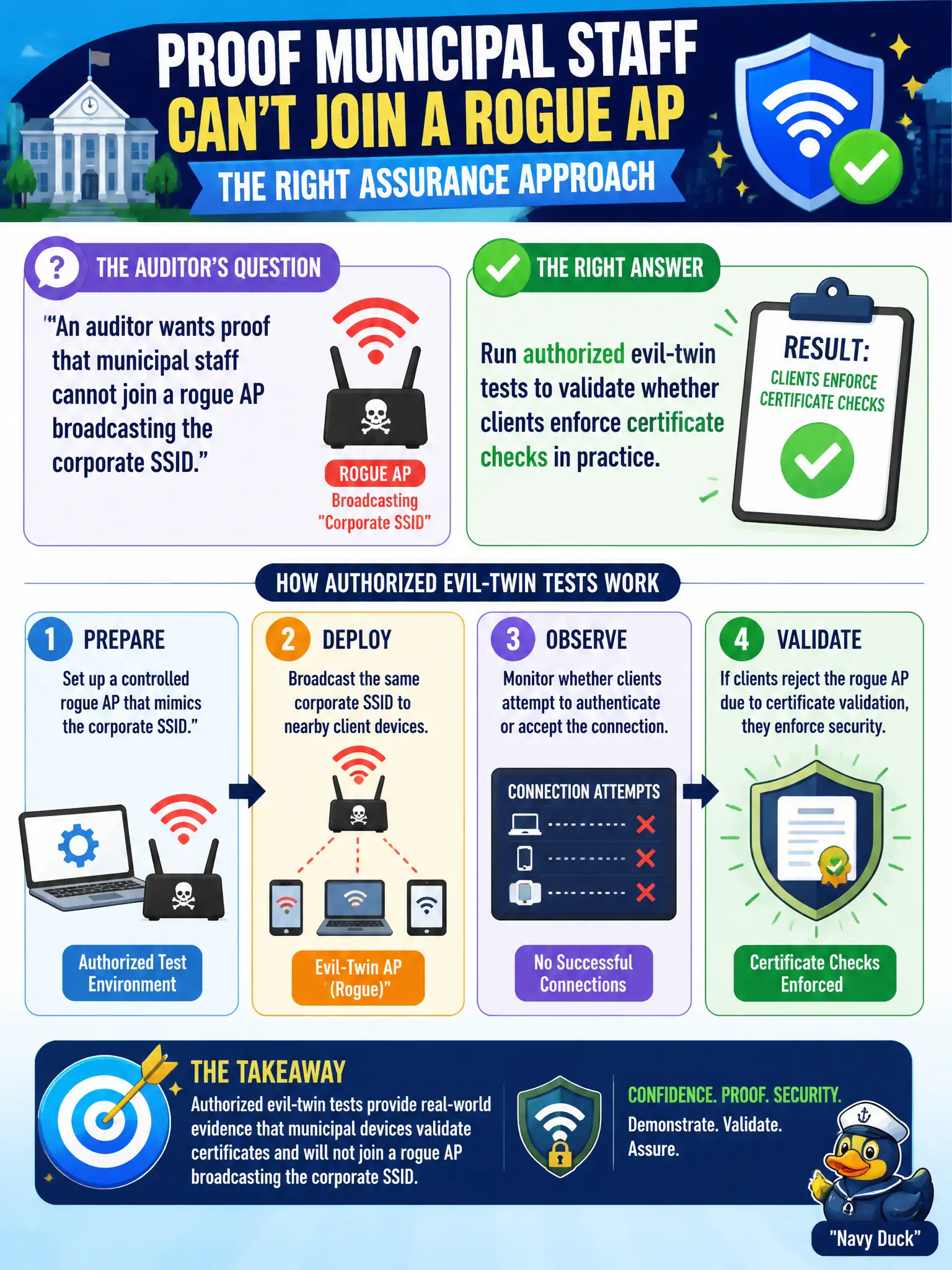
An auditor wants proof that municipal staff cannot join a rogue AP broadcasting the corporate SSID. What assurance approach fits?
Select an answer to reveal the explanation.
Short Explanation
Want proof staff will not wander into a twin? Purple-team it under RoE: authorized evil-twin tests show whether cert checks actually stick. Hiding the SSID is not that proof.
Full Explanation
Proof that municipal staff cannot join a rogue AP broadcasting the corporate SSID comes from assurance testing: run authorized evil-twin tests to validate whether clients enforce certificate checks in practice, supported by configuration evidence. Relying solely on SSID hiding is weak because clients still probe and twins can still advertise familiar names. Disabling RADIUS logging to avoid confusing audit trails removes defensive visibility. Assuming WPA3 logos on APs prevent any client from associating to unauthorized BSSIDs overstates branding as a control. Exam caveat: assurance requires both policy and empirical client behavior under RoE. Operational check: schedule a controlled civic twin window, measure join success or failure across laptop images, remediate profiles that connect, and retain evidence for auditors without exposing production credentials. For municipal and campus engagements, keep the finding language tied to authorized scope, name the building or SSID class affected, and state the residual risk to residents or staff if the rejected option had been chosen. Re-validate after the next change window that the selected control still matches inventory, monitoring, and RoE abort criteria used by the city wireless program.