
FreeRADIUS appears in municipal lab notes for authenticating test clients on an Enterprise SSID. What is its AAA purpose in that design?
Select an answer to reveal the explanation.
Short Explanation
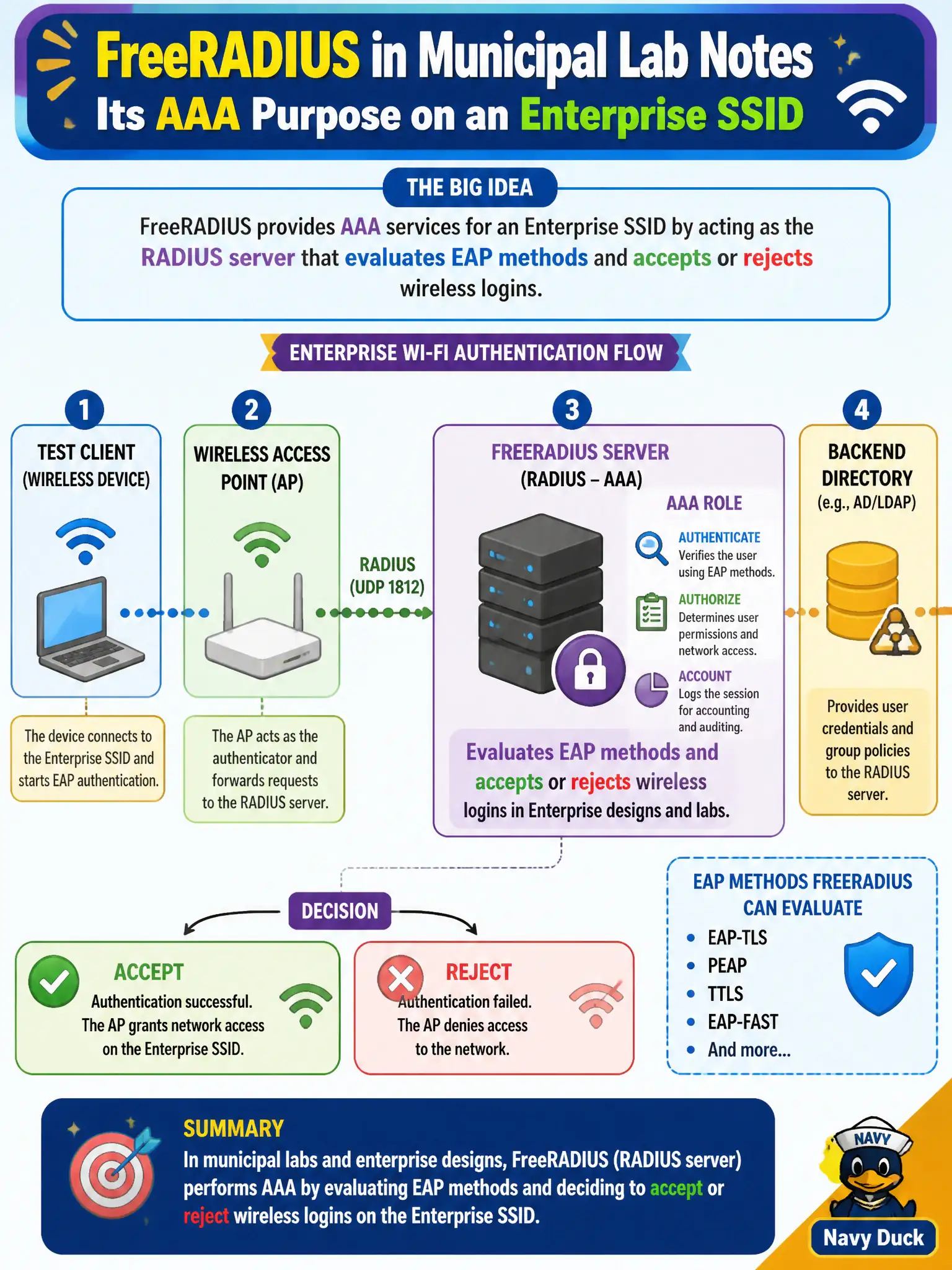
Picture the badge checker at the city WLAN door. FreeRADIUS (or similar) sits behind 802.1X, runs the EAP conversation, and says accept or reject. It does not replace the four-way handshake, act as DHCP alone, or play WPS registrar.
Full Explanation
FreeRADIUS in municipal lab notes serves as the AAA authentication server: it evaluates EAP methods and accepts or rejects wireless logins in Enterprise designs and authorized labs. RADIUS does not replace the four-way handshake or eliminate the need for pairwise transient keys after successful authentication. RADIUS is not merely a DHCP relay that assigns guest VLAN addresses after open association, though authorization attributes may later influence VLAN placement. RADIUS is not a WPS registrar that distributes PIN-based credentials to IoT printers. Exam caveat: lab RADIUS must be isolated and authorized; pointing production municipal authenticators at an assessor's AAA without change control is out of scope. Operational check: document which EAP methods the civic lab RADIUS offers, verify accept and reject paths with a test supplicant, and keep shared secrets and certificates out of public repositories. For municipal and campus engagements, keep the finding language tied to authorized scope, name the building or SSID class affected, and state the residual risk to residents or staff if the rejected option had been chosen. Re-validate after the next change window that the selected control still matches inventory, monitoring, and RoE abort criteria used by the city wireless program.