
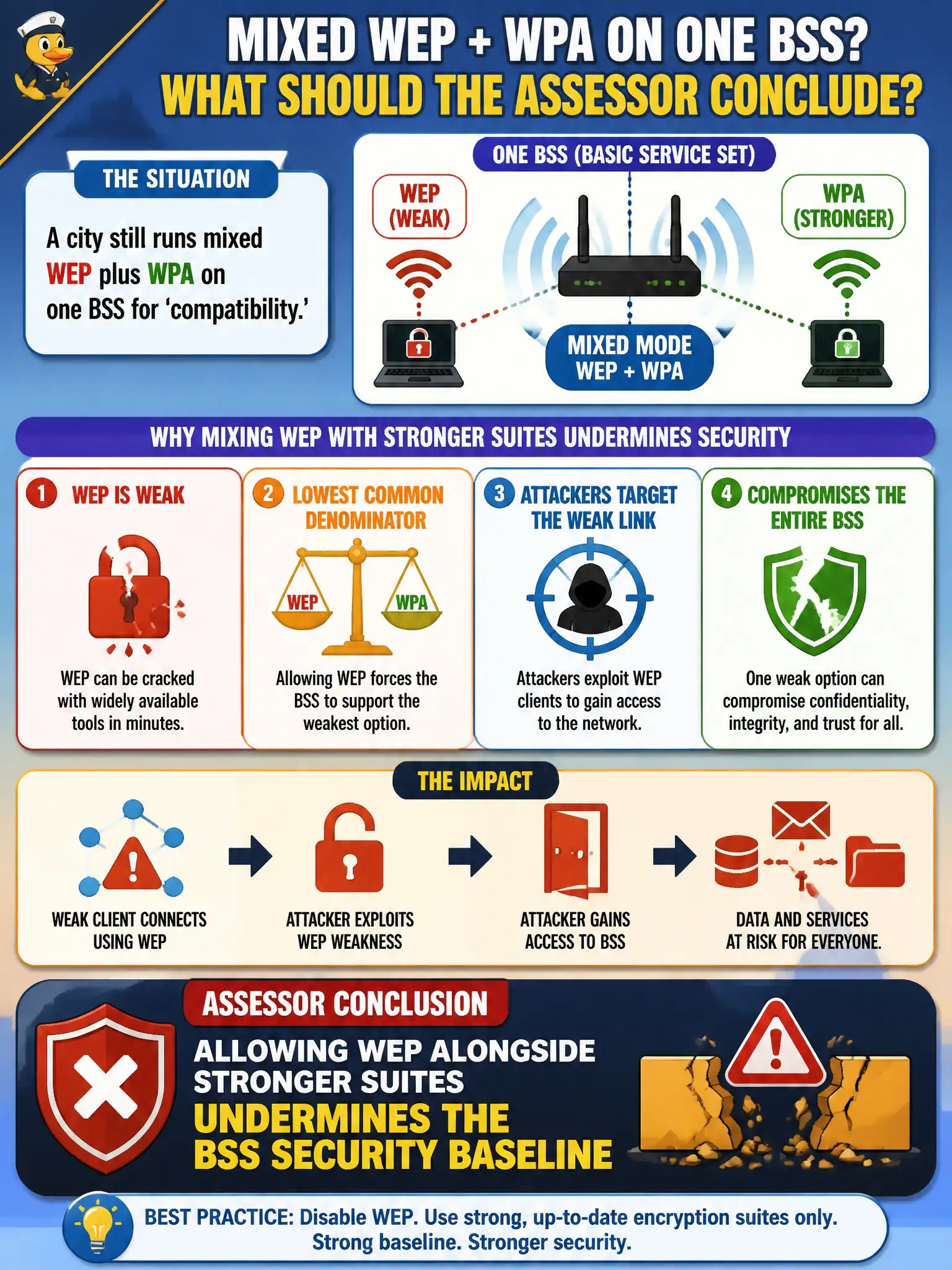
A city still runs mixed WEP plus WPA on one BSS for 'compatibility.' What should the assessor conclude about that baseline?
Select an answer to reveal the explanation.
Short Explanation
Leaving WEP on 'just for the old printer' is leaving the alley door unlocked while bragging about the front deadbolt. Attackers aim at the weak door. Mixed weak modes trash the whole building's security story.
Full Explanation
Allowing WEP alongside stronger suites on one BSS for “compatibility” undermines the security baseline because clients or attack paths can still land on WEP. Mixed WEP plus WPA is not a preferred strongest-frame-by-frame design and does not prove PMF or satisfy WPA3 Transition Mode requirements. Assessors should conclude the coexistence itself is the finding and push retirement of WEP offers. Saying mixed WEP+WPA is preferred because clients automatically pick the strongest frame-by-frame romanticizes negotiation. Claiming WEP coexistence proves PMF is active is unrelated. Asserting WEP-inclusive compatibility modes satisfy WPA3 Transition Mode confuses entirely different transition concepts. Exam caveat: Weakest offered suite often defines practical risk for municipal BSS baselines. Operational check: Inspect beacon suites on the mixed BSS, demonstrate a client or lab path that can still use WEP under RoE, and schedule WEP removal. In civic WLAN stewardship, keep authorization boundaries explicit, prefer the least disruptive technique class allowed by RoE, and record BSSID, channel, band, and security mode beside every conclusion so another assessor can reproduce the observation. In civic WLAN stewardship, keep authorization boundaries explicit, prefer the least disruptive technique class allowed by RoE, and record BSSID, channel, band, and security mode beside every conclusion so another assessor can reproduce the observation.