
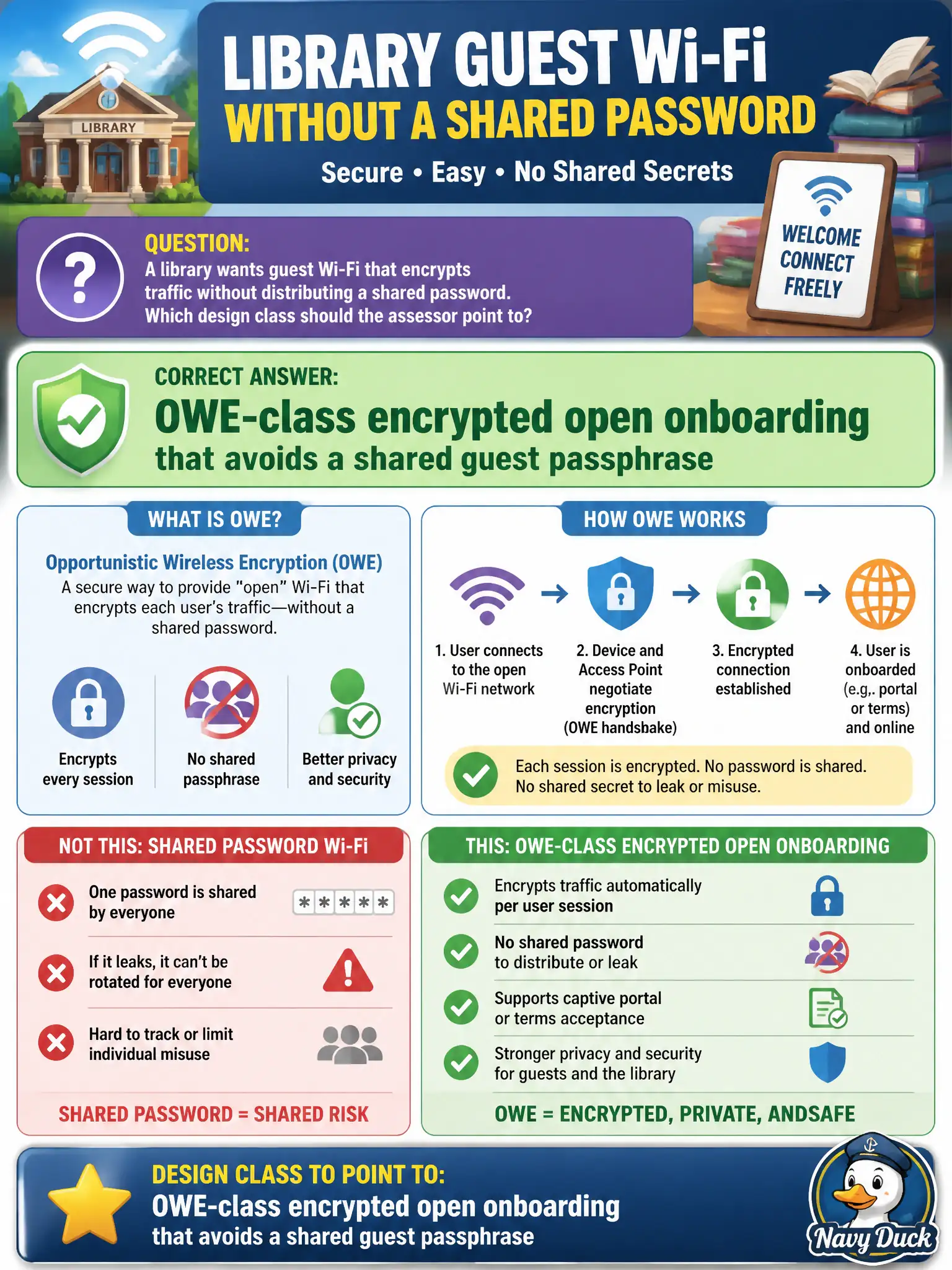
A library wants guest Wi-Fi that encrypts traffic without distributing a shared password. Which design class should the assessor point to?
Select an answer to reveal the explanation.
Short Explanation
Guests hate scavenger hunts for café passwords, but cleartext open Wi-Fi is a postcard. OWE-class 'encrypted open' puts privacy on the air without handing out a shared sticky note. That is the library-friendly middle path.
Full Explanation
Guest Wi-Fi that encrypts traffic without distributing a shared password points to OWE-class “encrypted open” onboarding: clients obtain individualized encryption without a café PSK. Library designers seeking that property should evaluate OWE-capable APs and clients rather than WEP backups, fake Enterprise without RADIUS, or WPS PIN tents. OWE is the awareness-level design class that matches the requirement. Classic open authentication with WEP shared-key backup reintroduces broken crypto. WPA2-Enterprise without RADIUS using only MAC allow-lists is not real Enterprise. Mandatory WPS PIN entry on table tents creates a different weak onboarding problem and is not passphrase-free encryption design. Exam caveat: Confirm client support; otherwise fall back to separate guest PSK with strong entropy or captive-portal plus HTTPS guidance. Operational check: Pilot an OWE SSID in the library lab, verify no PSK prompt and encrypted association for supported clients, and document unsupported device exceptions. In civic WLAN stewardship, keep authorization boundaries explicit, prefer the least disruptive technique class allowed by RoE, and record BSSID, channel, band, and security mode beside every conclusion so another assessor can reproduce the observation.