
A city explores Opportunistic Wireless Encryption (OWE) for an 'enhanced open' guest network. What is OWE's core purpose at awareness depth?
Select an answer to reveal the explanation.
Short Explanation
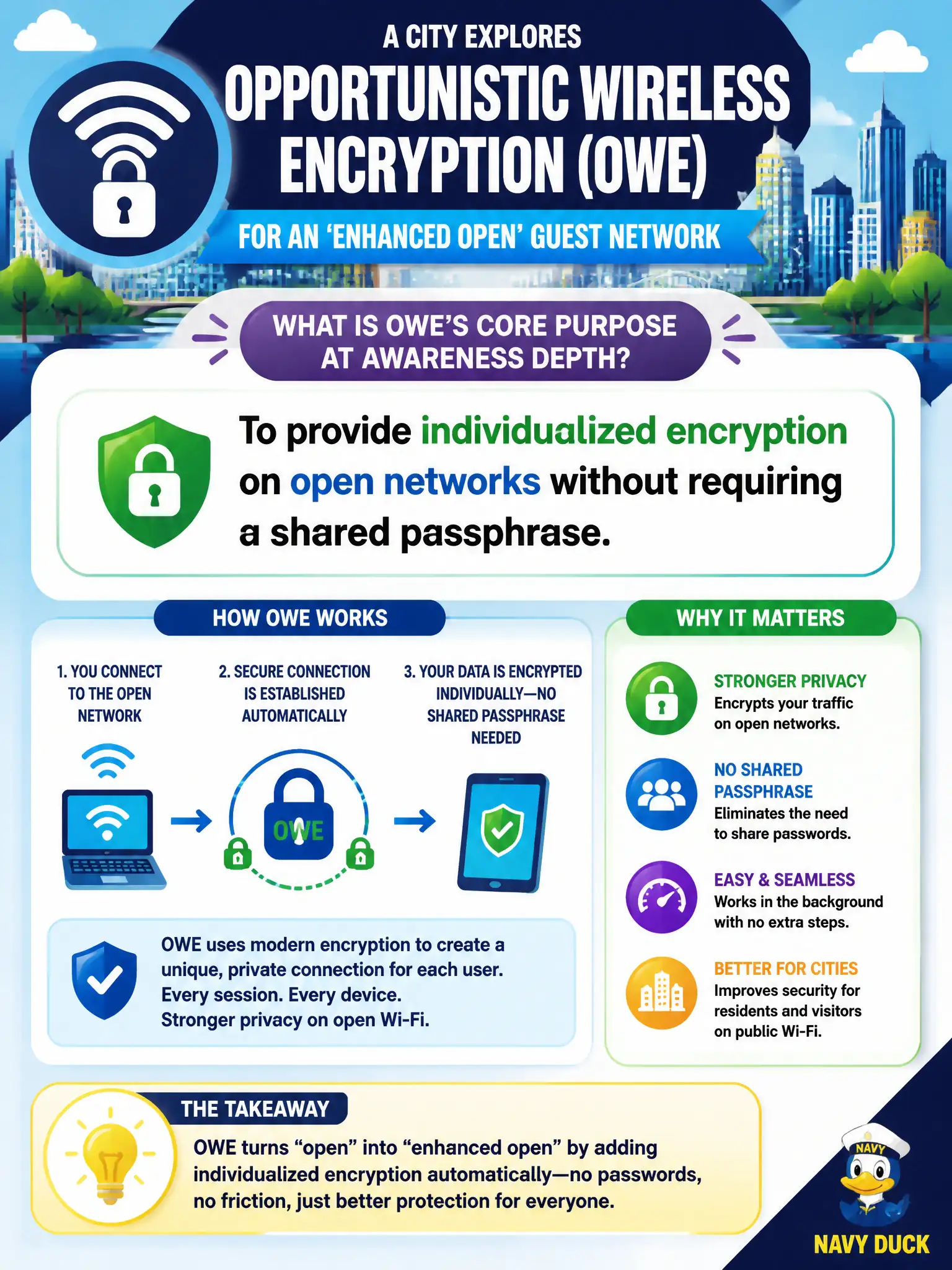
OWE is the 'open cafe with frosted glass' idea — guests still don't type a Wi-Fi password, but the conversation isn't sitting in cleartext for every passerby with a radio. Individualized encryption without a shared passphrase.
Full Explanation
Opportunistic Wireless Encryption (OWE), often discussed as “enhanced open,” aims to provide individualized encryption on networks that remain open in the sense of not requiring a shared passphrase or 802.1X login. City guest designers exploring OWE seek confidentiality against passive sniffers without forcing PSK distribution. It is not a full Enterprise identity system and should be described accurately at awareness depth. Saying OWE replaces all Enterprise 802.1X deployments with one shared guest passphrase misstates both OWE and Enterprise goals. Claiming OWE restores WEP as the recommended public cipher is historically backward. Asserting OWE disables all encryption so captive portals can inspect cleartext invents the opposite of OWE’s purpose. Exam caveat: OWE availability and client support vary; validate before promising “encrypted open” citywide. Operational check: On a pilot enhanced-open SSID, confirm OWE-related AKM in beacons and that a modern client negotiates encryption without a PSK prompt under authorized testing. In civic WLAN stewardship, keep authorization boundaries explicit, prefer the least disruptive technique class allowed by RoE, and record BSSID, channel, band, and security mode beside every conclusion so another assessor can reproduce the observation.