
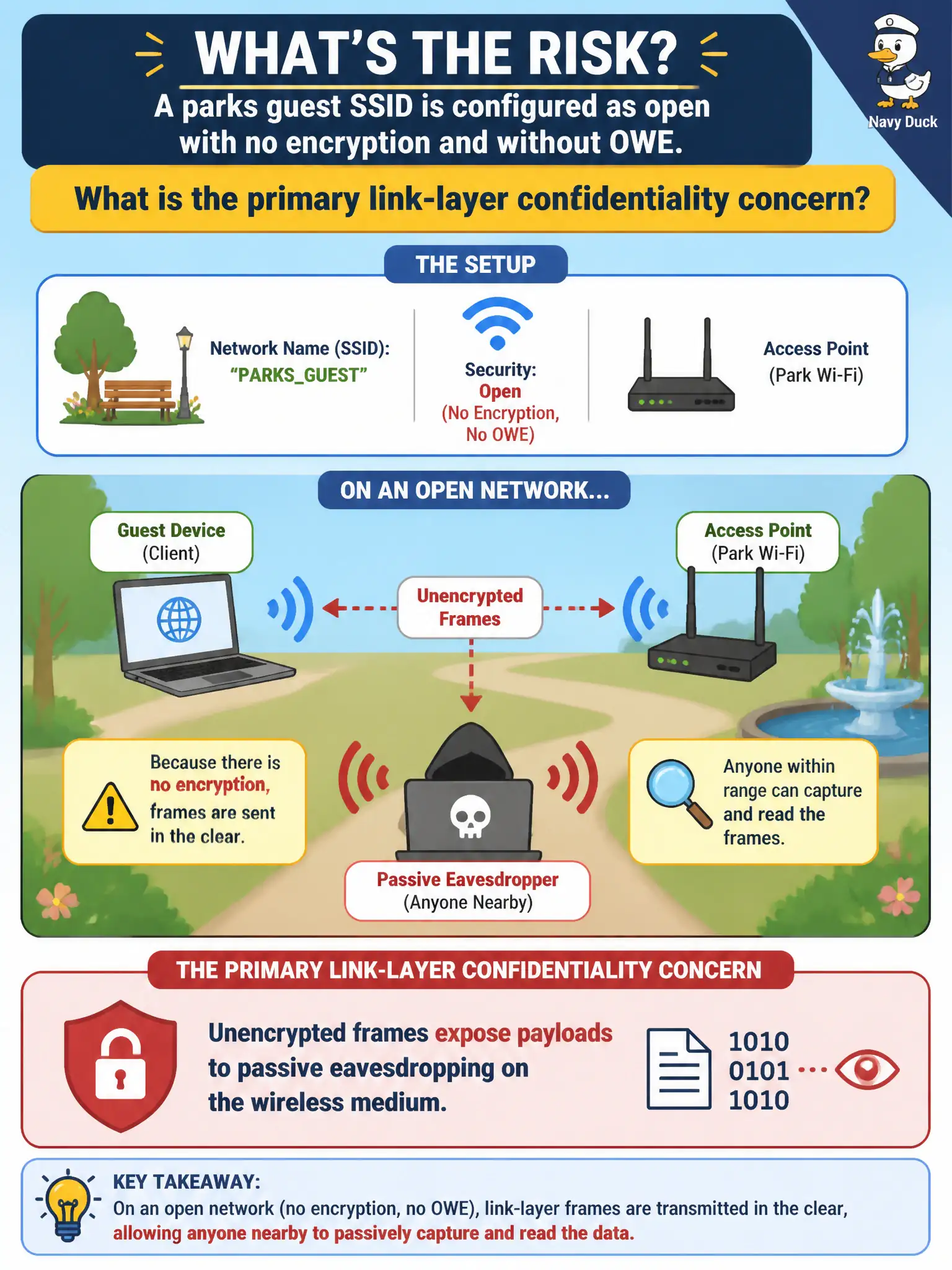
A parks guest SSID is configured as open with no encryption and without OWE. What is the primary link-layer confidentiality concern?
Select an answer to reveal the explanation.
Short Explanation
Open guest Wi-Fi without encryption is like chatting on a park bench with a megaphone — anyone nearby can listen to the words that aren't separately protected higher up the stack. No OWE means no free link-layer privacy blanket.
Full Explanation
An open guest SSID without encryption and without OWE sends data frames without link-layer confidentiality, so passive eavesdroppers on the parks medium can observe payloads that are not otherwise protected by higher-layer TLS. The primary link-layer concern is exactly that exposure. Civic guest designs must either accept the risk with strong HTTPS hygiene messaging, adopt OWE, or move to an encrypted SSID model. Claiming open SSIDs automatically provide AES-CCMP to every client contradicts open mode. Saying open mode encrypts management frames only so data frames are always confidential reverses the usual exposure pattern. Asserting lack of encryption only matters on 2.4 GHz while 5 GHz open SSIDs are confidential by band invents a false band-based crypto guarantee. Exam caveat: HTTPS helps but does not erase metadata leakage or non-TLS apps on open Wi-Fi. Operational check: Verify the parks guest beacon shows no pairwise cipher/OWE, then confirm under RoE that cleartext non-TLS flows are observable from monitor mode before writing the confidentiality finding. In civic WLAN stewardship, keep authorization boundaries explicit, prefer the least disruptive technique class allowed by RoE, and record BSSID, channel, band, and security mode beside every conclusion so another assessor can reproduce the observation.