
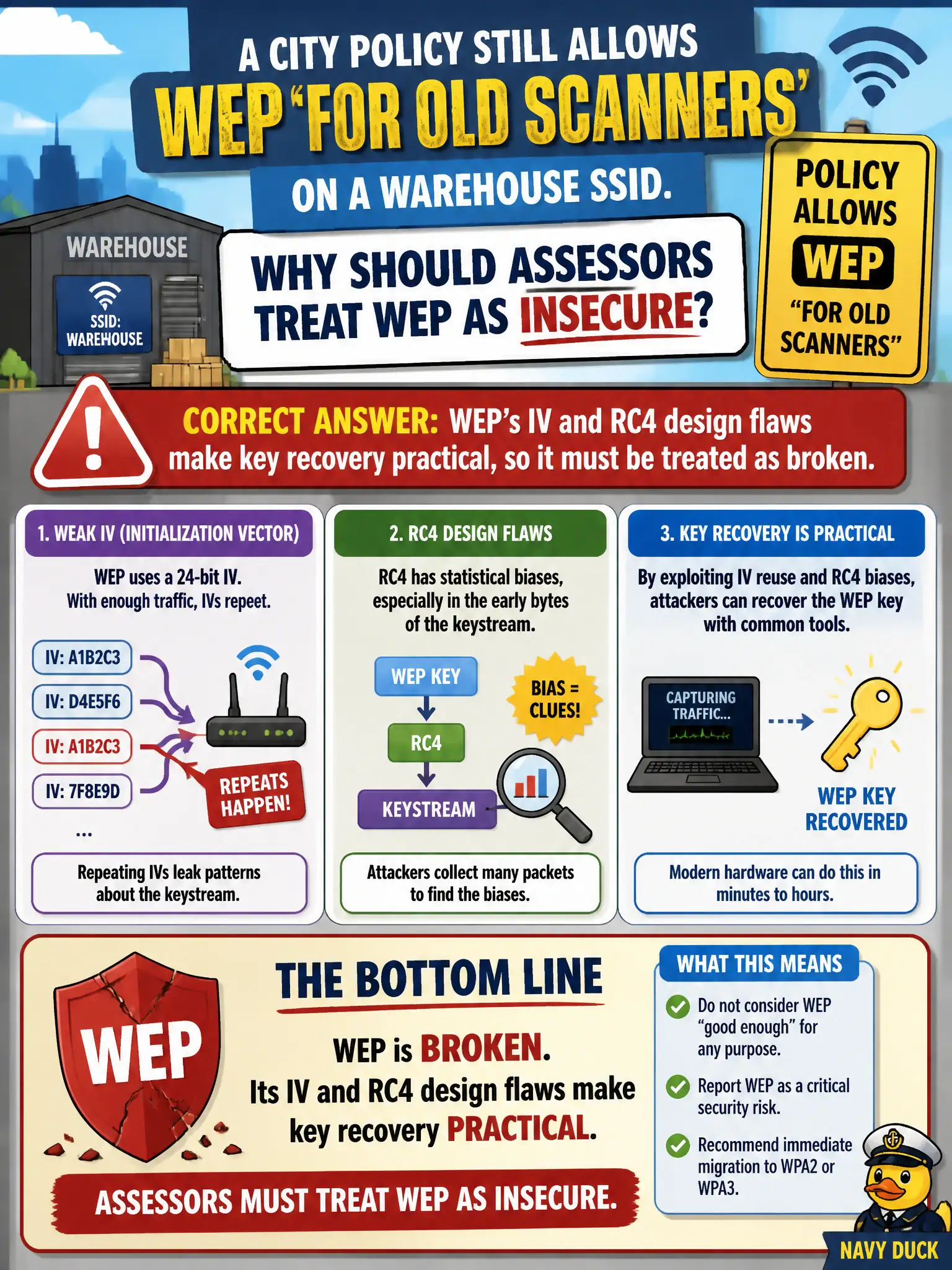
A city policy still allows WEP 'for old scanners' on a warehouse SSID. Why should assessors treat WEP as insecure?
Select an answer to reveal the explanation.
Short Explanation
WEP is the lock everyone learned to pick in training — not because the password was short, but because the lock design itself was flawed. Old scanners don't get a free pass on broken crypto.
Full Explanation
WEP’s initialization-vector handling and RC4-based design have well-known practical key-recovery weaknesses. Assessors must treat any warehouse SSID still allowing WEP “for old scanners” as broken confidentiality, not as a quirky exception that remains safe if the passphrase is long or the SSID is hidden. Civic policy that retains WEP creates an active finding regardless of nostalgia for legacy scanners. Claiming WEP is insecure only when the passphrase is shorter than eight characters understates structural flaws. Saying WEP remains approved if the AP also broadcasts a hidden SSID awards false credit to non-controls. Asserting WEP fails solely because it cannot support 5 GHz confuses band support with cryptographic failure. Exam caveat: OSWP-aligned thinking flags WEP as a classic weak crypto class even when business owners plead compatibility. Operational check: Confirm WEP advertisements in beacons for the warehouse SSID, capture evidence under RoE, and recommend migration to WPA2/WPA3 with a scanner replacement or compensated wired path. In civic WLAN stewardship, keep authorization boundaries explicit, prefer the least disruptive technique class allowed by RoE, and record BSSID, channel, band, and security mode beside every conclusion so another assessor can reproduce the observation.