
An assessor wants to confirm injection support with a non-destructive check before a timed municipal lab. What principle should guide that step?
Select an answer to reveal the explanation.
Short Explanation
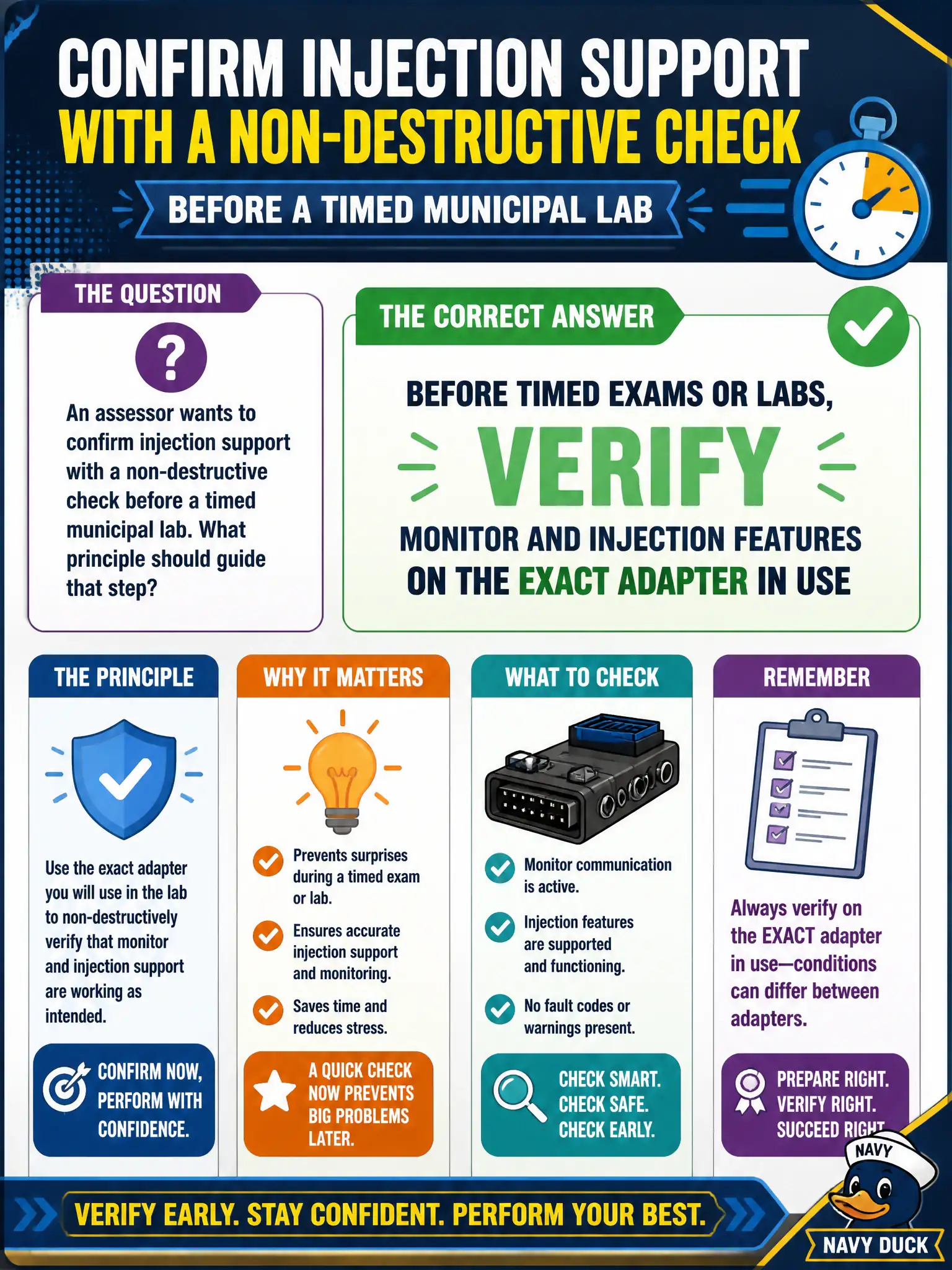
Prove the wrench fits before the clock starts—same idea for monitor and injection on your actual dongle. A quick authorized capability check beats discovering mid-lab that the card cannot inject. Box art is not a test result.
Full Explanation
Before timed municipal labs or exams, assessors should verify monitor and injection features on the exact adapter they will use. Non-destructive capability checks—creating a monitor interface, confirming traffic from a lab AP, and validating injection against an authorized test target—prevent discovering hardware inadequacy after the clock starts. The guiding principle is prove the kit on the engagement image early, under RoE, without relying on assumptions. Skipping capability checks because all USB adapters inject equally under deadline pressure fails by concept: adapters are not equal, and deadlines amplify the cost of unknowns. Assuming injection support from a retail box photo alone fails by concept: packaging art is marketing, not a verified driver/feature matrix. Saying only production client traffic on the live city SSID can prove injection readiness fails by concept: disruptive proofs against production civic SSIDs may violate RoE; lab APs are the right proving ground. Exam caveat: “non-destructive” still means authorized—never inject against out-of-scope BSSIDs just to feel prepared. Operational check: on the assessment host, bring up monitor mode on the assigned dongle, capture a known lab SSID, run an approved injection self-test if allowed, document pass/fail, and only then enter the timed municipal exercise.