
A city asks how to identify a USB Wi-Fi adapter’s chipset when the plastic shell is unlabeled. What approach is most useful?
Select an answer to reveal the explanation.
Short Explanation
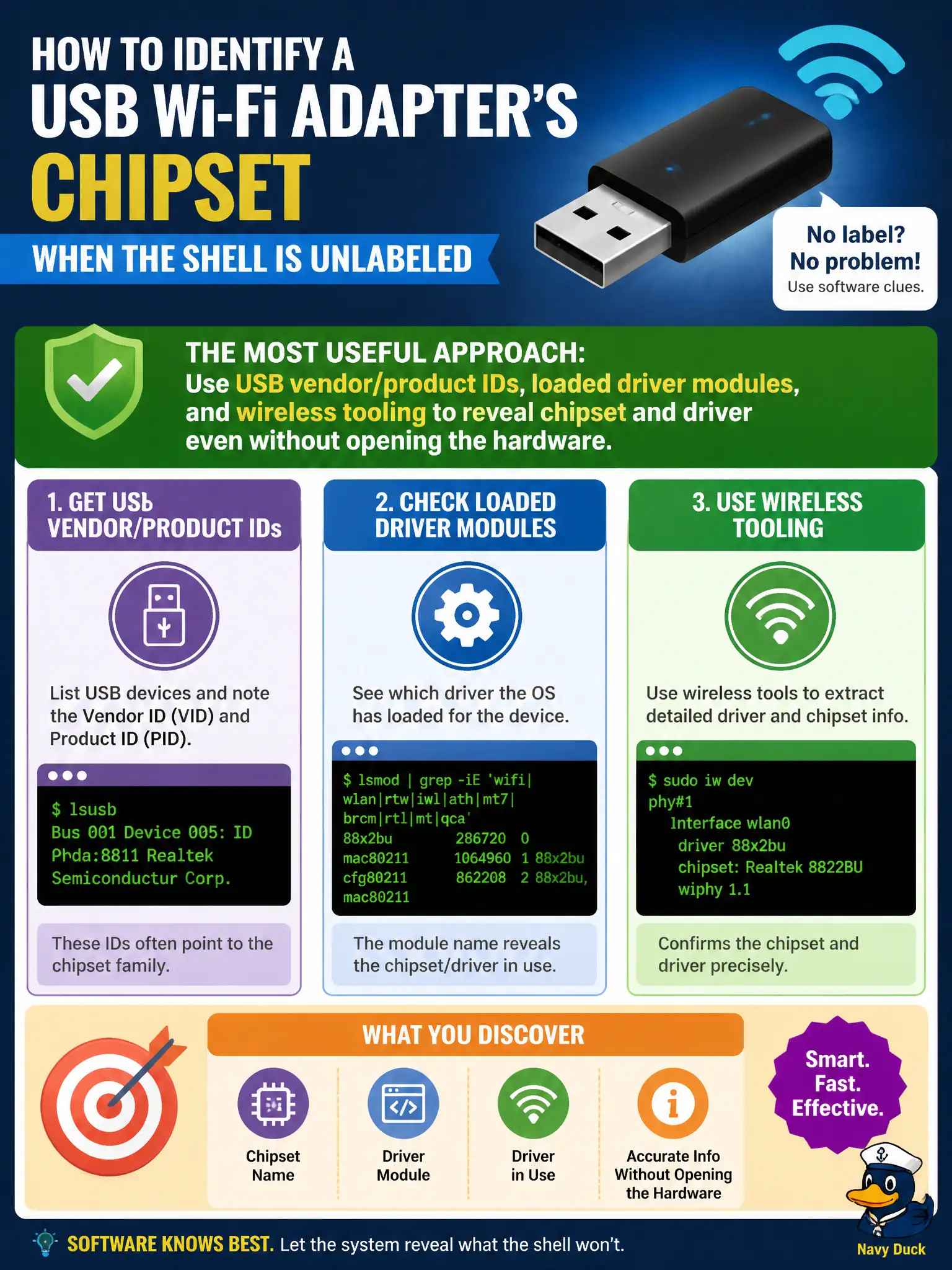
Unlabeled plastic is like a mystery flash drive—look at the USB IDs and which driver grabbed it, not the sticker that isn’t there. Tools and modules usually spill the chipset story without cracking the shell open. Guessing from the laptop’s built-in radio is a dead end.
Full Explanation
When a city assessment kit includes unlabeled USB Wi-Fi dongles, chipset identity still matters because monitor mode, injection, driver stability, and regulatory behavior all depend on the silicon and its Linux driver—not the plastic shell. The practical approach is software enumeration: read USB vendor and product IDs (for example via lsusb), note which kernel modules bind, and cross-check wireless tooling and documentation to identify the chipset and expected capabilities without opening the hardware. That inventory lets civic teams decide whether an adapter belongs in the authorized capture kit or should be quarantined as client-only gear. Assuming every unlabeled dongle matches the laptop’s built-in card fails by concept: internal and USB radios are independent devices with independent chipsets and drivers. Requiring microscope teardown as the only identification method fails by concept: destructive physical inspection is unnecessary when USB IDs and loaded modules already reveal the chipset for assessment planning. Declaring chipset identity irrelevant because all USB adapters support monitor mode equally fails by concept: monitor and injection support vary widely across chipsets and drivers, which is exactly why municipal playbooks inventory hardware before RF work. Exam caveat: VID/PID and driver name identify likely chipset family, but firmware revisions and SoftMAC versus FullMAC behavior can still change what features work—validate capability on the engagement image rather than trusting marketing stickers alone. Operational check: for each city kit dongle, record lsusb IDs, lsmod or driver binding, whether a monitor interface can be created under RoE, and a short note on injection suitability before the adapter is issued for county WLAN assessment use.