
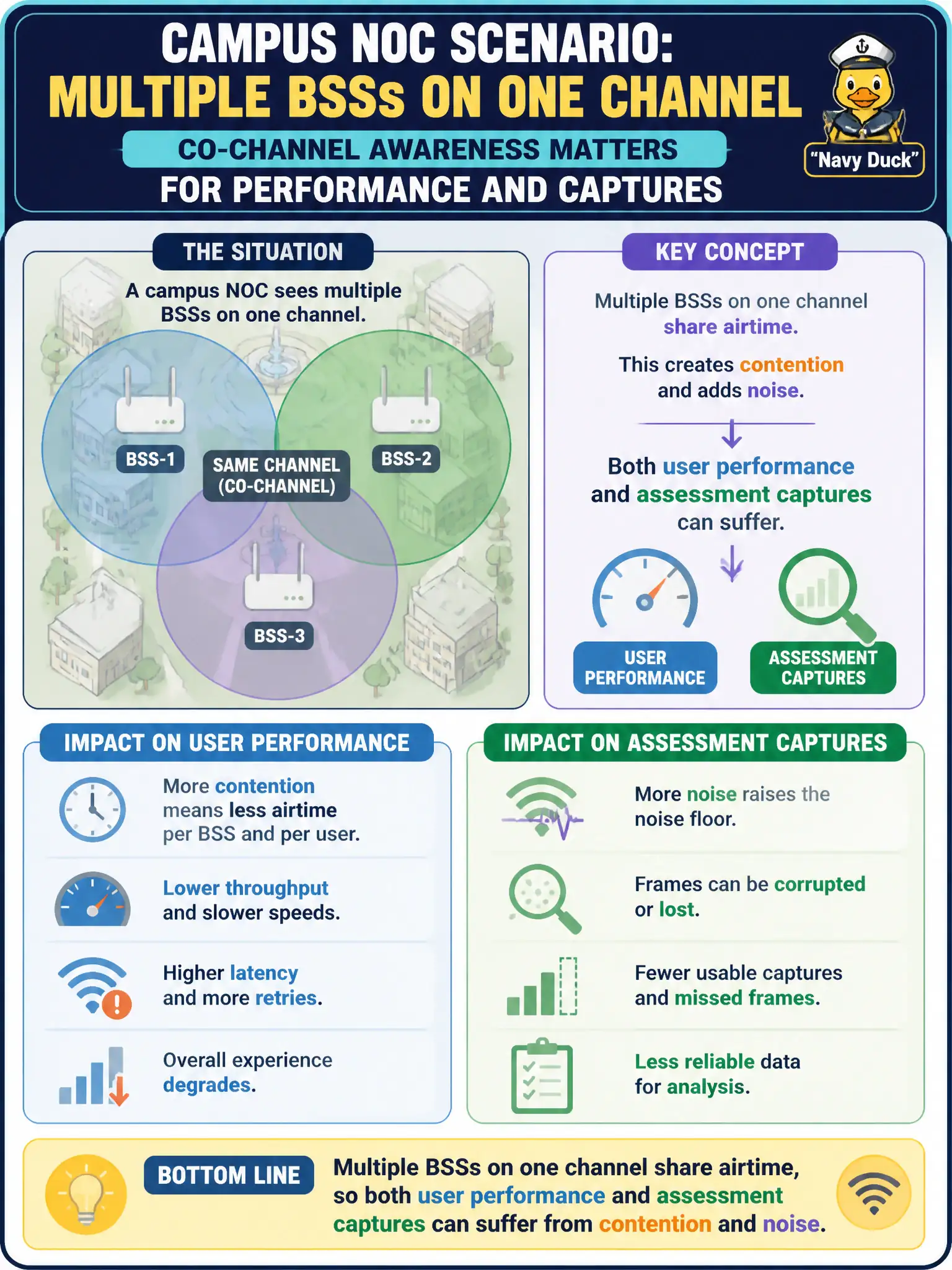
A campus NOC sees multiple overlapping BSSs on one channel. What co-channel awareness matters for performance and captures?
Select an answer to reveal the explanation.
Short Explanation
One microphone, three speakers talking at once—everyone waits their turn and the recording gets messy. Shared channels mean shared airtime and noisier captures.
Full Explanation
When multiple Basic Service Sets share one channel, they contend for the same airtime under CSMA/CA. That co-channel contention can degrade user throughput on a campus WLAN and can also make assessment captures noisier, slower, or incomplete because frames from many BSSIDs interleave on the monitor interface. NOC and assessor awareness should treat co-channel overlap as a shared-medium problem, not as free parallelism that somehow accelerates every network on the channel. Claiming overlapping BSSs multiply airtime so every network gets faster automatically reverses contention physics and produces bad capacity advice. Saying co-channel neighbors never appear in monitor-mode captures by design is false; they often clutter the same channel view. Asserting that one channel can host unlimited BSSs with zero contention because 802.11 isolates airtime magically contradicts real MAC behavior on municipal spectrum. Exam caveat: Prefer cleaner channels when RoE and operations allow; noisy co-channel environments increase handshake wait time and raise the chance of incomplete evidence. Operational check: On the target channel, count distinct BSSIDs and note utilization before capture; if contention is high, record it and schedule work inside timing windows already approved in the rules of engagement.