
Parks imports dense tree instances and stage writes stall. Which approach restores acceptable performance?
Select an answer to reveal the explanation.
Short Explanation
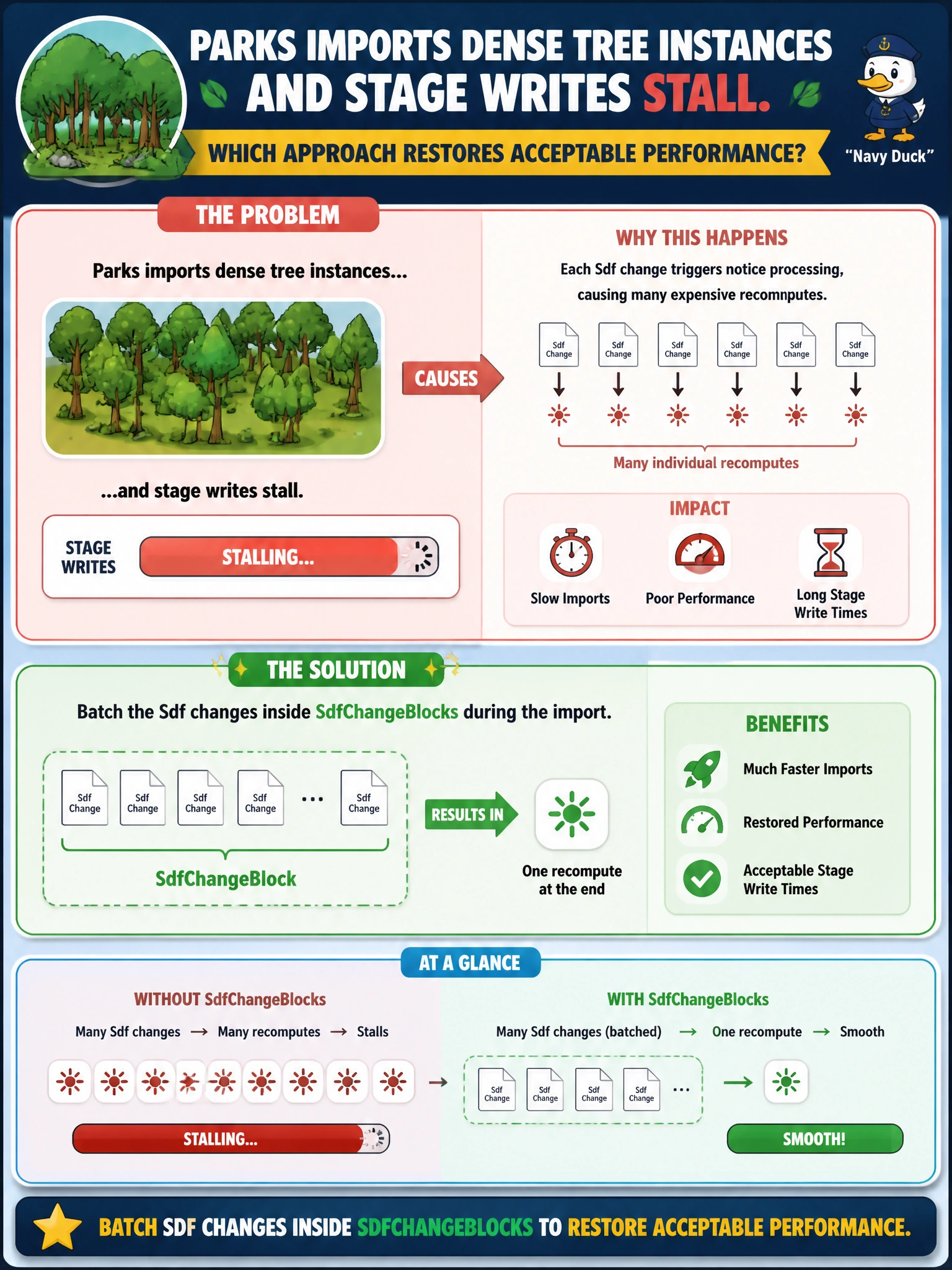
When dense tree imports make stage writes stall, you can restore performance by batching Sdf changes inside SdfChangeBlocks, so change processing is coalesced across many writes. Importing each tree on a separate calendar day only spreads out the schedule, while replacing trees with empty layers or keeping transforms in a temporary text file does not complete the import. Coalesce the Sdf writes during the import.
Full Explanation
When parks imports dense tree instances and stage writes stall, batching the Sdf changes inside SdfChangeBlocks during the import restores acceptable performance by coalescing change processing across many instance and transform writes. Without change blocks, each prim or attribute write can re-enter expensive stage work, slowing interactive or automated imports. Importing each tree on a separate calendar day only spreads the schedule across days; it does not reduce per-write overhead during an import. Converting every tree to a muted empty layer with no geometry may reduce work, but it removes the tree content parks needs. Keeping tree transforms in a temporary text file until stage writing is complete leaves them outside USD, so they cannot populate the stage as imported tree instances. Exam caveat: Instancing, point instancers, and payloads can further reduce forest costs, but SdfChangeBlock is the immediate write-path fix described here; batching changes is not the same as muting layers to hide work. Practical check: Instrument the import, enclose bulk Sdf mutations in SdfChangeBlock, compare import time and notice volume, and validate instance counts and transforms against the parks planting plan before making the blocked import path standard for dense vegetation.