
City batch authoring of thousands of parcel overlays is painfully slow. What technique most directly alleviates that authoring bottleneck?
Select an answer to reveal the explanation.
Short Explanation
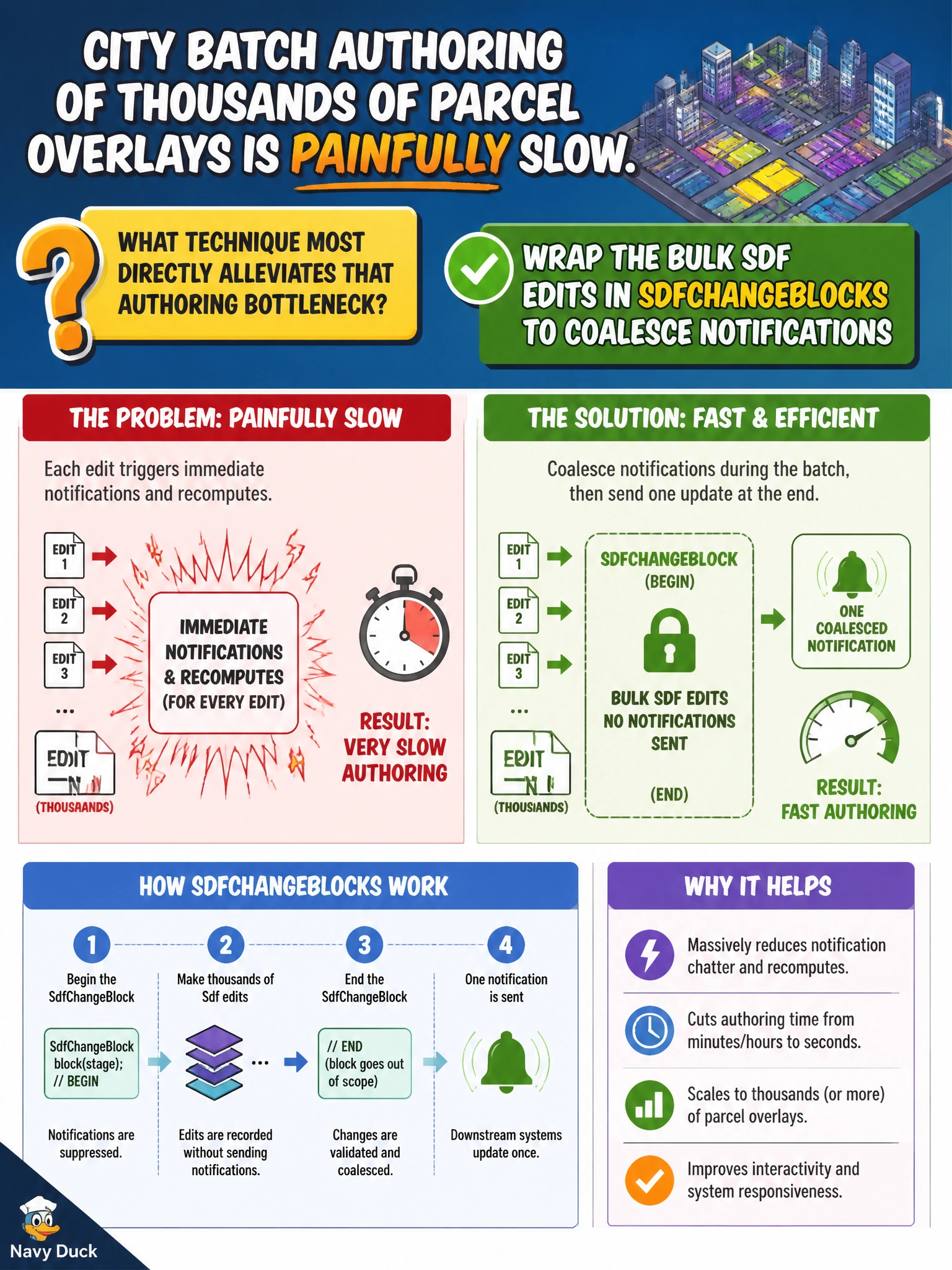
You can speed up thousands of parcel edits by wrapping the bulk Sdf writes in SdfChangeBlocks, which coalesces notifications instead of triggering recomposition work after every write. Extra workstations, deleting the LayerStack, or using screenshot filenames won’t solve that per-edit bottleneck.
Full Explanation
City batch authoring of thousands of parcel overlays can become painfully slow when each Sdf edit triggers immediate change notification and recomposition work. Wrapping the bulk Sdf edits in SdfChangeBlocks coalesces those notifications, allowing the stage to process a batch instead of thrashing after every attribute write. This directly addresses the authoring bottleneck while preserving the composition structure and structured parcel data. Assigning each parcel to a dedicated workstation only relocates the same per-edit cost; it does not coalesce notices on a given stage. Deleting the LayerStack disables composition by destroying the composition model, not by providing a sound performance strategy. Storing parcel attributes as screenshot filenames abandons structured USD data and cannot drive composed overlays. Exam caveat: SdfChangeBlocks improves throughput for many fine-grained edits, but correct, exception-safe scoping still matters; it does not eliminate the need to consider how the authoring work is structured. Practical check: profile the parcel overlay batch with and without SdfChangeBlock around the write loop, confirm that notices are coalesced and wall-clock time improves, and verify that the LayerStack remains intact. Document the pattern for bulk GIS imports so future authoring jobs can use it consistently.