
A referenced transit platform appears tiny in the city twin. What data-modeling mismatch commonly causes that unexpected scale?
Select an answer to reveal the explanation.
Short Explanation
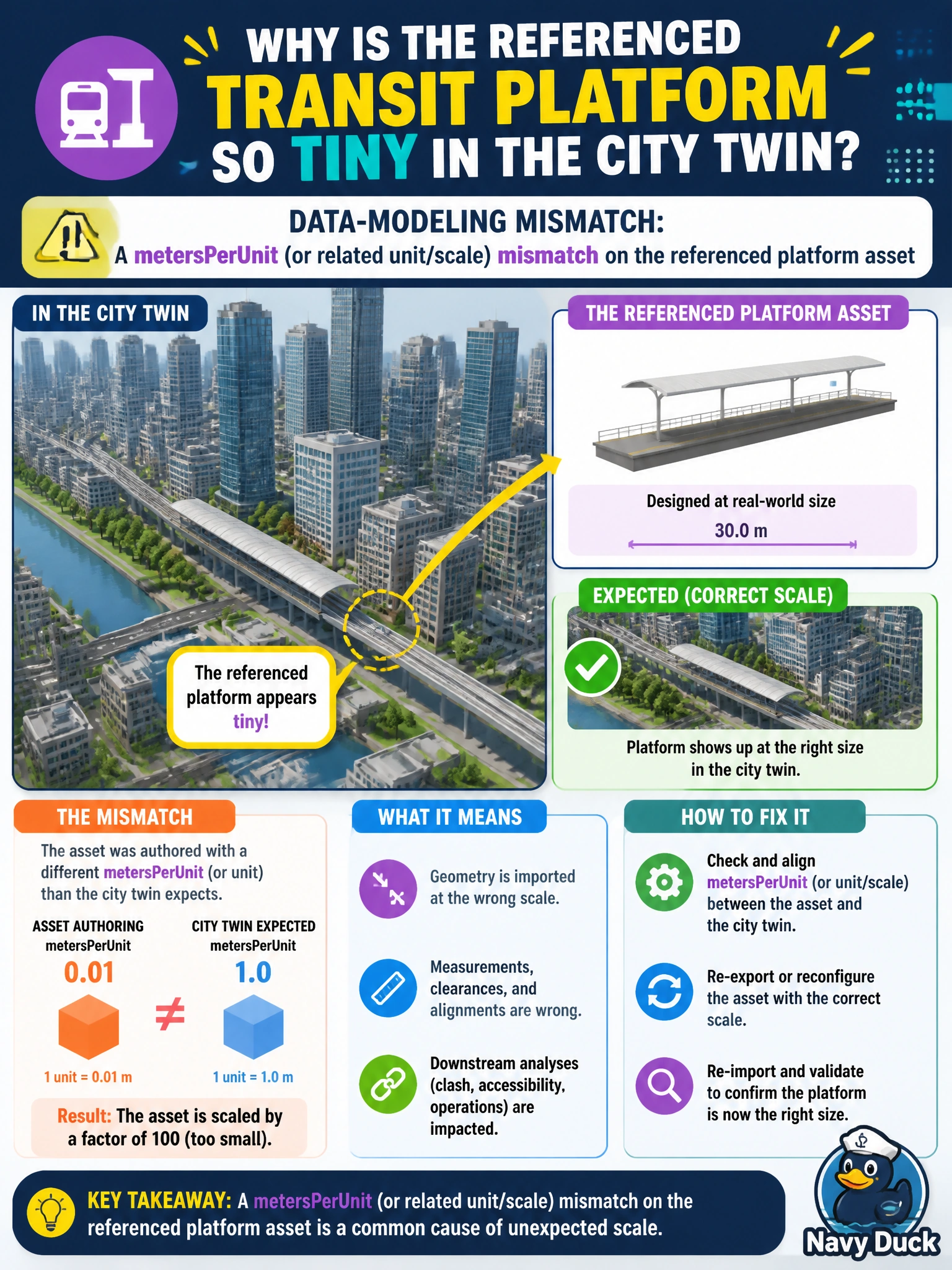
A postage-stamp platform usually means the referenced asset’s units disagree with the city twin—its metersPerUnit or related scale is off. A token string attribute, muted TfDebug categories, or length stored only in customData won’t correct the rendered geometry. Align the platform asset’s unit conventions with the twin.
Full Explanation
When a referenced transit platform appears tiny in the city twin, a common data-modeling cause is a metersPerUnit or related unit/scale mismatch between the platform asset and the municipal stage that consumes it. If the platform was authored assuming centimeters or an unstated scale while the twin expects meters, or vice versa, composed transforms can shrink or enlarge the geometry even though its topology and references are intact. Aligning unit metadata and authored scale on the referenced asset restores correct world size for the platform, clearances, and ADA overlays. Displaying the platform only as a token string attribute supplies a label rather than geometry, so it cannot produce a correctly scaled mesh; tokens do not carry metersPerUnit contracts. Muting TfDebug categories on the GIS workstation changes diagnostic verbosity, not asset scale. Storing platform length exclusively in customData metadata may help people, but customData alone does not drive composed world transforms as stage and asset unit conventions do. Exam caveat: incorrect xformOps or double application of parent scales can also cause scale failures; when units are in question, check metersPerUnit and related conventions first. Do not confuse display-unit preferences in a DCC with authored USD metersPerUnit. Practical check: compare metersPerUnit and related scale metadata on the platform package and city stage, load a known-length curb or platform strip as a measuring stick, then correct the asset or insert an explicit scale xform before publishing the transit reference into the twin.