
Housing authority twin must tag each apartment shell mesh with a stable unit ID for selection tools. Which primvar choice is appropriate?
Select an answer to reveal the explanation.
Short Explanation
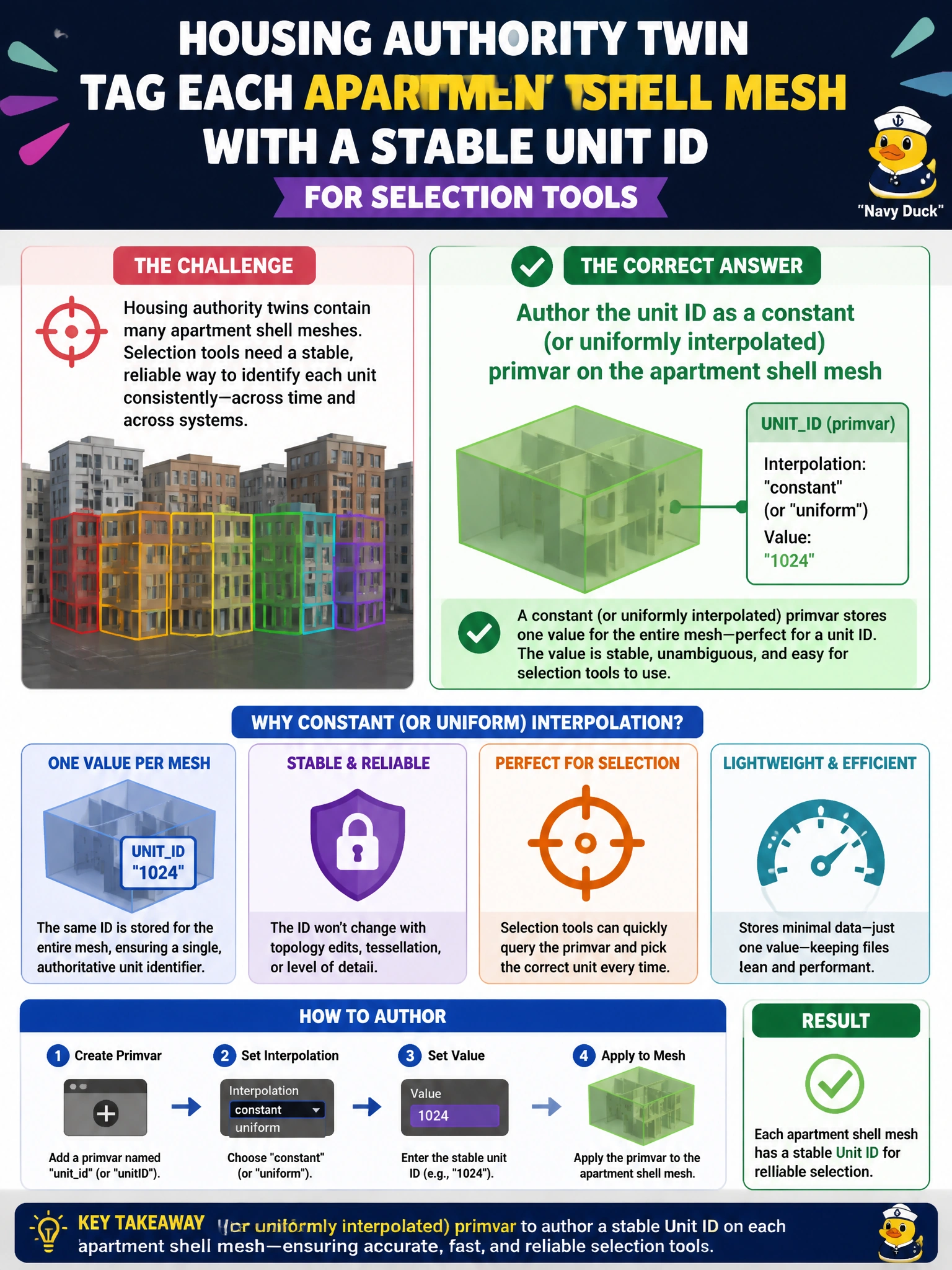
Give each apartment shell a constant primvar so your selection tools can read one clear unit ID from the mesh. Winding order, filenames, and displayOpacity are poor places to hide identity; keep the tag on the shell as a primvar.
Full Explanation
Housing-authority selection tools need a stable unit ID on each apartment shell mesh. Authoring the ID as a constant (or uniformly interpolated) primvar puts one clear, typed tag on the shell for tools to query through standard USD property APIs. This interpolation suits an identifier that does not vary across the mesh, and keeps identity available to selection and inventory scripts without decoding topology or packaging details. Baking the ID into triangle winding order is opaque, fragile under remeshing, and unavailable through normal property queries. Hiding it inside anonymous payload filenames couples identity to packaging paths that can change when assets are moved, and does not expose a prim property for tools. Overwriting displayOpacity with the unit number corrupts shading, may fail for non-numeric IDs, and conflates visualization with identity. Exam caveat: a unit ID identifies the whole shell, so it should not vary by face or vertex; constant or uniform interpolation is appropriate. Practical check: author unit-ID primvars on several shells, use the selection tool to highlight them by ID, then rename or re-reference the asset package and confirm the IDs still resolve from the primvars. Reject any workflow that must decode winding order or filenames to recover identity.