
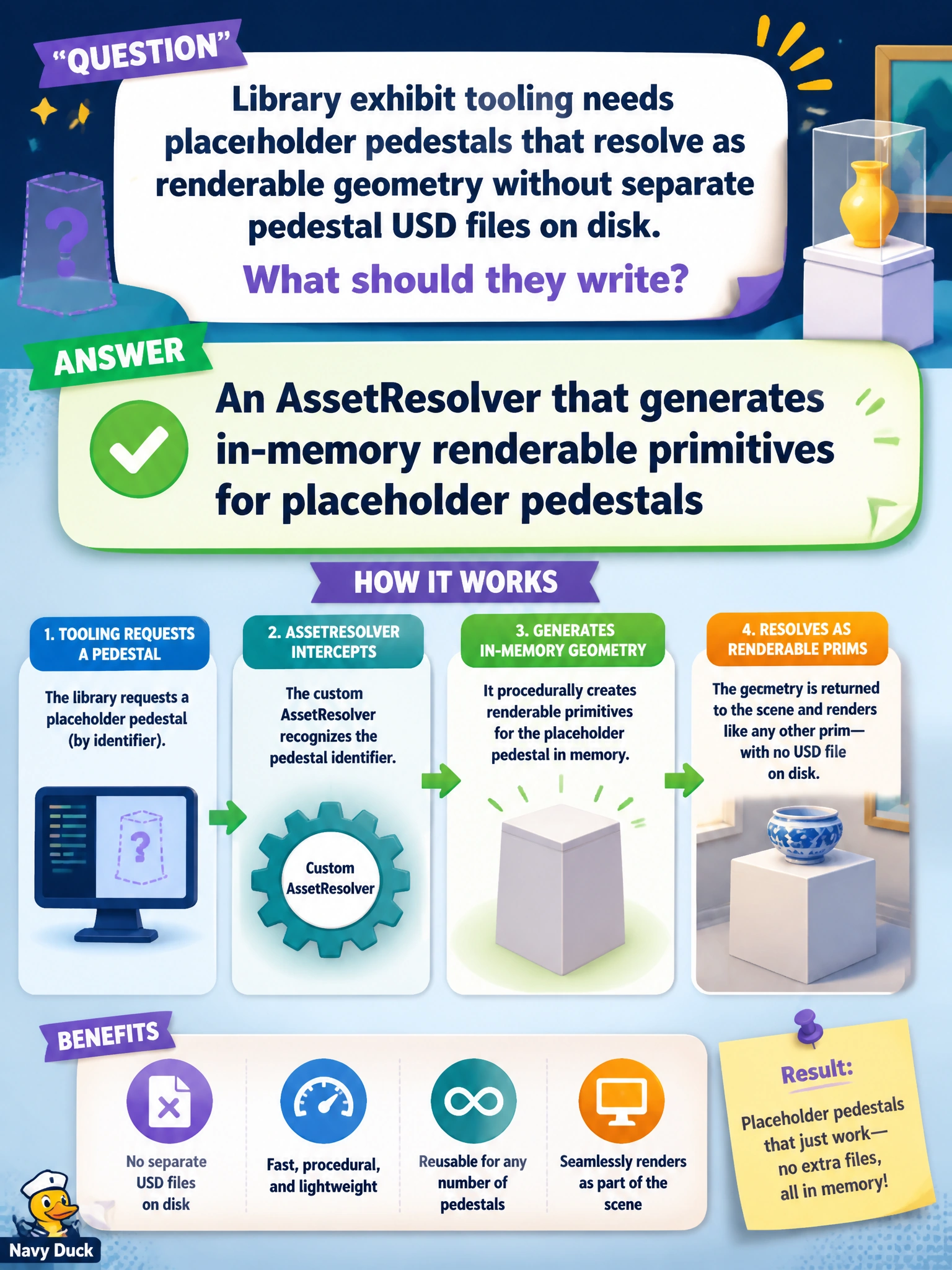
Library exhibit tooling needs placeholder pedestals that resolve as renderable geometry without separate pedestal USD files on disk. What should they write?
Select an answer to reveal the explanation.
Short Explanation
Placeholder pedestals are like foam stand-ins—you want them to show up without a warehouse of pedestal files. An AssetResolver that spins up in-memory primitives does exactly that.
Full Explanation
Library exhibit tooling often needs placeholder pedestals that look real in Hydra or other consumers without maintaining a separate pedestal USD file for every stand-in. An AssetResolver that generates in-memory renderable primitives for those placeholder identifiers resolves asset paths to synthetic geometry at open time. Curators see pedestals in context while disk stays free of hundreds of nearly identical pedestal stages.
Inventing a ninth LIVERPS strength letter is not a supported composition mechanism and does not create pedestal geometry. Hard-coded absolute paths to empty folders named pedestal will fail resolution or resolve to nothing useful when machines or CI runners lack those folders. A muted sublayer that only contains displayColor opinions cannot invent mesh topology; color overrides do not substitute for resolved, renderable pedestal primitives.
Exam caveat: In-memory resolver assets must still present stable identifiers and extents so layout tools and accessibility previews measure placement consistently; synthetic does not mean untyped chaos.
Operational check: Open an exhibit stage that references placeholder pedestal assets, confirm the AssetResolver supplies in-memory primitives that render, verify no pedestal USDA/USDC files are required on disk, and confirm swapping a placeholder ID for a real pedestal asset path loads the authored asset without pipeline changes.