
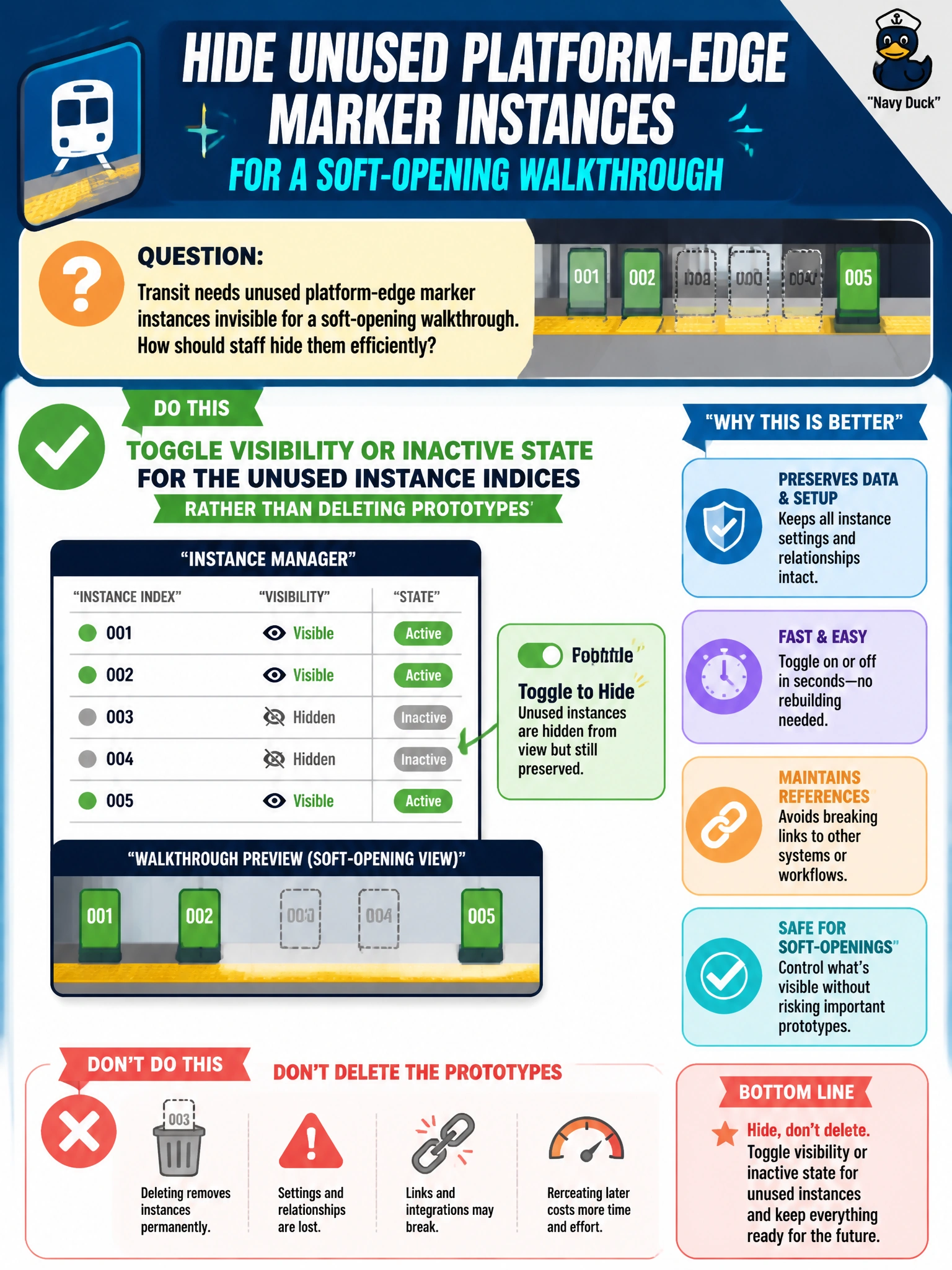
Transit needs unused platform-edge marker instances invisible for a soft-opening walkthrough. How should staff hide them efficiently?
Select an answer to reveal the explanation.
Short Explanation
Think of unused markers like seats with the tray table up—still part of the plane, just not in use. Hide those instance indices; do not scrap the prototype fleet.
Full Explanation
For a soft-opening walkthrough, transit often needs unused platform-edge marker instances invisible without discarding the marker system used in full revenue service. Staff should toggle visibility or inactive state for the unused instance indices rather than deleting prototypes. That keeps the pointInstancer (or equivalent instance population) structurally intact, preserves the marker prototype for stations that still need it, and makes the soft-opening configuration a reversible layer opinion instead of a destructive library edit.
Erasing marker prototypes from the asset library so no station can show them is an agency-wide content outage. It fails soft-opening intent (temporary hide) and damages every twin that still requires those markers. Converting markers to sublayers and muting the entire LayerStack is the wrong granularity: muting the stack can hide far more than unused markers and breaks composition debugging for the station package. Replacing the pointInstancer with one unique mesh per marker coordinate unique-ifies what should remain a compact instance cloud, increasing memory and edit cost for a temporary walkthrough.
Exam caveat: visibility/inactive masks are per-instance population controls; they are not the same as muting composition arcs or deleting prototypes. If your USD version/API uses invisibleIds, inactiveIds, or a pipeline schema for masks, the concept under test is selective instance suppression—not asset deletion.
Operational check: hide the unused indices, scrub the soft-opening camera path, confirm markers that must remain are still visible, reload the stage without the walkthrough layer and verify full marker population returns, and confirm the prototype asset path still resolves in the library.