
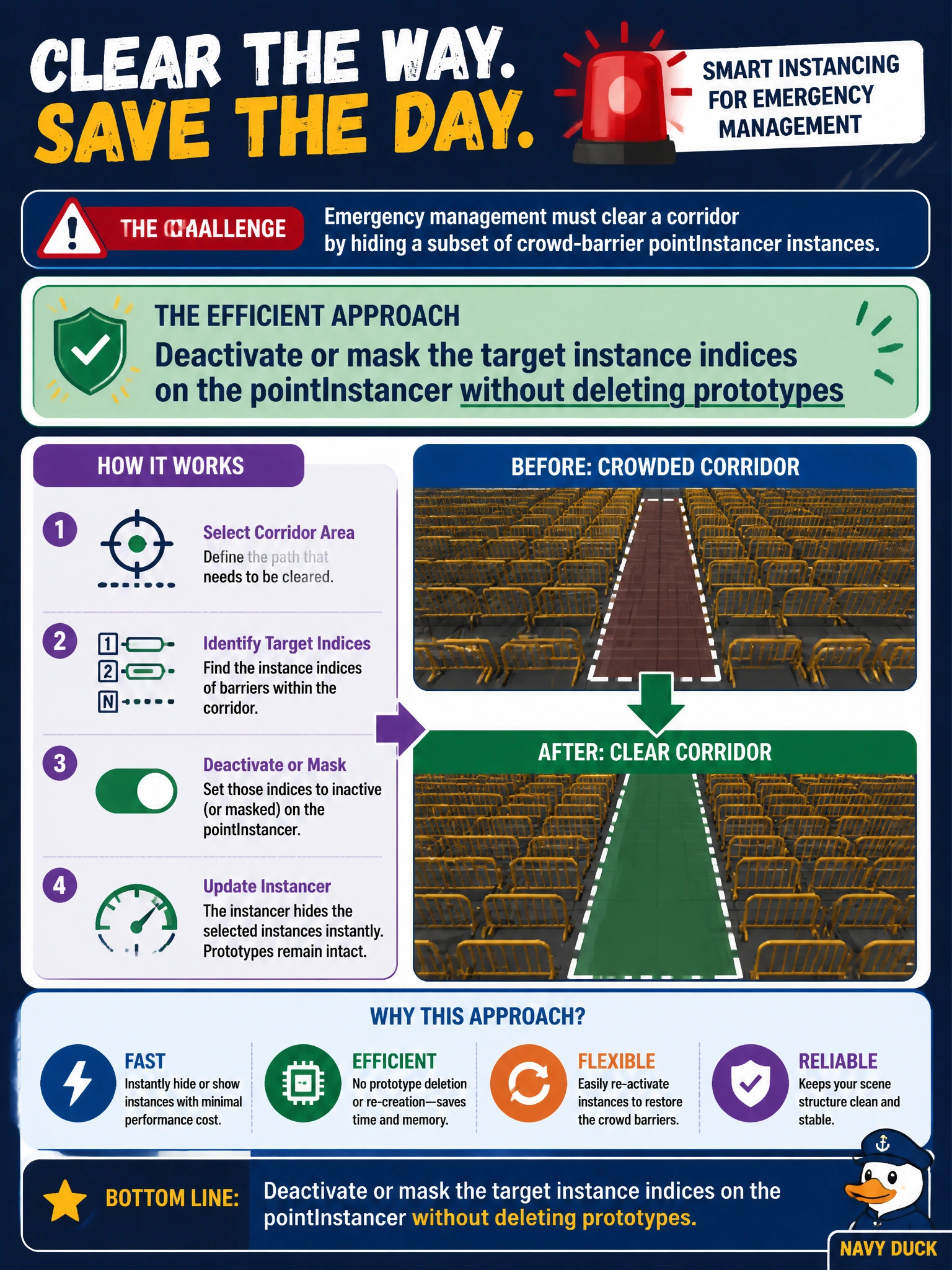
Emergency management must clear a corridor by hiding a subset of crowd-barrier pointInstancer instances. What is an efficient approach?
Select an answer to reveal the explanation.
Short Explanation
You can clear the corridor without disturbing the shared barrier asset: mask only the target instance indices and leave the prototype intact. That makes it easy to restore the barriers when the drill is over.
Full Explanation
Emergency-management corridor drills may require hiding selected crowd-barrier pointInstancer instances so responders can visualize a cleared path. Deactivating or masking the target instance indices is efficient because PointInstancers support large repeated populations, and per-index inactive or visibility masks (pipeline-dependent but conceptually standard) suppress selected barriers while keeping the prototype mesh and remaining instances valid. You can restore the barriers by clearing the mask, reusing the same city twin for after-action review. Temporarily removing the prototype asset from disk is an asset-library outage masquerading as a visibility edit: it breaks every consumer of that prototype, including non-drill scenes. Rebuilding the city root with each barrier as a unique referenced asset defeats the pointInstancer’s purpose—compact transforms, shared prototypes, and fast population edits. Flattening point positions into a single mesh and hiding faces by material is a brittle geometry hack that loses instance identity, complicates selective restoration, and couples emergency routing to mesh surgery. Exam caveat: distinguish masking or deactivating specific instance indices from deactivating the entire pointInstancer prim, and distinguish instance masking from deleting a shared prototype. Practical check: confirm the selected barriers no longer obstruct the corridor, remaining barriers still draw from the shared prototype, the prototype file still exists and resolves, and toggling the drill overlay restores the full barrier field for normal operations.