
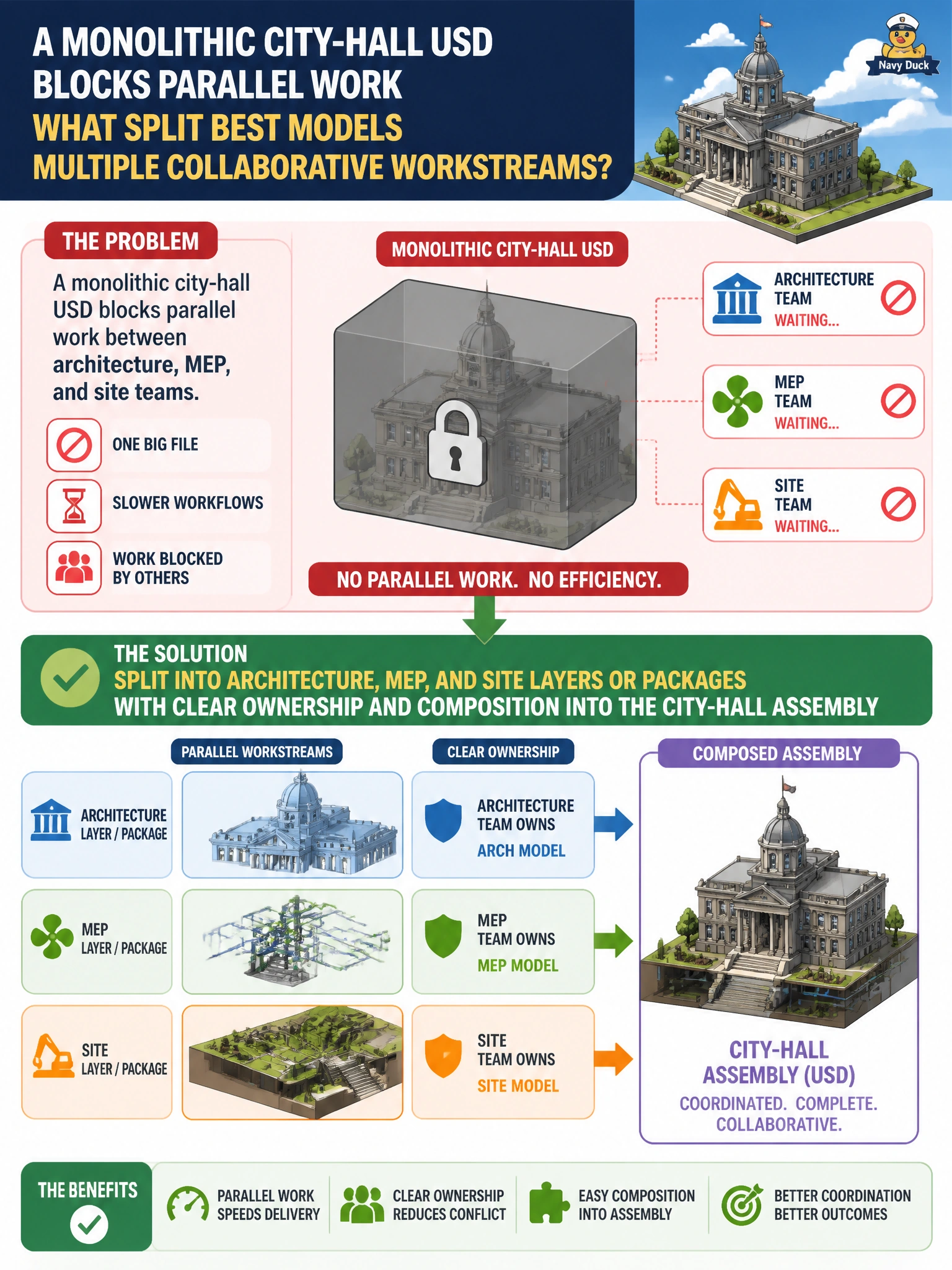
A monolithic city-hall USD blocks parallel work between architecture, MEP, and site teams. What split best models multiple collaborative workstreams?
Select an answer to reveal the explanation.
Short Explanation
One giant city-hall file is like one whiteboard three departments keep erasing. Split architecture, MEP, and site into owned layers or packages that compose back together. Parallel workstreams need separate desks, not a shared eraser.
Full Explanation
A monolithic city-hall USD serializes collaboration and raises conflict risk among architecture, MEP, and site teams. The best split models multiple workstreams as discipline-owned layers or packages that compose into the city-hall assembly with clear ownership. Parallel authorship becomes possible because each department writes to its own content boundary while the assembly LayerStack or references reintegrate the building twin.
Keeping one file and rotating exclusive checkout weekly preserves the bottleneck. Merging all departments into a single flattened anonymous prim nightly destroys modular history and ownership. Storing MEP only as screenshots referenced by URL metadata abandons composed, actionable USD content for coordination.
Exam caveat: splitting without a defined assembly contract creates drift—name ownership, defaultPrim/entry assembly, and interface prims explicitly. Operational check: create architecture, MEP, and site packages; compose them into the city-hall root; have two departments edit concurrently; verify merges do not require weekly exclusive locks and that the composed hall still resolves. If conflicts cluster in one file, ownership boundaries are still wrong—tighten package scopes before adding more process.