
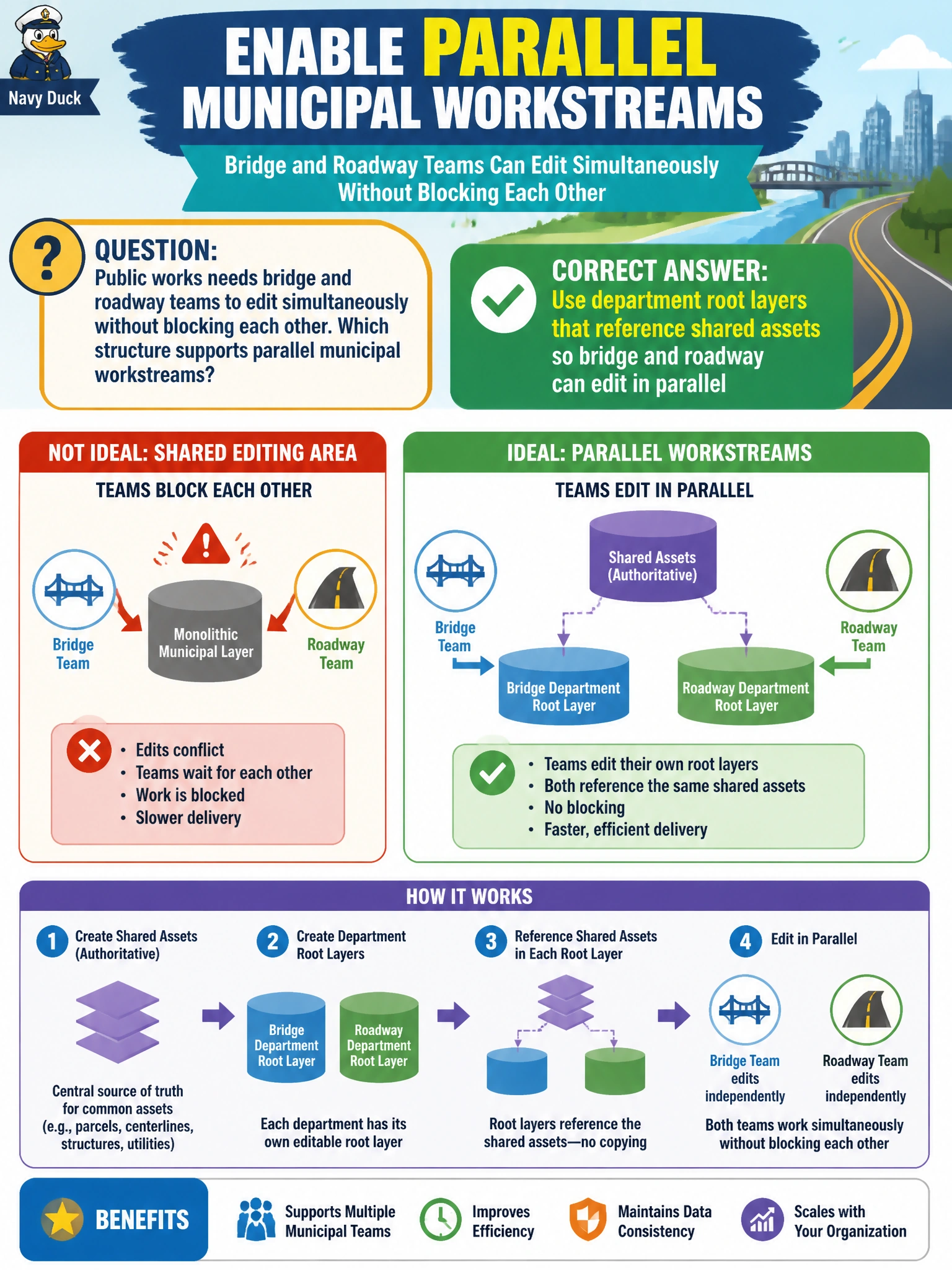
Public works needs bridge and roadway teams to edit simultaneously without blocking each other. Which structure supports parallel municipal workstreams?
Select an answer to reveal the explanation.
Short Explanation
Two crews, two drafting boards, one shared parts catalog—department layers plus shared references. One locked root turns parallel work into a queue.
Full Explanation
Parallel municipal workstreams need separate department roots over shared assets. Public works needing bridge and roadway teams to edit simultaneously without blocking each other should use department root layers that reference shared assets so bridge and roadway can edit in parallel. Each team authors in its own root/layer context while referencing common catalogs, enabling concurrent progress without a single-writer bottleneck.
Serializing all edits onto one locked root layer with a single nightly writer fails by concept: it forces a queue and blocks parallel civic delivery. Requiring both teams to edit only inside a single pointInstancer prototype fails because a prototype is for instance reuse, not a multi-team collaboration boundary, and serializes unrelated bridge/roadway authorship into the wrong structure. Disabling composition arcs and pasting USDA text into chat for merges fails because ad-hoc text pastes abandon composition tooling, versioning, and arc semantics.
Exam caveat: parallel teams → department layers + shared references; locked single root and chat-paste merges are wrong. Operational check: open bridge and roadway department roots concurrently, edit distinct prims that reference shared assets, compose both into the city stage, and confirm neither team waited on a nightly single-writer lock.