
City twin leads want GIS, architecture, and utilities to co-author without stomping each other. Which layering strategy best supports that multi-user workflow?
Select an answer to reveal the explanation.
Short Explanation
Think separate drafting tables sharing the same city base—GIS, architecture, and utilities each get a layer. One shared root for everyone is a stomping festival; nightly flatten-only collab is slow and brittle.
Full Explanation
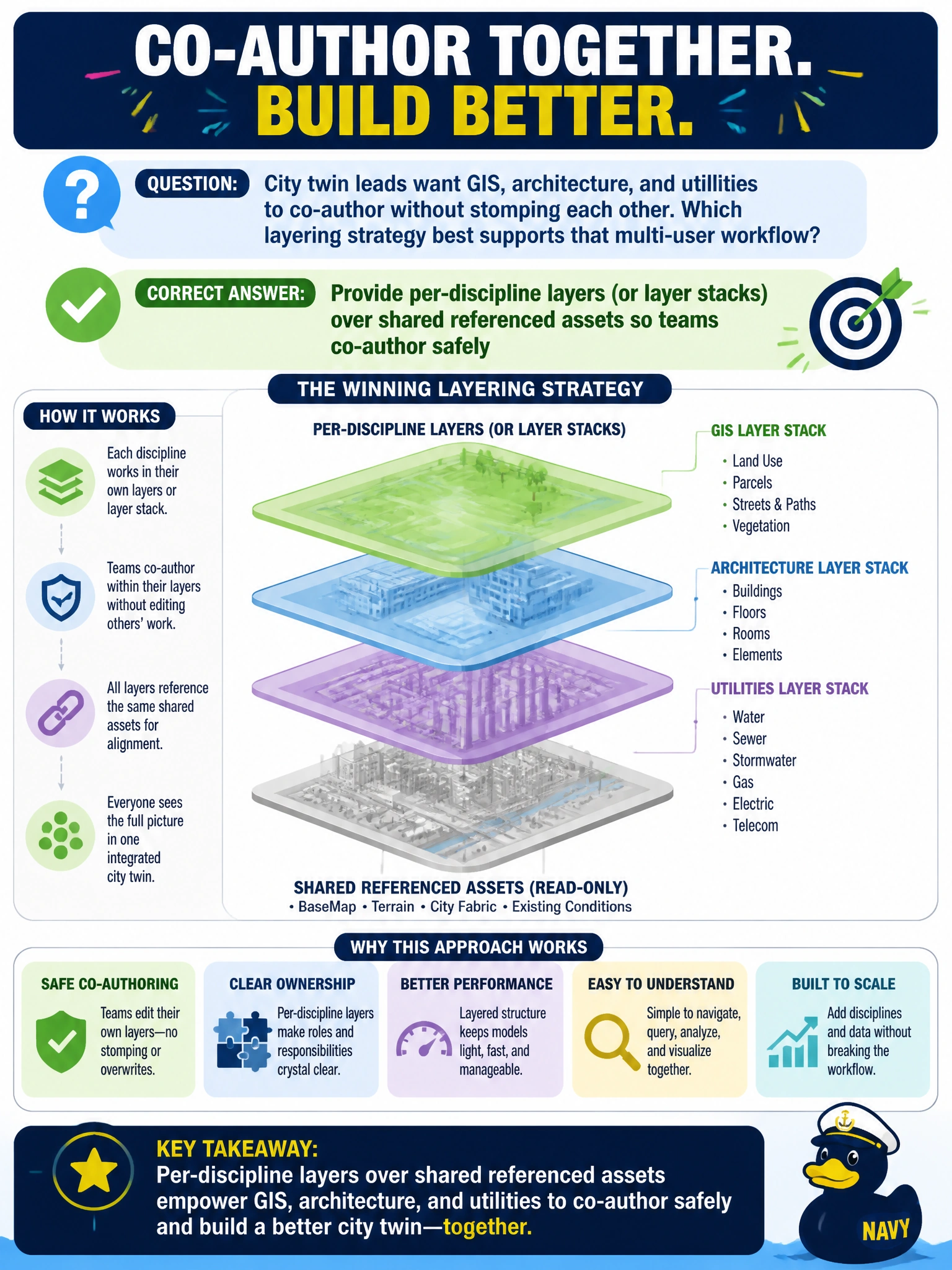
Multi-discipline co-authoring needs isolated writable opinions over shared reads. City twin leads who want GIS, architecture, and utilities to co-author without stomping each other should provide per-discipline layers (or layer stacks) over shared referenced assets so teams co-author safely. Each department writes to its own layer while consuming shared referenced city assets, reducing overwrite collisions and preserving clear opinion provenance for municipal governance.
Giving every discipline write access to one shared root layer only fails by concept: a single writable root invites stomping and opaque conflict. Forbidding layers and requiring nightly flatten merges as the only collaboration path fails because flatten-only workflows are slow, lossy for iterative co-authoring, and brittle for daily municipal work. Storing each discipline’s work as anonymous unsaved memory edits with no layers fails because unsaved memory is not durable, reviewable, or shareable composition structure.
Exam caveat: per-discipline layers over shared references is the collaboration pattern; single-root write and flatten-only are anti-patterns. Operational check: assign GIS/architecture/utilities their own layers, have two teams edit simultaneously on different prim opinions, compose the stack, confirm both sets of opinions appear without silent overwrite, and review which layer contributed which civic opinion.