
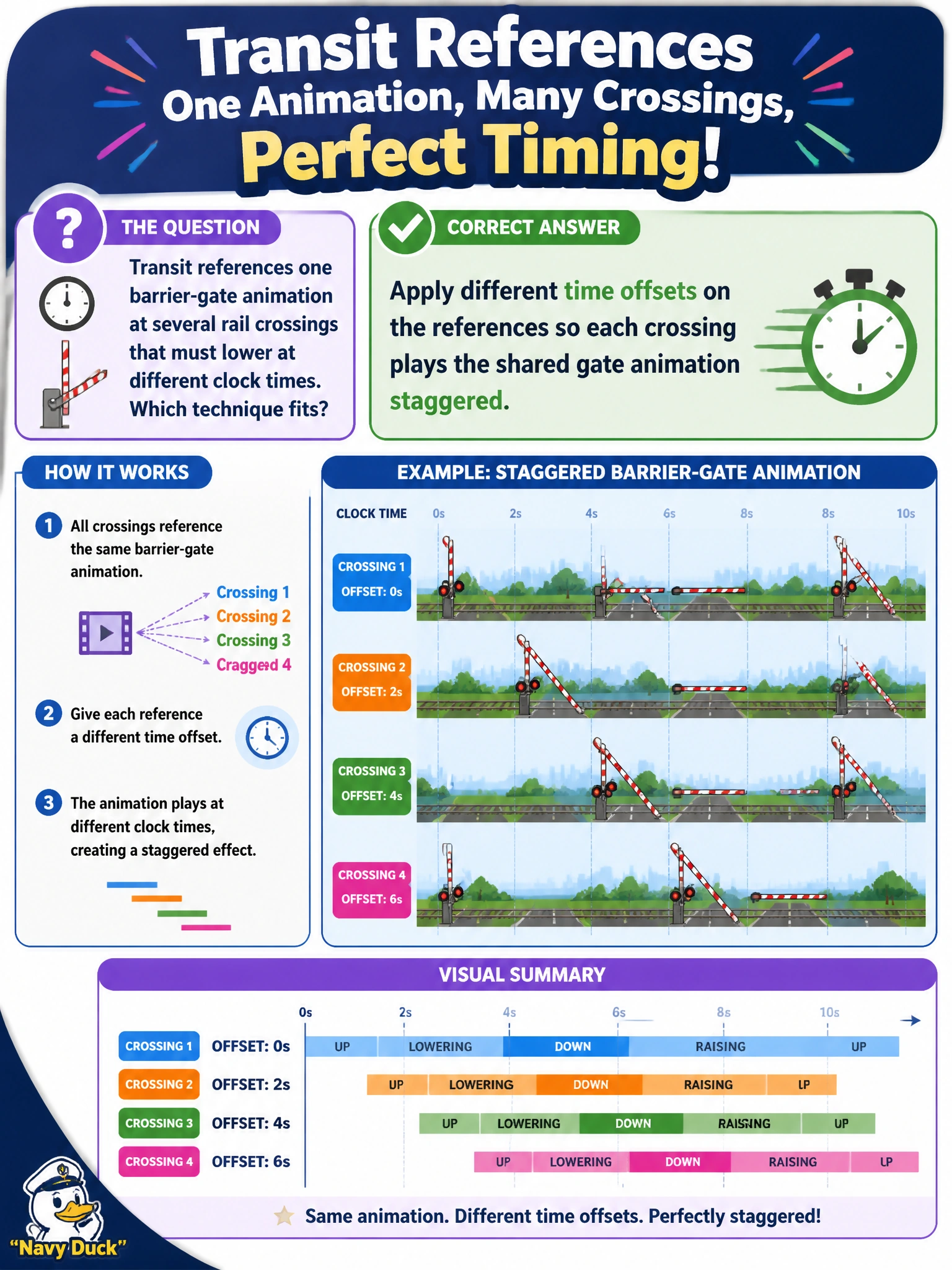
Transit references one barrier-gate animation at several rail crossings that must lower at different clock times. Which technique fits?
Select an answer to reveal the explanation.
Short Explanation
One gate movie, many crossings—offset when each reference starts, like staggered traffic lights on the same sequence. New schemas or static defaults don’t give you timed stagger.
Full Explanation
Transit crossings that share one barrier-gate animation but must lower at different clock times need per-reference time offsets. Authors should apply different time offsets on the references so each crossing plays the shared gate animation staggered. That preserves a single maintained gate animation while composing intentional temporal diversity across the rail network’s municipal safety assets.
Creating a new animation schema type for each crossing ID fails conceptually: per-ID schemas do not implement staggered playback of a shared clip and invent unnecessary type proliferation. Specializing the gate under inherits so time always matches the prototype exactly fails because forcing exact prototype timing is the opposite of staggered clocks. Removing timesamples and driving gates only with static default opinions fails because static defaults cannot express timed lowering sequences across crossings.
Exam caveat: time offset on shared references is the Domain 1 technique; schemas, specializes-for-identical-time, and static defaults do not stagger. Operational check: place the shared gate animation on two crossings with different offsets, advance the composed clock, confirm gates lower at different civic schedule times, and ensure a single animation asset update propagates to both crossings.